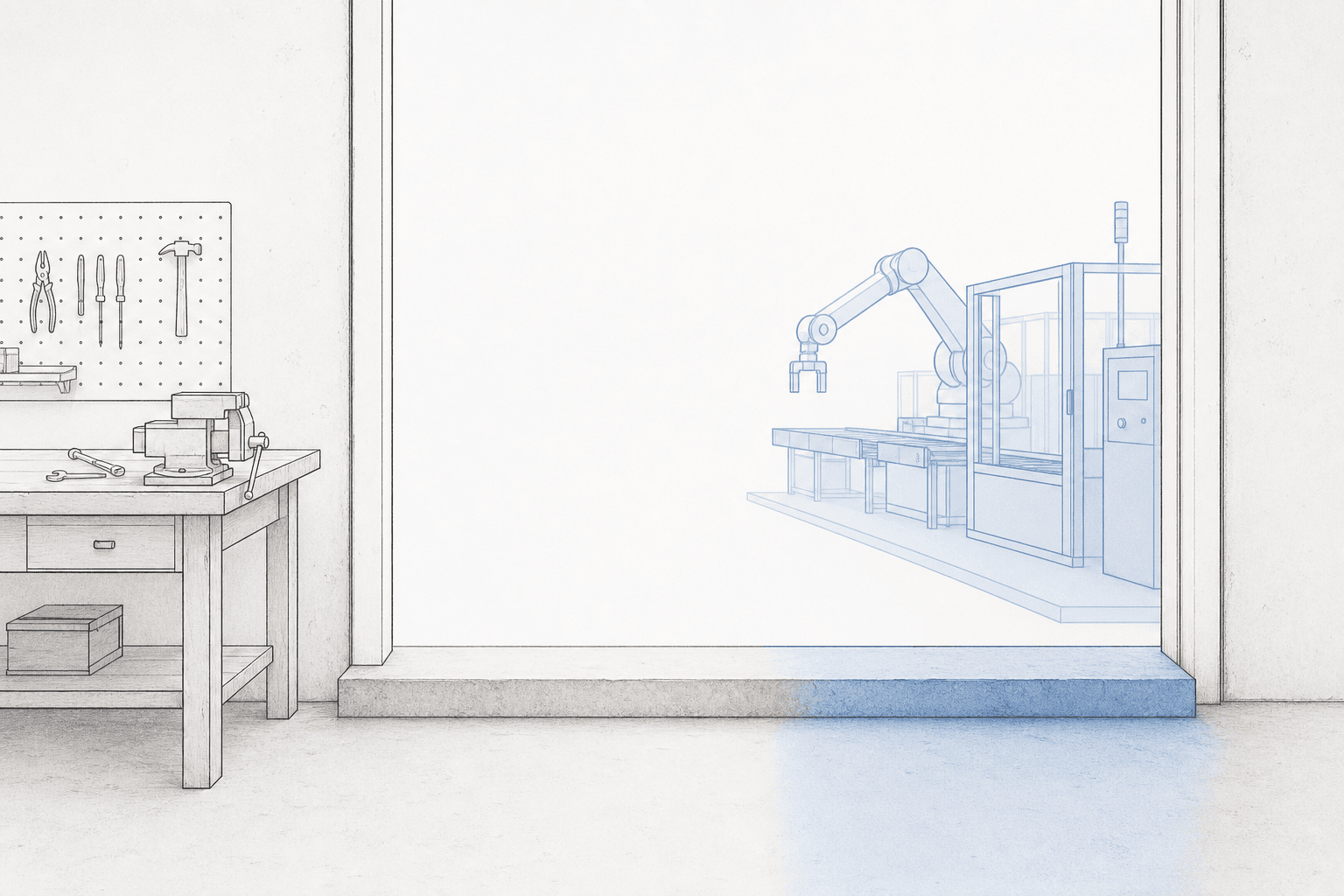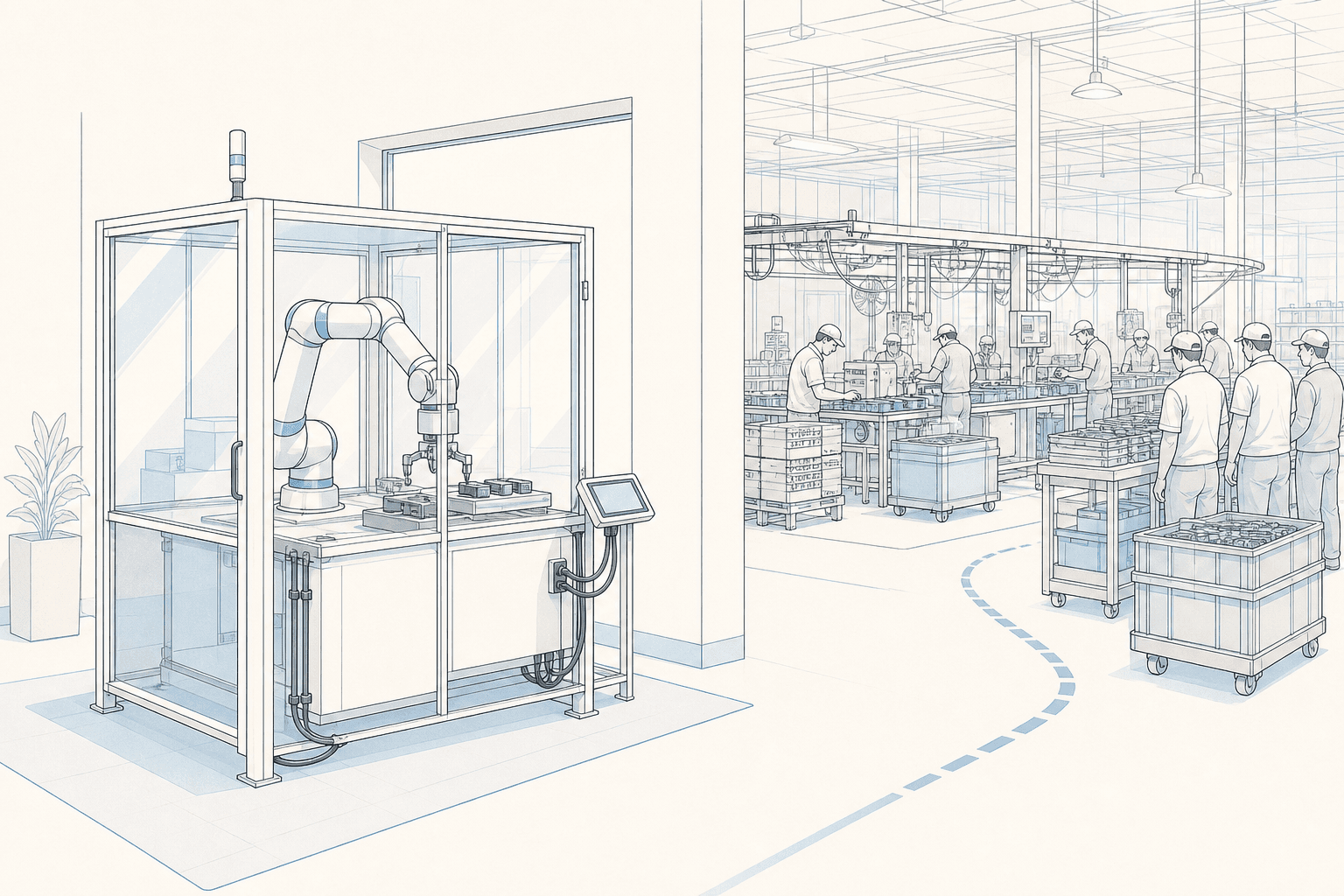
In charter meetings, one station type gets named with suspicious frequency: near the visitor path, single-motion, loose takt, a stop that does not block the main line. None of those traits is wrong. They rise to the top because they are easy to present—not because they pay back fastest.
The first cobot in an SME often carries two jobs: remove repeat labor, and prove automation works. Robotomated’s cost guide cites payback around 12–24 months (single shift) and 8–14 months (multi-shift)—assuming labor release and utilization actually happen. If station one was chosen because it photographs well, finance models station two from a skewed sample (full ledger in the ROI guide).
Evidence project vs capacity project
Evidence wants stability and a story non-specialists grasp in one walk-through. Capacity wants the bottleneck, peak season, and load when hiring hurts. If station one mainly serves evidence, the slide deck wins and the line “does not feel it.” Every later ROI and replication talk starts thin.
Risk minimization is the first reason the wrong station goes first
Touch the bottleneck and delivery promises move. Touch the showcase station and the story stays “we are exploring.” Visibility is the second driver—a good shot is not capacity. The third is technical avoidance: hard stations hide messy parts and loose fixtures; commissioning on a clean station does not prove the dirty one.
The bill often arrives in year two
When the board asks for more units, finance models payback from station one. If that station was never chosen to save labor hours, the cycle looks long and automation loses the budget call. Replication hurts the same way: templates learned on an easy cell get rebuilt on the hard one.
How to tell if station one stood in the right place
Run an honest filter: in the last twelve months, did overtime, hiring pain, or scrap variance from repeat work here rank in the top three? If not, admit station one is mainly learning or internal proof—and lower the ROI promise. Two hard checks: was worst-case on the proof list, and would you default peak-week output to this cell?
The IFR position paper describes expanding collaborative application classes—not “any station fits for station one.” We are often station one—we understand that role. The point is not “always pick the hardest.” It is “tell the truth about why.” Capacity and proof are both legitimate; do not use a proof project’s story to approve a capacity budget. Worst-case in the charter matters more than the arm by the door. Choosing the wrong first station is not shameful. Using the wrong sample to plan the whole factory’s automation future is.