Quick answer
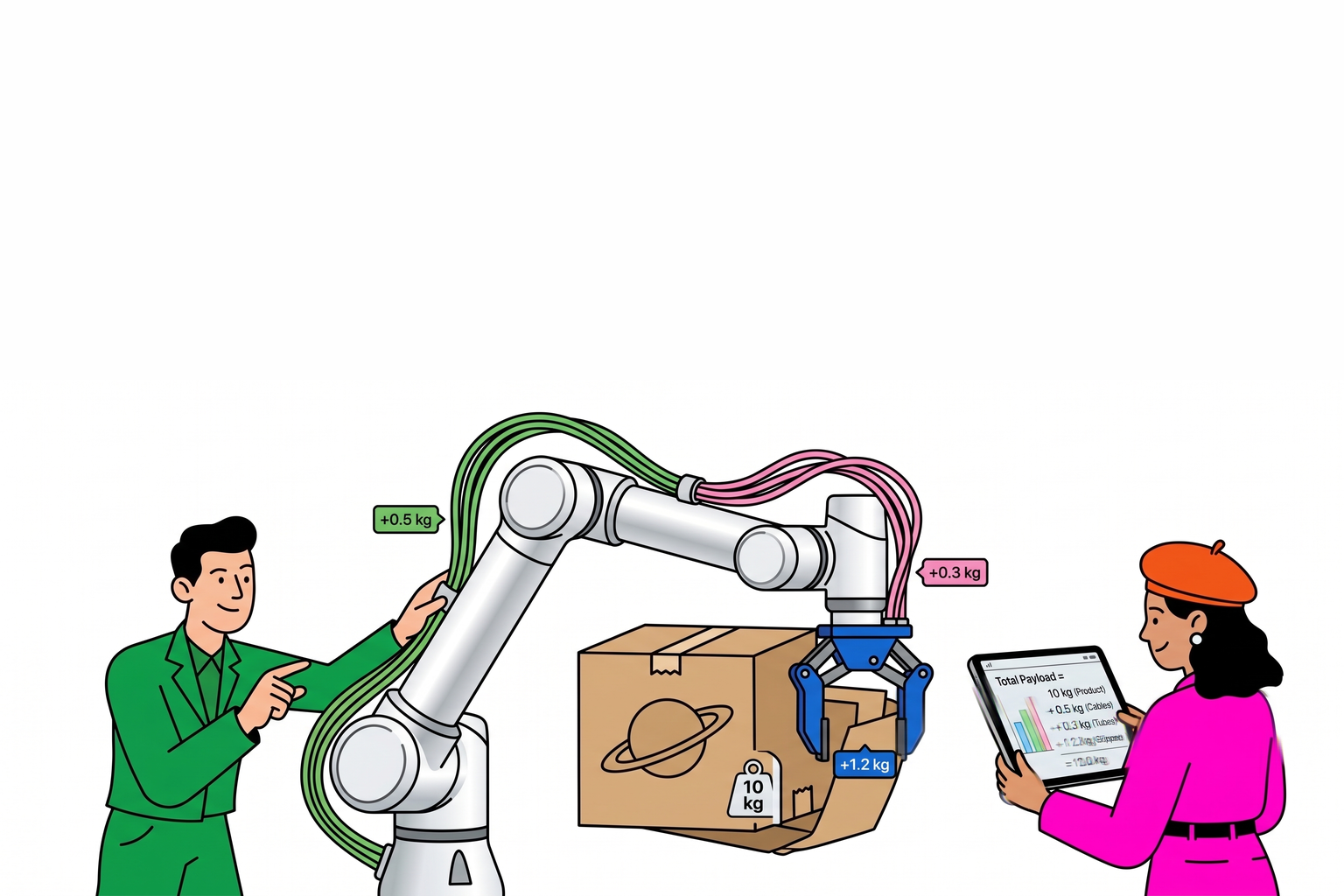
Formula: total payload = heaviest part + EOAT (gripper/vacuum/tool changer/sensors/adapters) + flange-side cable/hose allowance
EOAT share: published sizing guides often say tooling alone consumes about 30–70% of rated capacity—your part budget is whatever remains
Primary spec: size everyday work to rated payload; treat peak/max as a short-time ceiling, not a design target
Margin: add about 20–30% above static worst case, or keep daily operation near 70–80% of rated
Still check: center-of-gravity (CoG) offset and wrist moment—mass can pass while a long lever still trips protective stops
The part on the bench weighs two kilos. The gripper goes on, the air lines dress out, acceleration opens in week one—parts drop, or the wrist trips protective stops on repeat. Someone still points at the datasheet: “It says 5 kg.” What usually failed is not the scale on the part. It is that nothing beyond the flange was ever booked into the same payload ledger. Below: terms you can paste into a comparison table, plus examples that scale from intuition to the cell.
What payload capacity means (align the terms)
Cobot payload is the maximum mass the arm can move stably at the tool flange—and that number covers everything beyond the flange: gripper, vacuum, adapter plates, F/T sensors, camera brackets, tool-changer couplers, dress-out, and the workpiece. A catalog “5 kg / 10 kg” is not “how heavy the part may be.” Subtract tooling first; the remainder is your true part budget.
The datasheet answers whether the arm can sustain rated speed and accuracy under the manufacturer’s stated mount, pose, and CoG test conditions. It does not mean “any part lighter than this number is fine.” Industrial arms often assume fencing and high speed; cobot ratings sit in a collaborative force/power context as well (commonly referenced to ISO 10218 / ISO/TS 15066)—overload is not only a takt problem; it can invalidate speed and stopping assumptions in your risk assessment.
| Term | Meaning | How to use it |
|---|---|---|
| Rated payload | Headline figure, usually with the load near the flange under standard duty | Primary criterion for selection and daily cycles |
| Peak / max payload | Short-time mechanical ceiling, often near the base or under stricter conditions | Ceiling only—not a production design point |
| Usable payload | Rated − EOAT − margin, then derated for CoG/reach | The cell you write into comparisons and quotes |
How EOAT reduces usable payload
Start with a scale anyone can see: a 120 g part plus 180 g of gripper/vacuum/adapter is already 300 g at the flange—not 120 g; start/stop dynamics push the effective load higher still. Same logic on the line, larger numbers: a 3 kg part + 2 kg gripper leaves almost no headroom on a 5 kg rated arm; add a camera or tool changer and “fine on paper” fails on day one.
Buyer guides repeat the same trap: grippers, brackets, changers, and sensors spend rated capacity before the part ever lifts. Ocean Player’s payload guide frames EOAT at about 30–70% of rated capacity. AMD Machines notes a dual-gripper + pneumatics + changer plate can already hit 5–8 kg before a 4 kg part—total wrist load 9–12 kg on a “15 kg rated” arm running at roughly 60–80% of capacity.
Typical EOAT mass bands (estimate from catalogs; weigh the built tool)
| EOAT type | Published order of magnitude |
|---|---|
| Pneumatic parallel gripper | About 0.3–1.0 kg |
| Electric adaptive gripper | About 0.9–2+ kg |
| Palletizing / case vacuum tooling | About 3–8 kg (subtract in full) |
| Automatic tool changer | About 0.5–3 kg (both halves, model-dependent) |
| Adapter / bracket / camera | About 0.1–0.5 kg+ |
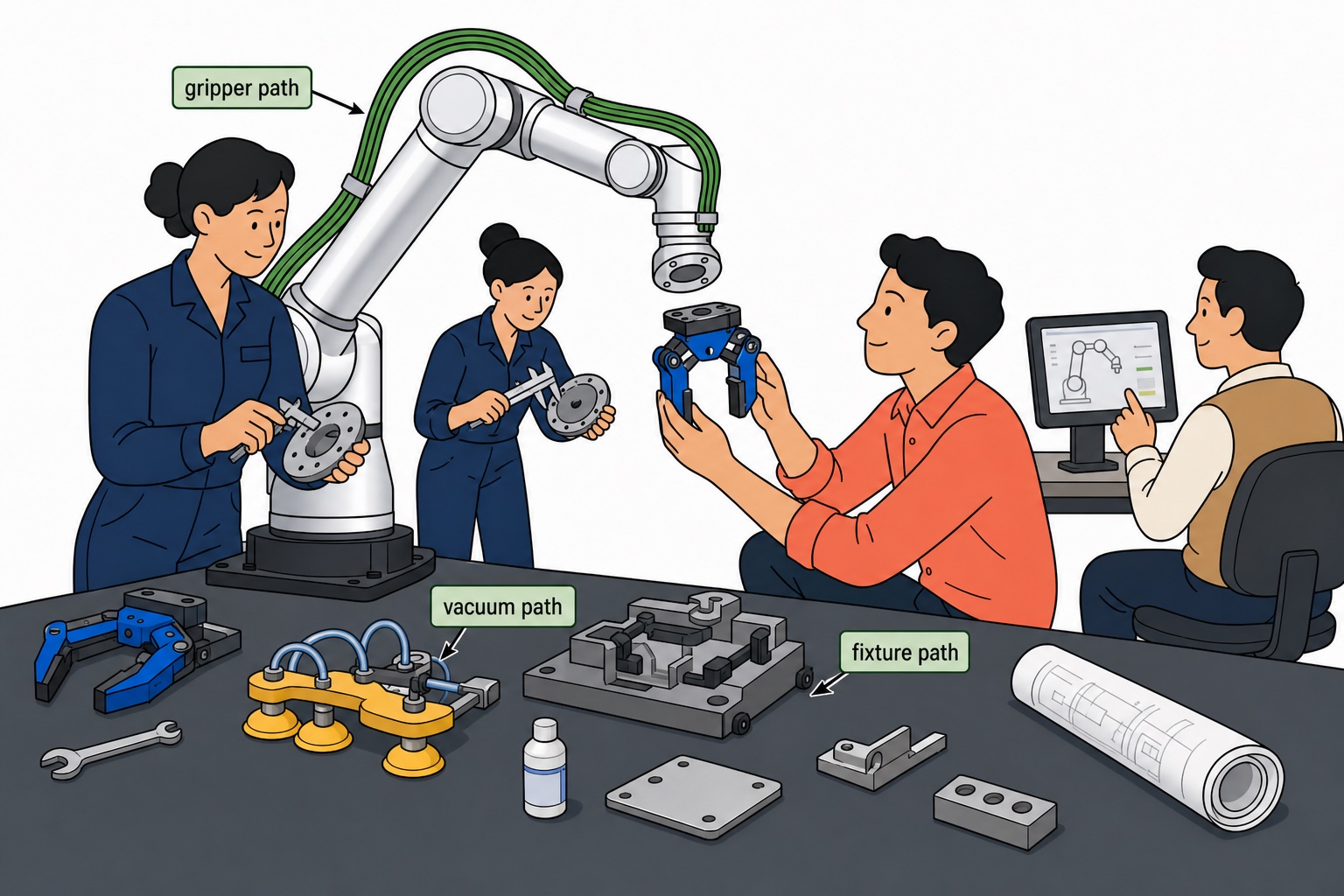
Practice: weigh the fully dressed EOAT. Harnesses, fittings, and printed fingertips routinely add 100–200 g; catalog sums often run 10–15% light. Gripper path still open? Read the End-effector guide.
CoG offset and wrist moment (mass OK, cell still fails)
Rated figures usually assume CoG near the flange center. Move CoG out and moment = mass × lever arm rises; wrist and shoulder hit torque/inertia limits first. Published rules of thumb: each extra ~50 mm of offset can cut usable payload further (often ~15–25%, model-dependent). Long fingers, thick changers, and cantilevered cups are usual culprits—total mass under rated, teach pendant still faulting.
Decision rule: plot your point on the manufacturer’s payload-vs-offset curve (or load calculator)—X = flange-to-combined-CoG distance, Y = total mass. Below the curve is clear; on or above means lighten, shorten, or step up rated class. Vendors such as Universal Robots publish curves and calculators; ask for your model’s chart—not a reseller paraphrase.
Step-by-step: calculate total payload need
Core static equation:
Static total = EOAT mass + adapter/coupler + heaviest workpiece (including nests/inserts)
List every gram beyond the flange: gripper body, fingers, cups, valves, sensors, camera, changer, plates, flange-side air and cable
Use the heaviest SKU / full fixture—never the average part
Measure or estimate flange-to-combined-CoG distance (mm)
Add about 20–30% engineering margin (accel, changeover, future sensors)—the band repeated across EVS, Ocean Player, and AMD; some integrators also keep daily duty near 70–80% of rated
Compare to rated; use peak only to confirm short spikes stay inside the mechanical ceiling
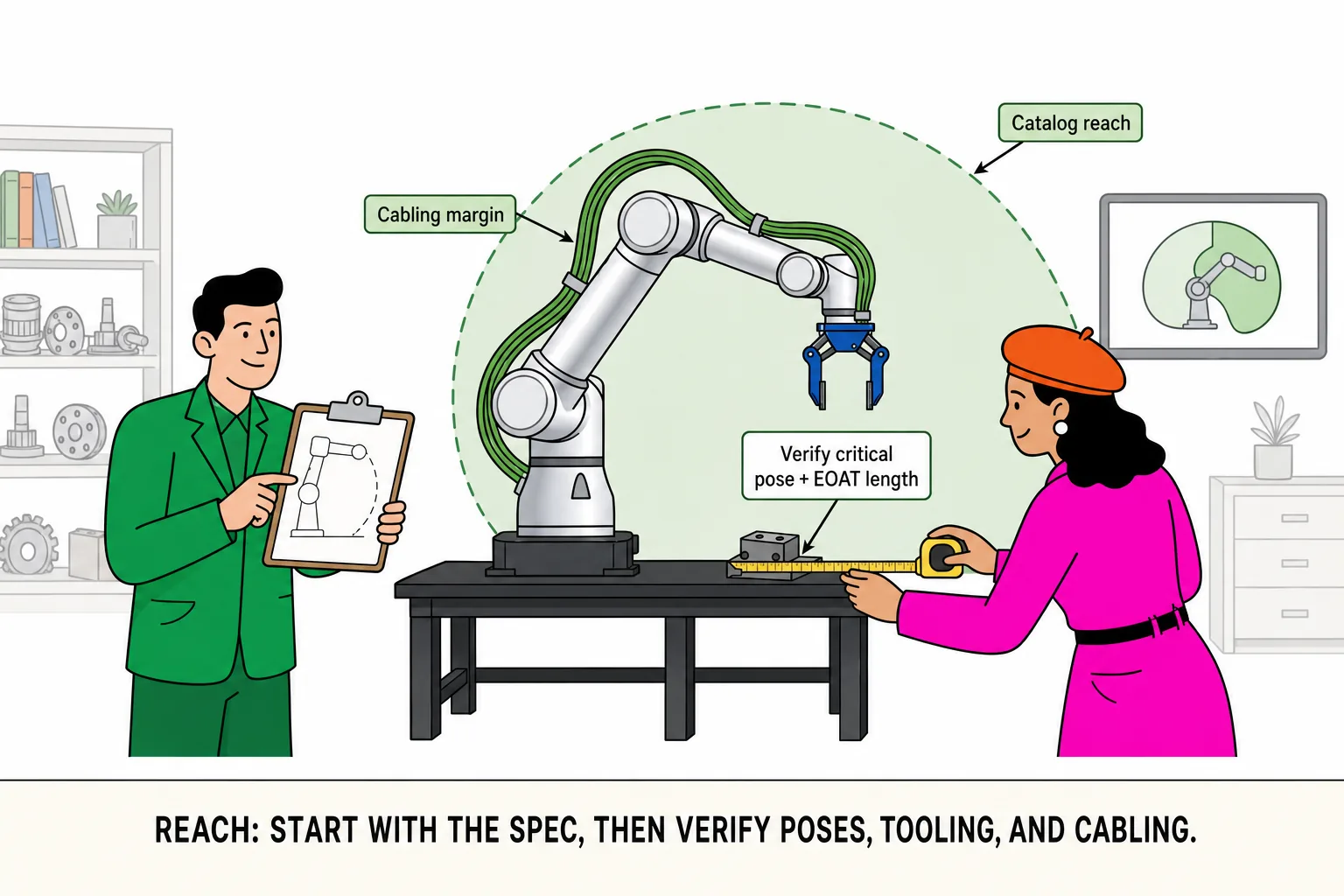
Re-check critical poses and far points → Reach guide
Worked example (machine-tending scale)
| Line item | Mass |
|---|---|
| Pneumatic gripper + fingers | 0.95 kg |
| Adapter + fittings | 0.35 kg |
| Heaviest part (aluminum housing) | 3.20 kg |
| Static total | 4.50 kg |
| Target after +25% margin | ≈ 5.6 kg rated class |
Against a 5 kg rated tier: 4.5 kg static is already ~90% of rated—thin margin. Accel or a camera add-on pushes you into the red. Step up a tier with clear rated headroom, or lighten EOAT. In the Roooll catalog, r-Core standard is commonly 5 kg rated (7 kg max); lighter cells → r-Lite (~3 kg rated); heavier → r-Reach / r-Max / r-Ultra—compare on one table, not in chat.
How payload trades with speed and reach
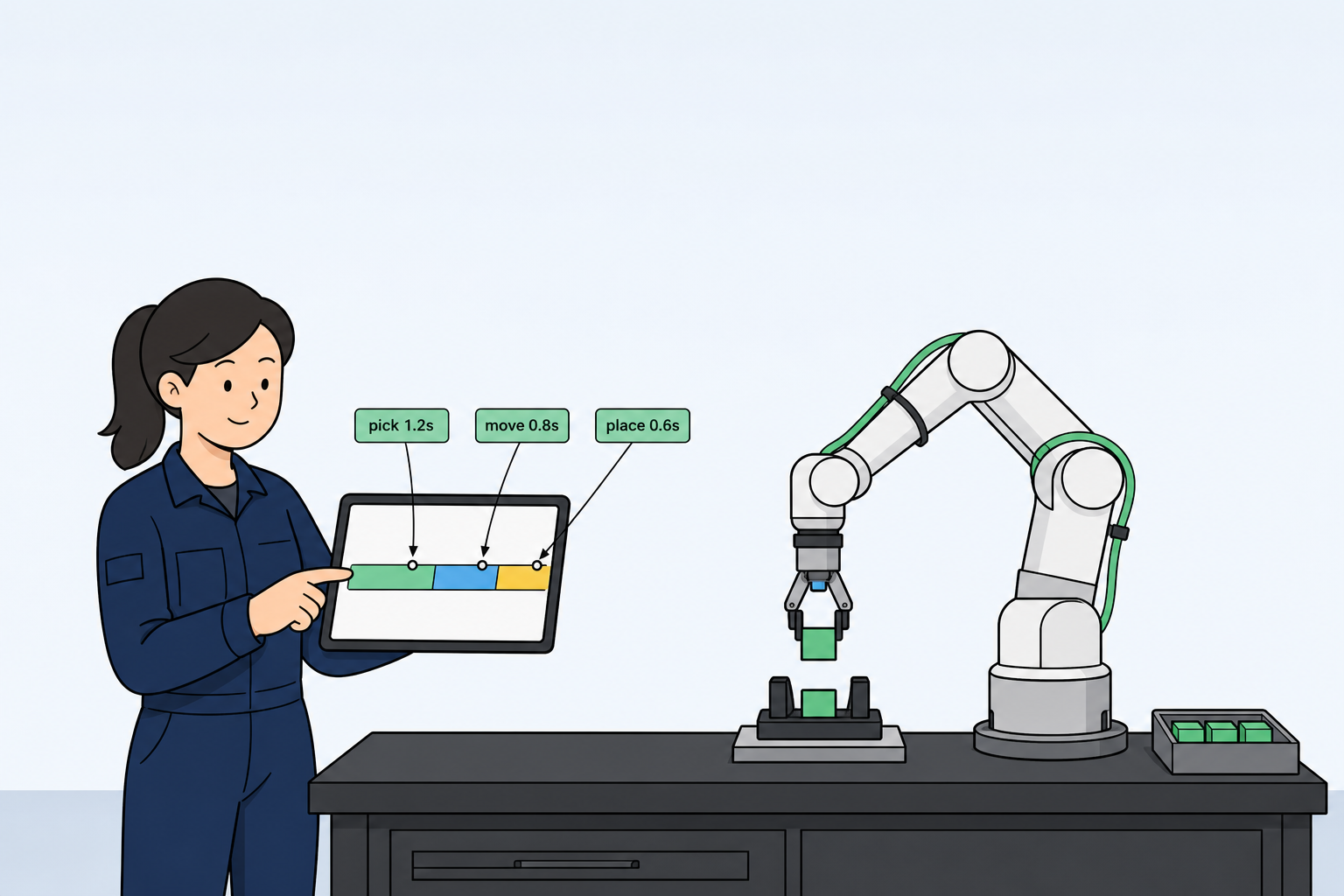
Near full load, controllers often throttle TCP speed—published notes cite on the order of 30–50% below top rated speed—so takt estimates at “max payload + max speed” are optimistic. Far reach + heavy load hits base/shoulder torque first. Practical sweet spot: when load exceeds ~75% of rated, keep the working envelope inside ~70–80% of max reach (Ocean Player). Beat breakdown: Cycle time guide.
Common sizing mistakes
| Mistake | Floor symptom | Fix |
|---|---|---|
| Part weight only | Overload once EOAT mounts | Subtract EOAT, then compare to rated |
| Peak as daily load | Demo OK, production unstable | Design to rated only |
| Ignore CoG / moment | Mass OK, protective stops | Plot offset curve or vendor calculator |
| Run at 100% of rated | One changeover breaks the cell | Keep 20–30% margin or ~70–80% duty |
| Never check far pose | Near OK, far slows/faults | Review with reach and layout |
Published evidence bands (payload sizing)
| Band | Published range / claim | Source |
|---|---|---|
| EOAT share of rated | About 30–70% | Ocean Player |
| Engineering margin | About 20–30% above worst static | EVS cobot payload guide · AMD |
| Daily utilization | Stay near ≤70–80% of rated | Ocean Player · AMD |
| Cobot sweet spot | Many cells around ≤~20 kg | Common buyer/integrator framing—still weigh on site |
Payload tiers (market bands → Roooll)
| Tier | Common published band | Typical work | Roooll entry |
|---|---|---|---|
| Light | About 3–5 kg | Precision assembly, lab, small parts | r-Lite / r-Core |
| Medium | About 10–12+ kg | Machine tending, packaging, handling | r-Reach and peers |
| Heavy | About 16–30 kg | Palletizing-class, heavy EOAT | r-Max / r-Ultra |
Bands are market shorthand; your static total + margin + CoG clearance wins. Three-model table → Side-by-Side Comparison; five-question shortlist → Product Advisor.