Quick answer
North star: spindle utilization—published bands often 40–65% manual vs 80–95% after tending (verify with your door-wait minutes)
Doors & I/O: without reliable auto-door and interlocks, utilization does not return; pneumatic doors often $2k–$5k, servo $5k–$10k
Dual grip: when cut time clearly exceeds one door cycle, tending motion may drop 30–40%; on short cuts, weigh gripper mass first
One arm, multiple machines: part cycle often needs >3 minutes and machines close enough—travel cannot eat the gain
Pilot reality: infeed must cover your unattended window; chips/coolant and cable dress in scope—a day-shift demo is not overnight proof
Cut ends; the spindle waits on the door. Open, unload, load blank, confirm, restart—cutting may be only half the loop. When utilization sits near fifty percent, buying another machine is often worse than taking the changeover idle back first.
Cobot CNC machine tending opens the machine door under interlock, removes the finished part, loads a blank, and starts the next cut—so the spindle keeps cutting between operations instead of waiting on a person. The cell is not “how fast is the arm”; it is spindle utilization: door cycle, part presentation, whether dual-grip pays, machine I/O, and whether you can run across shifts unattended—all of that decides whether idle minutes come back.
Why CNC tending is automated early
The familiar scene: an operator at the door—open, extract, load, restart—while cutting may be only part of the loop; the rest is door wait, part wait, and confirm wait. Published bands put manual tending spindle utilization often around 40–65%; after load/unload automation, the same sources often cite about 80–95% (table below; Robotomated machine tending guide, EasyRobotics CNC tending article). Idle time × machine hourly rate often drives the business case more clearly than “save one operator wage”—but table before/after numbers are sanity checks, not quote commitments. Size yours from one week of measured door/part-wait minutes × rate.
Spindle utilization: published before/after bands
| Source | Manual / before | After cobot tending (as published) |
|---|---|---|
| Robotomated | Often ~40–50% of available hours | About 80–90%; cells commonly ~$50k–$120k |
| EasyRobotics | Often ~50–65% | ~85–95%; payback often 6–12 months |
| IPE · NPI Solutions | ~50% efficiency | ~85% |
| UR × EMI | OEE ~70% | ~95%; about +1,200–1,600 hours/year per machine; payback ~12–18 months |
UR in-shift math adds: cutting through two 15-minute breaks and a 30-minute lunch is about +12.5% over an 8-hour shift—before overnight. When you read the table, ask whether your machine is “long cut, short door cycle” or the opposite—the former recovers utilization from tending more easily; the latter needs door and gripper math before you trust the band.
Where manual tending burns money
Breaks and shift handovers — EasyRobotics: often 15–25% of available cut time
Dedicated operator cost — same guide: European wage bands often €35k–€55k/person/year before stacking shifts
Misload scrap, night premiums, idle iron when operators cannot be hired — rarely on the “operator line” but directly eats OEE
Put “idle minutes × machine hourly rate” and “labor + turnover + scrap” on one sheet—more convincing to finance than copying utilization percentages alone.
Standard cycle and dual-grip (when the 30–40% is real)
Standard loop: open → extract finished → load blank → close → start → wait while cutting.
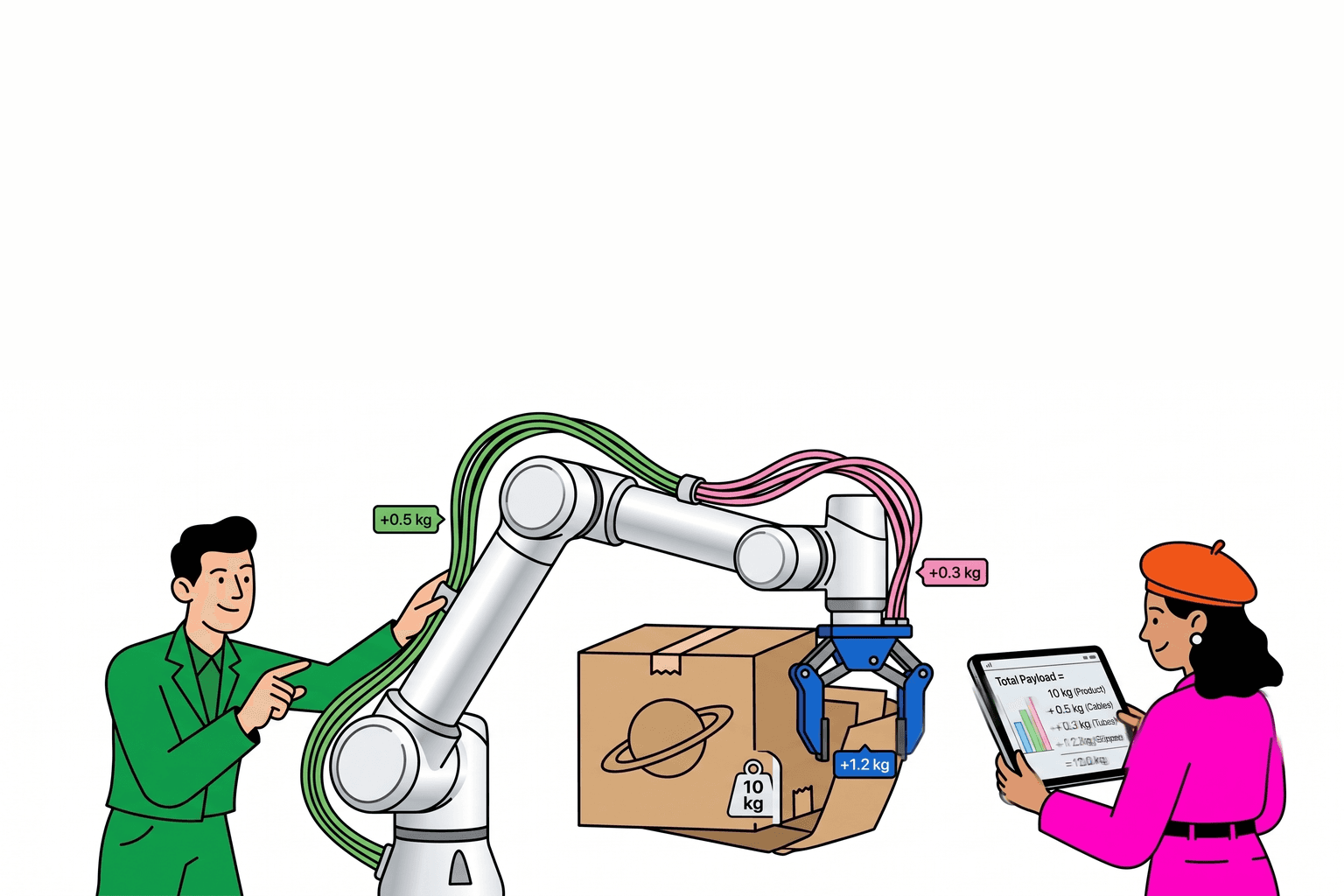
Dual grippers (blank on one side, finished on the other): Robotomated cites about 30–40% less tending motion time by avoiding a second entry. It pays when: cut time is clearly longer than one full door cycle; door opening and fixture clearance allow a one-entry swap; combined gripper mass still sits inside rated payload (payload guide). On very short cuts, dual-grip mass eats payload margin first—dual grip can be negative ROI.
Doors, I/O, and “can we run unattended?”
Most stock CNC doors are manual. Without reliable auto-door and interlocks, the arm only assists—and idle time returns. Robotomated ranges: pneumatic openers ~$2k–$5k, servo ~$5k–$10k; robot-hooked doors are slower and constrain gripper design.
Minimum signals usually include permit-enter, clamp confirm, cycle-complete/alarm, and cycle start. Missing any of these → do not contract lights-out. Scope: Safety & I/O guide; collaborative tending risk assessments often reference ISO 10218 and ISO/TS 15066.
Chips, coolant, and cables
CNC spray wets connectors, wraps chips, and abrades dress. Write into scope: whether in-cycle blow-off is in the takt table, near-door sealing/IP, cable track or jacket, and gripper clean intervals. Skip this and day-shift demos pass while week-two overnight misgrips appear—the 80–95% band collapses back toward manual.
Part presentation (often decides utilization more than arm speed)
Fixed trays/peg boards — reliable; changeover needs nest changes.
Magazines/drawers — support longer unmanned blocks—size how many hours a full magazine covers.
Conveyor — continuous, but upstream instability idles the arm.
Vision picking — flexible; Robotomated often cites ~$10k–$30k adders. Chaotic infeed → fix presentation before the arm.
Review question: for your unmanned target window, can infeed run without a person feeding every cycle? If not, utilization tracks manual curves.
Cobot vs industrial arm / gantry
| Factor | Cobot (Robotomated) | Industrial (same table) |
|---|---|---|
| Payload | Often ~3–16 kg | 6–250+ kg |
| Floor space | ~15–25 sq ft/cell | ~50–100+ sq ft |
| Changeover | ~30 min–2 h | ~2–8 h |
| Cell cost | ~$50k–$120k | ~$100k–$300k |
Rule of thumb: under ~10 kg, frequent changeovers, under ~$100k/cell → cobot bias; heavier, need under ~15 s, long single-SKU → industrial or gantry. In the gray zone, gate on heaviest part + farthest in-door nest + measured door cycle—do not reverse-engineer from “we want a cobot.”
Multi-machine: usually needs over about 3 minutes per part
Marketing often says 2–3 machines (sometimes 4). Robotomated: usually needs over about 3 minutes per part—while machine A cuts, the arm tends B; travel + each door cycle + blow-off must not eat the gain. Split the beat and prove the arm is not the bottleneck (cycle time guide). Machines too far apart or cuts too short → multi-machine lowers per-spindle utilization.
Roooll shortlist and in-door corners
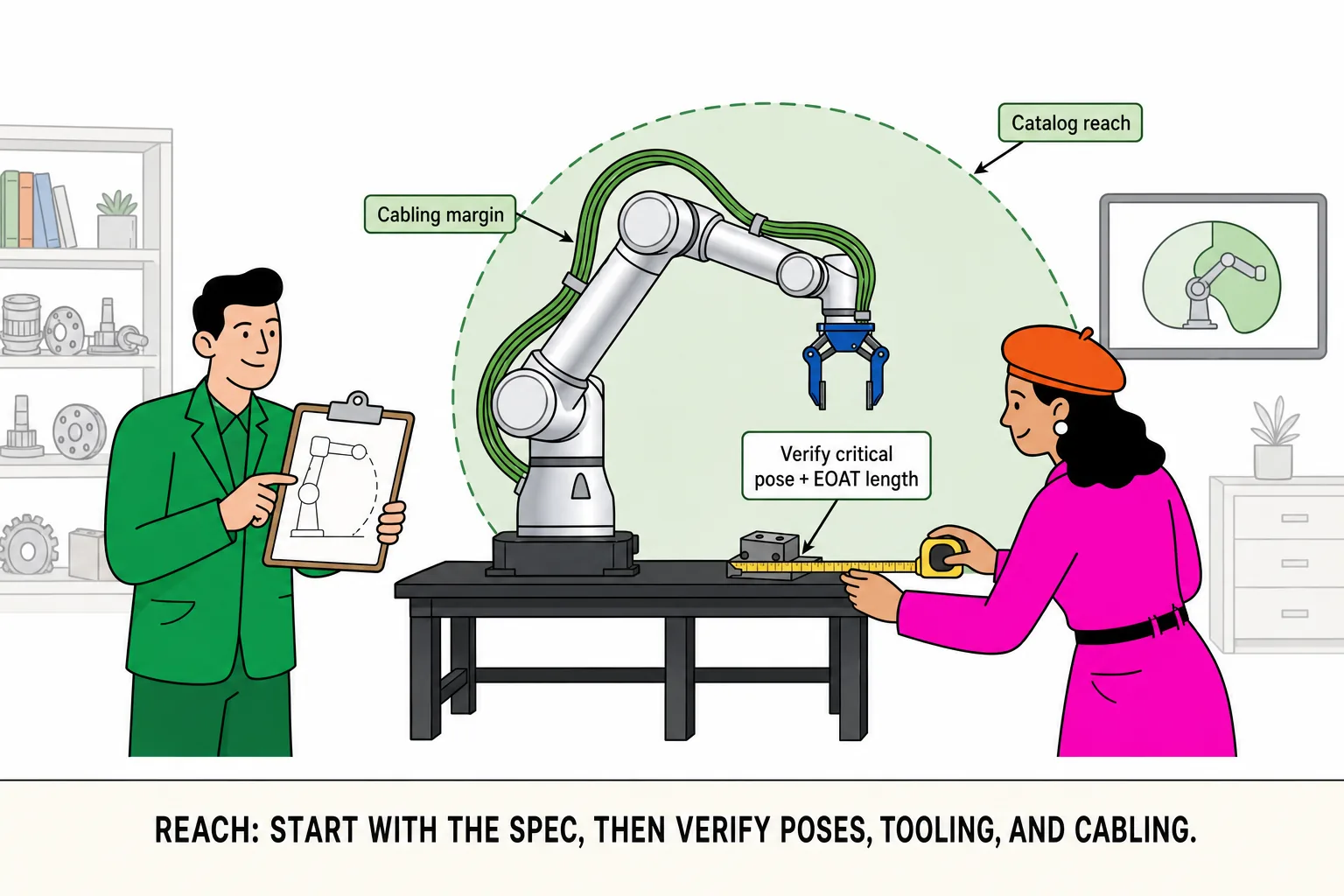
Heaviest part + gripper + adapter. r-Core (~5 kg rated) for small parts in tight doors; heavier blanks → r-Reach (~10 kg rated) in Side-by-Side Comparison. Farthest nest: reach guide. Fuzzy → Product Advisor. Door-side check: True-scale AR. Layout: workcell guide.
Your utilization sketch (with example)
Recovered value per shift ≈ R × (Δt × N / 60): R = machine hourly rate, Δt = non-cut minutes recovered per cycle, N = cycles/shift.
Example: R = $80/hour, 2 minutes recovered/cycle, N = 120 cycles/shift → about 80 × (2 × 120 / 60) = $320/shift. Compare to the 40–65%→80–95% band as sanity check, then weigh cell investment and labor—do not paste NPI 50%→85% or EMI ~70%→~95% into a contract as a promise.
Common failure modes
Promising overnight without an auto door — someone still opens the door; utilization does not return.
Still hand-feeding every cycle — published automation bands collapse to manual.
Dual-grip overweight — protective stops trip; rated margin gone.
Day-shift-only demo — chips and dress fail in week two.
Pilot sequence
Machine model, door type, I/O map, part family, measured utilization
Weigh heaviest part + choose gripper (single vs dual)
Presentation plan (tray/magazine hours must cover unmanned target)
Teach paths; supervised days before overnight
Blow-off, waits, and interlocks in the beat list; first-article sign-off
After PO: RooollTrack · spares Care