Quick answer
What it is: cobot welding assist = repeatable torch path + welder QC—not an unattended booth or a robot-owned WPS
Good starting point: repeat fillets/seams on controlled light-to-medium fabrications; multi-pass heavy plate → industrial line or stay manual
Payload band: torch + cable package often ~1.5–3 kg (weigh yours); shortlist r-Core / r-Reach after rated-load math
ROI driver: published arc-on often 60–80%; slow clamping or frequent tip change can collapse payback more than arm brand
Investment band: cells often $50k–$150k, payback 6–18 months in guides—fixture repeatability and joint tolerance come first
On the third identical fillet, the torch path starts to drift—not skill failure, the same posture held for two hours. The customer wants “match first article on day shift,” not “average for this crew.” Assist welding hands the repeat path to the arm; the welder owns puddle, gap, and sign-off—clear split is assist, not a silent swap of the welder.
Cobot welding assist (assist welding) uses a collaborative arm to carry the torch along a taught seam while welders keep process ownership: gap check before arc, first-article sign-off, stop authority on faults. It is not “the robot owns the WPS.” It is repeatable motion, stable torch path, and not lifting the same seam hundreds of times.
What an assist welding cell actually does
A typical loop:
Load — part nests in fixture; pins/clamps hold the joint within agreed tolerance
Pre-arc check — welder or lead verifies gap/fit-up; tweak if needed
Arm runs taught path — TCP follows the stored seam; welder monitors nearby
Crater, inspect, release — visual or sample QC; rejects do not advance
Automation here means repeatable motion, not an unattended booth. Parameters, material lots, and customer acceptance still belong to your welding process owner.
Why welding assist keeps coming up on the floor
Welder shortage is structural: the American Welding Society has cited a gap on the order of 300,000+ welders (Ebots cobot welding guide). Fully burdened skilled welder cost in developed markets is often about $55,000–$75,000/person/year (collaborative welding buyer’s guide). Seniors retire, fewer people want the booth, and the same fillet repeats until the body pays—assist sells retention + repeat-seam quality, not deleting welder headcount.
Published evidence bands (common in cobot welding guides)
| Metric | Published band | Source |
|---|---|---|
| Torch body (arc) | About 0.5–1.5 kg | SZGH collaborative welding buyer’s guide |
| Torch + cable package | About 1.5–3 kg (typical MIG dress) | Weldfabworld cobot welding |
| Arc-on time | Cobot cells often about 60–80% (fixture and changeover dependent) | Ebots cobot welding guide |
| Cell investment (order of magnitude) | Cobot welding about $50k–$150k; traditional lines often $150k–$500k+ | Weldfabworld cobot welding |
| Payback | Often about 6–18 months (shorter on multi-shift repeat seams) | Ebots cobot welding guide |
| High-mix shops | Above 8–10 part numbers/month, cobot welding often wins on output per dollar | SZGH collaborative welding buyer’s guide |
Read the table with your arc minutes, rework, and welder cost—case-study “2–3× output” claims are task-specific; do not paste them as contract KPIs.
What you usually gain on the floor
More consistent seams on repeat work. A 600 mm fillet drifts late shift; a taught path reproduces under rated load—especially across shifts when “match day shift” is a real instruction.
Less torch weight and awkward posture. Holding, squatting, and wrapping fixtures costs bodies on long runs. The arm carries a path you already trust; the welder stands where they can see the puddle and sign off.
Mixed low-volume lines change faster than hard automation. A full industrial welding line retool is program + fixture + guarding. A collaborative cell can often trial a new seam in hours-level teach time when the fixture is stable (certification rules still apply).
Easier traceability when quality matters. Same path, same program name, tied to batch records—customer issues map faster than handwriting alone.
Skills complement instead of replace. Senior value is window and exceptions; arm value is not making them lift the torch on a path you already approved. Clear split reduces pushback versus “robot replaces welder.”
Fixtures, payload, reach—make these concrete before quote
Fixture repeatability comes first. Wild gap, joint mismatch, or weak anti-distortion—no arm saves that. Assist fits when joint form is stable, locating is reliable, changeovers are planned.
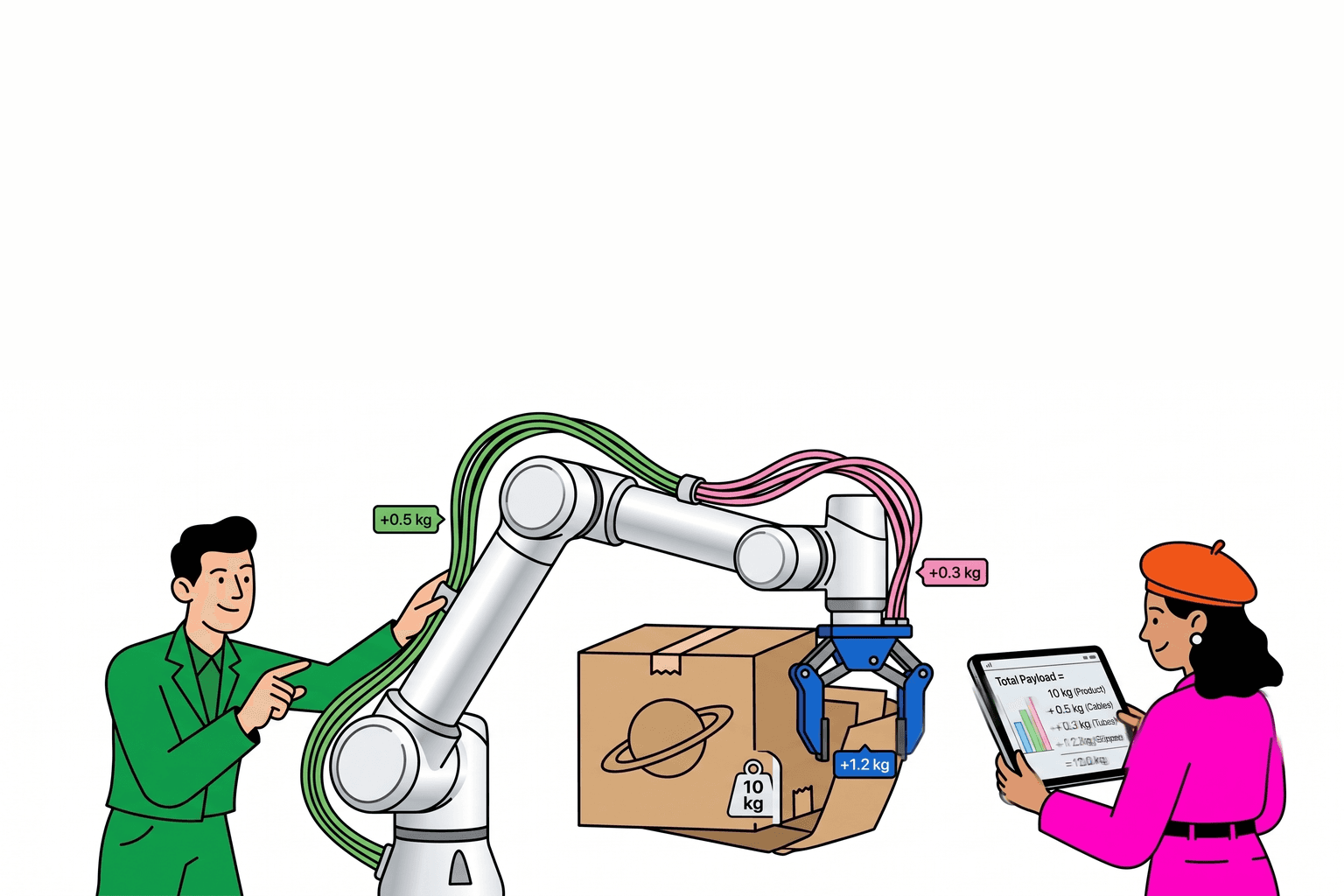
Payload is the whole torch package. Torch + cable dress + feed/gas interface + fixture reaction—worst-case TCP. Budget rated headroom; peak is reference. Weighing: Payload guide.
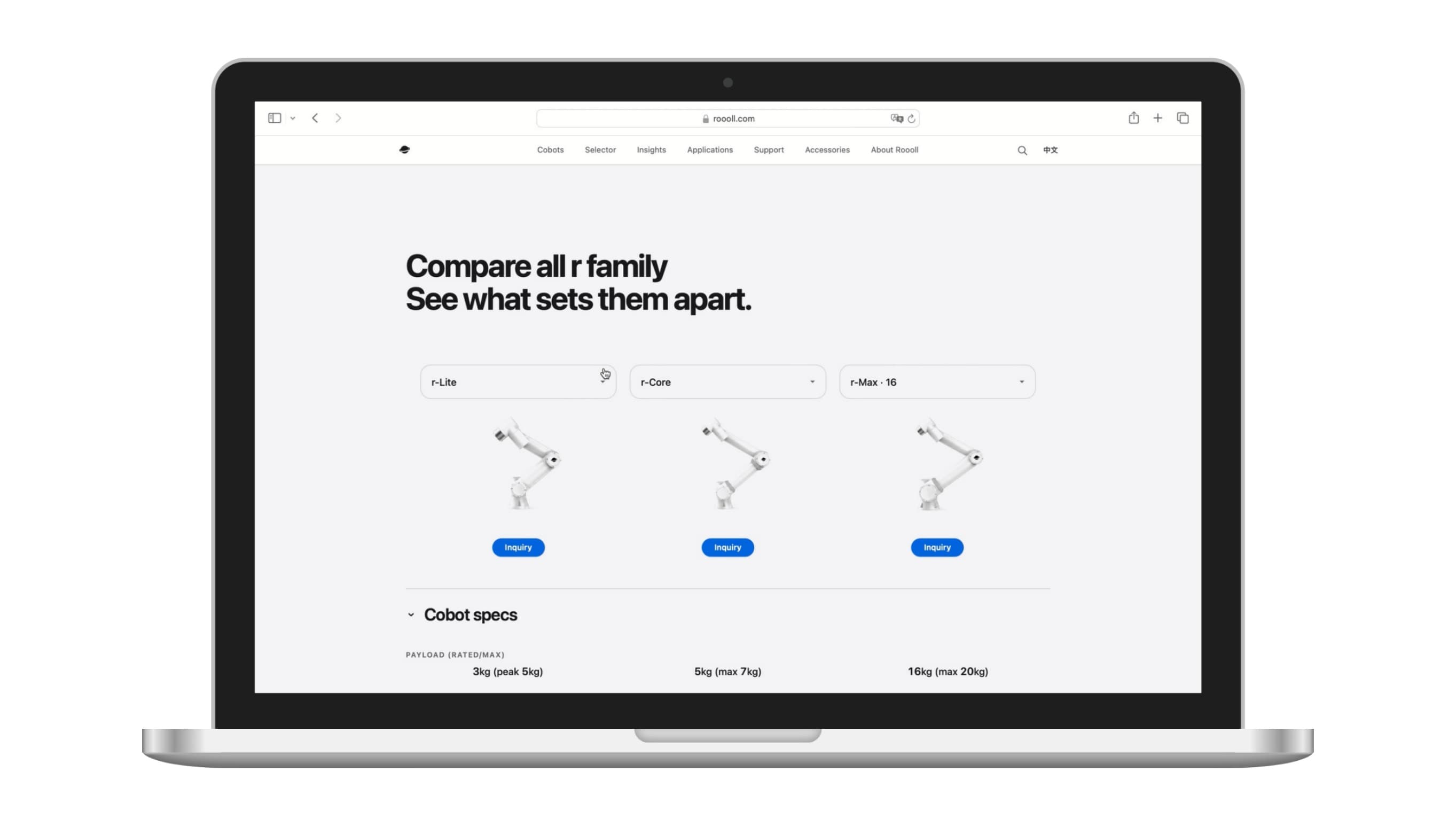
The common starting point is r-Core (~5 kg rated). Light MIG/MAG torch bodies plus partial cable dress often land around 3–4 kg on the scale—still validate arc-start accel and corner poses. If torch + cable totals at or above 5 kg rated: prefer lighter torch/cable routing, or add r-Reach (~10 kg rated) in Side-by-Side Comparison.
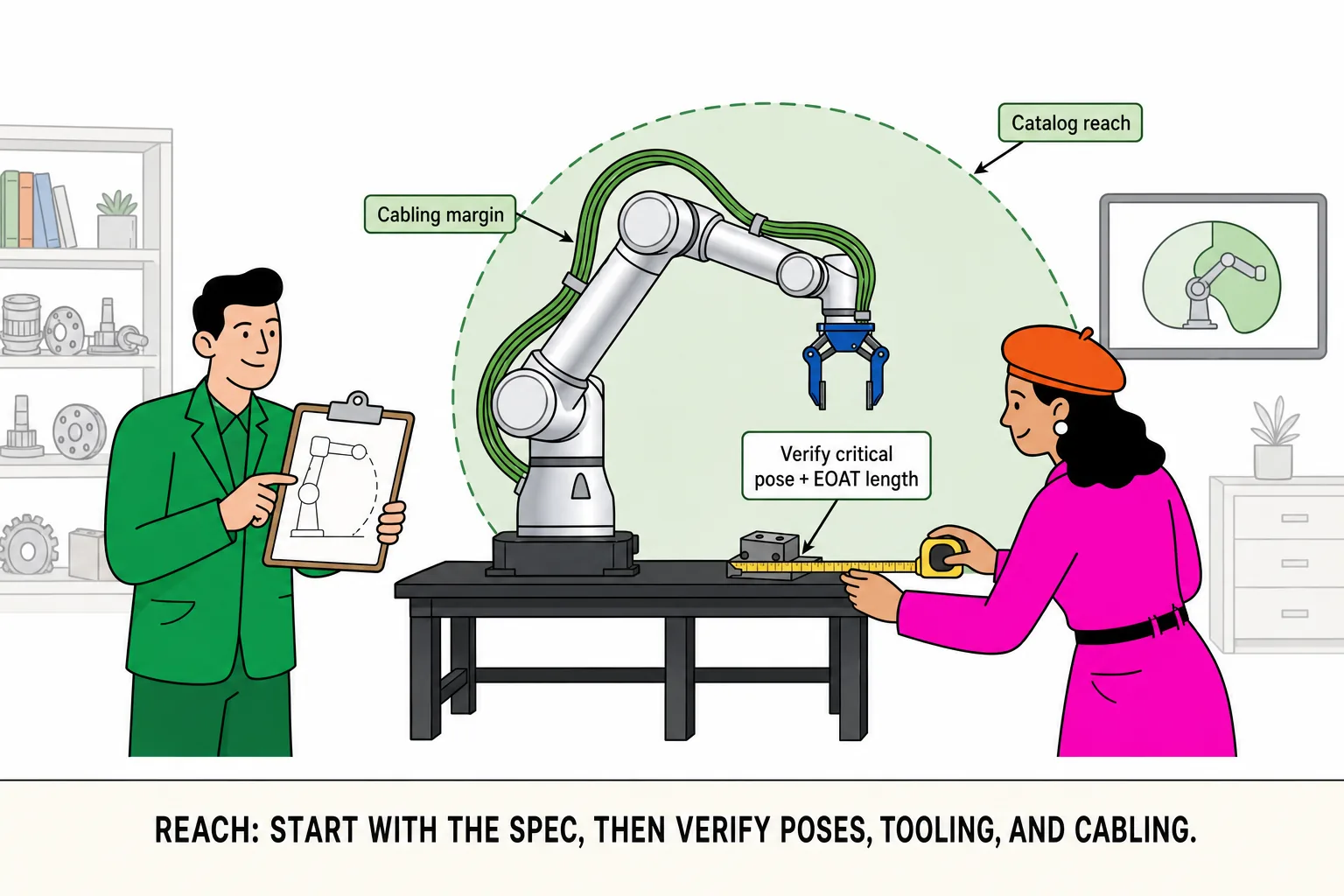
Reach is seam ends plus retract. Arc start, crater, torch rotation clearing clamps—these fail before “mid-seam distance to base.” r-Core catalog reach is ~922 mm; check flat, vertical, and wrap corners point by point—Reach guide. Booth layout: True-scale AR.
Payload vignettes (illustrative—weigh on site)
Vignette A — light package, r-Core stays in the set: Torch + cable scaled at 3.6 kg (reaction not added) → ~72% of r-Core 5 kg rated. Arc-start accel and corners still need teach validation—3.6 < 5 is not automatic approval.
Vignette B — heavy package: Scale reads 5.4 kg → above r-Core rated. Lighten torch/cable first; if process forbids it, add r-Reach ~10 kg rated in the comparison table.
Arc-on time and takt
Cobot welding ROI often hinges on arc-on percentage (duty cycle) more than arm brand. Guides often cite 60–80% arc-on for collaborative cells; slow clamping, frequent tip cleaning, and wire changes can pull that toward ~30%—payback weakens. Ask who clamps, who cleans the tip, and how changeovers interrupt arc time. Takt split: Cycle time guide.
How this differs from an industrial welding line
| Dimension | Cobot welding assist | Industrial welding line |
|---|---|---|
| What you buy | Repeatable path + human QC | Throughput + locked procedure |
| Batch shape | Mixed SKUs, moderate volume | Long runs, same SKU |
| People | Welder nearby, first-piece sign-off | Often hard-guarded, remote |
| Investment (approx.) | $50k–$150k | $150k–$500k+ |
| Typical limiter | Fixture and fit-up | Takt, certification, multi-pass |
Heavy multi-pass, pressure-vessel class unattended production—usually outside assist cobot territory. Repeat structural seams, small batches, need to keep welders—that is where the conversation starts.
Safety: fume, optical radiation, and collaborative limits
Collaborative does not waive booth EHS. Extraction, screens, estop, and interlocks belong in the quote with the arm—Safety & I/O guide; booth zoning and risk assessment often reference ISO 10218 and ISO/TS 15066. Layout: Workcell layout guide.
Three ways assist welding projects stumble
Sold internally as fully automatic welding — no QC sign-off or sealed first article; complaints become liability arguments.
Path taught before fixture is under control — batch two gap opens, path misses—locating drift, not “robot accuracy.”
Fume, optical, and guarding added late — collaborative booths still need EHS sign-off; do not plywood after delivery.
When to look at industrial robots or stay manual
Heavy multi-pass production needing certified automation packages
Fit-up cannot be held teachable without sensing budget
Torch package consumes rated payload with no lighter option
Customer spec excludes cobot welding or demands unattended operation
Integrator review checklist (welding assist)
| Check | What it tells you |
|---|---|
| Torch + cable + adapter worst-case load | Margin at arc start |
| Arc start / crater / retract poses | First place paper reach fails |
| Fixture repeatability and gap tolerance | Teach-only vs sensing |
| Welder QC, first article, stop authority | Human–robot split |
| Fume, optical, screens, estop | EHS on collaborative booths too |
| Arc-on target and clamp/cleaning ownership | Whether ROI holds |
| Customer/industry rules on assist welding | Avoid PO vs standard conflict |
Pilot sequence
Freeze seam type, joint tolerance, samples, and acceptance
Weigh torch + cable worst-case; compare r-Core / r-Reach
Fixture first article; teach arc start/crater/retract poses
Supervised production batch → then multi-shift; log arc-on and rework
Fume, screens, estop in scope and signed off
After PO: RooollTrack · spares Care