Quick answer
What you buy: torque consistency, fewer missed/high screws, lot traceability—not “one less hire”
Cobot-friendly torque band: published rule of thumb ~≤50 in-lb (~5.6 Nm); higher torque → dedicated cell or reinforced reaction/safety first
Cycle bands: blow-feed often ~1 s/screw; pick-and-drive often ~3–4 s/screw—feed method usually caps throughput more than arm brand
Best fit: high-mix / low-volume, 6–20 screws with sequence, tight footprint; long single-SKU extreme takt → multi-spindle
Payback: collaborative fastening guides often cite ~12–18 months—verify on your rework rate and fastening labor minutes
The same M3 looks tight on day-shift torque curves and scatters on mid-shift. On deep or side approaches, hands compensate angle without writing it down—quiet AOI when the compensation works, a full board of rework when it does not. Screw automation freezes a known-good approach and torque window; it is not a race to beat hand speed.
Cobot screw driving (automated screw fastening) uses a collaborative arm to present a driver/bit at taught hole positions and run a torque or torque-plus-angle program into a pass window. Cells usually add feed (hand load, bowl, blow), a fixture, and optionally a floating head. The win is repeatable approach angle and tightening curves—not “the robot is 10× faster.”
On electronics, appliance, and sub-assembly lines, the same M3 spec drifts between day and night shift; deep or side entries strip threads or sit high; batch audits struggle to map handwritten torque logs to “which gun, which shift.” Locking in a known-good path and torque recipe often beats holding the same first-pass yield on feel alone.
Manual vs cobot screw driving
| Factor | Manual | Cobot fastening |
|---|---|---|
| Torque consistency | Drifts with fatigue, fill-ins, tool condition | Same program and torque window every cycle |
| Missed / high screws | Rise late shift and on hard approaches | Programmed order + pass criteria; faults can stop the cell |
| Takt | Wobbles on changeover and fatigue | Measurable by hole sequence; feed method sets the ceiling |
| Traceability | Handwriting rarely maps cleanly to lots | Program name + torque record tied to batch |
| Changeover | Tribal order and feel | Swap program / bit / feed params |
| Human role | Full-time trigger pull | First article, odd holes, new-material trials |
What automation usually buys on a fastening station
First-pass yield — fewer strips and high screws; post-SMT or final rework often beats “remove one operator” on the ROI sheet
Schedulable takt — when one fixture carries 6–20 screws with sequence rules, the arm finishes N before N+1
Lot traceability — audits that want fastening params per lot map cleaner to program records than handwriting
High-mix / low-volume — ASSEMBLY’s cobot screwdriving feature also frames frequent changeovers, moderate throughput, tight space, and people beside the cell as where cobots often win
Published evidence bands (common in screw automation)
| Metric | Published band | Source |
|---|---|---|
| Cobot-friendly torque rule of thumb | About ≤50 in-lb (~5.6 Nm) | ASSEMBLY · Screwdriving With Cobots |
| Cycle per screw (blow-feed) | About 1 s/screw | FANUC CRX smart screwdriving solution |
| Cycle per screw (pick-and-drive) | About 3–4 s/screw | FANUC CRX smart screwdriving solution |
| Typical light EOAT torque window | About 0.15–5 Nm (roughly M1.6–M6) | OnRobot Screwdriver |
| Payback | Often about 12–18 months | Spin Robotics cobot screwdriving article |
Read the table carefully: vendor cycle times are fastening-segment bands—they omit load, changeover, and tip change. ASSEMBLY’s torque rule is a rule of thumb, not your customer’s max. Size ROI from your strip/high-screw rework and measured seconds per screw.
A cobot does not fix “every hole is hand-aligned.” If fixture and infeed datums fail, the program only drives the wrong place consistently. Cycle math: How to calculate cobot cycle time.
Which fastening stations to automate first
Prefer fixed holes, written torque windows, acceptance criteria, and fastening that eats real assembly time:
Panels/housings with multi-screw sequences (often 6–20) on one fixture
Electronics/appliance M1.6–M6 class torque inside light smart-driver windows
Limited side approach, or floating head / lead-in already planned
High-mix lines where SKU change is program + bit, not a multi-spindle rebuild
ASSEMBLY peers also warn: two screws in a four-minute assembly loop is hard to justify as a standalone fastening cell—confirm fastening owns meaningful labor minutes before you buy.
What a collaborative screw cell is made of
| Block | Role |
|---|---|
| Cobot + controller | Hole order and approach pose; line I/O handshake |
| Driver / smart screwdriver | Torque, angle, speed curve; pass/fail output |
| Feed | Hand load, bowl, blow—sets seconds-per-screw ceiling |
| Fixture | Hole datum and reaction support; access fails more often than rated reach |
| Floating head (optional) | Deep/countersink find; small hole-location forgiveness |
| Traceability (optional) | Torque curve archive, lot bind—write into scope before PO |
Tooling and flange I/O: How to choose a cobot end effector. Footprint: First cobot workcell layout.
Torque, feed, and sequence (usually ahead of reach)
| Dimension | What to nail down |
|---|---|
| Tightening strategy | Torque / angle / torque+angle; strip threshold and stop |
| Feed | Hand, bowl, blow—who owns changeover; blow is fast, screw-spec swaps are pickier |
| Bit and reaction | Deep-hole thrust, countersink lead-in; floating head? |
| Sequence | Structural order rules; hard stop on miss |
| First article & audit | Sign-off owner; bit and tool recheck cadence |
Cobot vs multi-spindle / hard-guarded auto station
| Path | Better when | Weaker when |
|---|---|---|
| Six-axis cobot fastening | High-mix, fast changeover, people beside cell, tight floor | Extreme takt, long single SKU, many screws at once |
| Multi-spindle dedicated | Many screws in parallel, takt locked | SKUs change often, tooling rebuilds costly |
| Hard-guarded industrial | High torque, certified auto packages | Early pilots, small-lot validation |
High torque and mandatory certified auto packages are usually not the cobot home field; repeatable light-to-mid torque with human first-article ownership is. People beside the cell still need a written risk assessment—see Safety & I/O scope guide (often referenced against ISO 10218 / ISO/TS 15066).
Payload and reach (fastening rarely dies on payload)
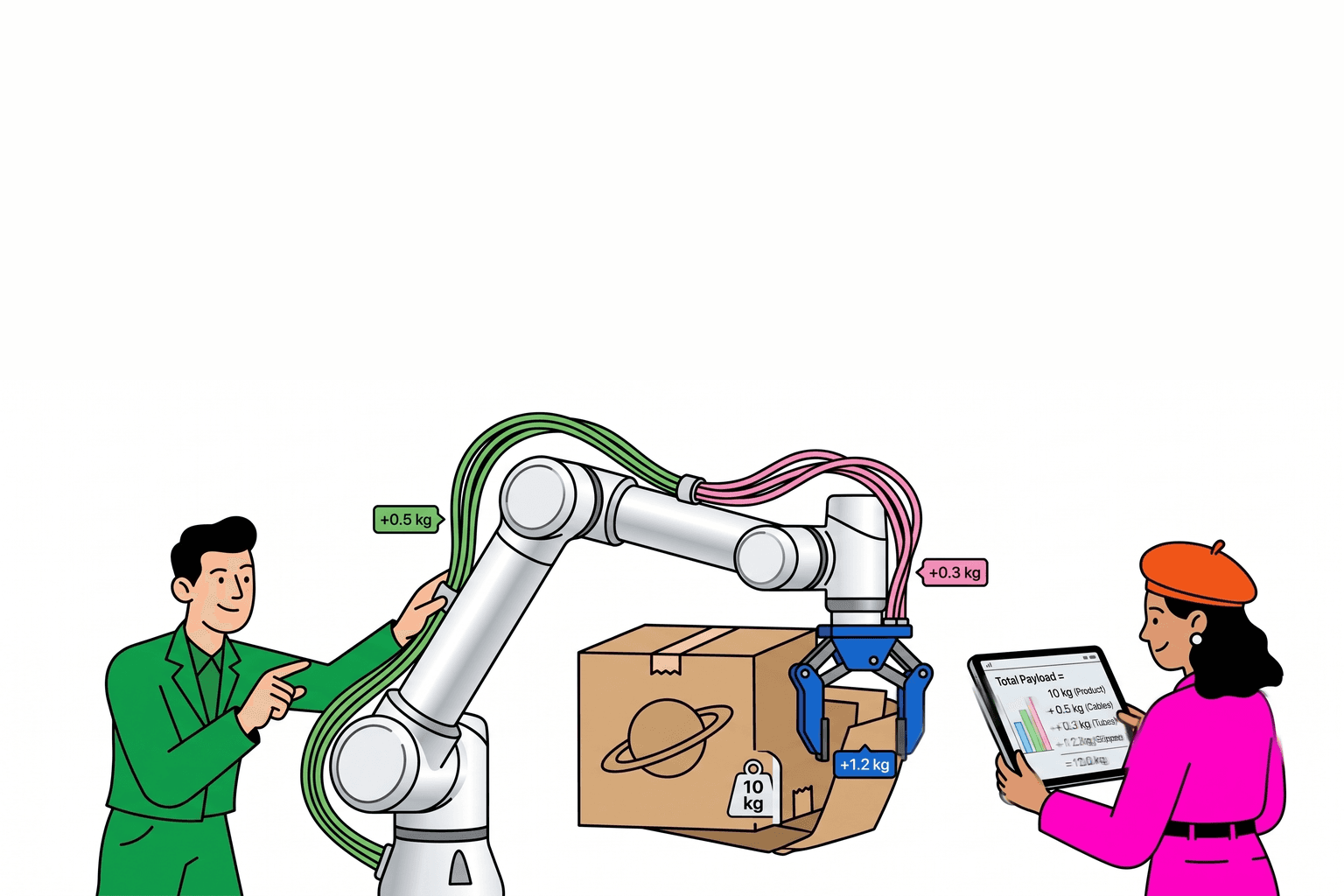
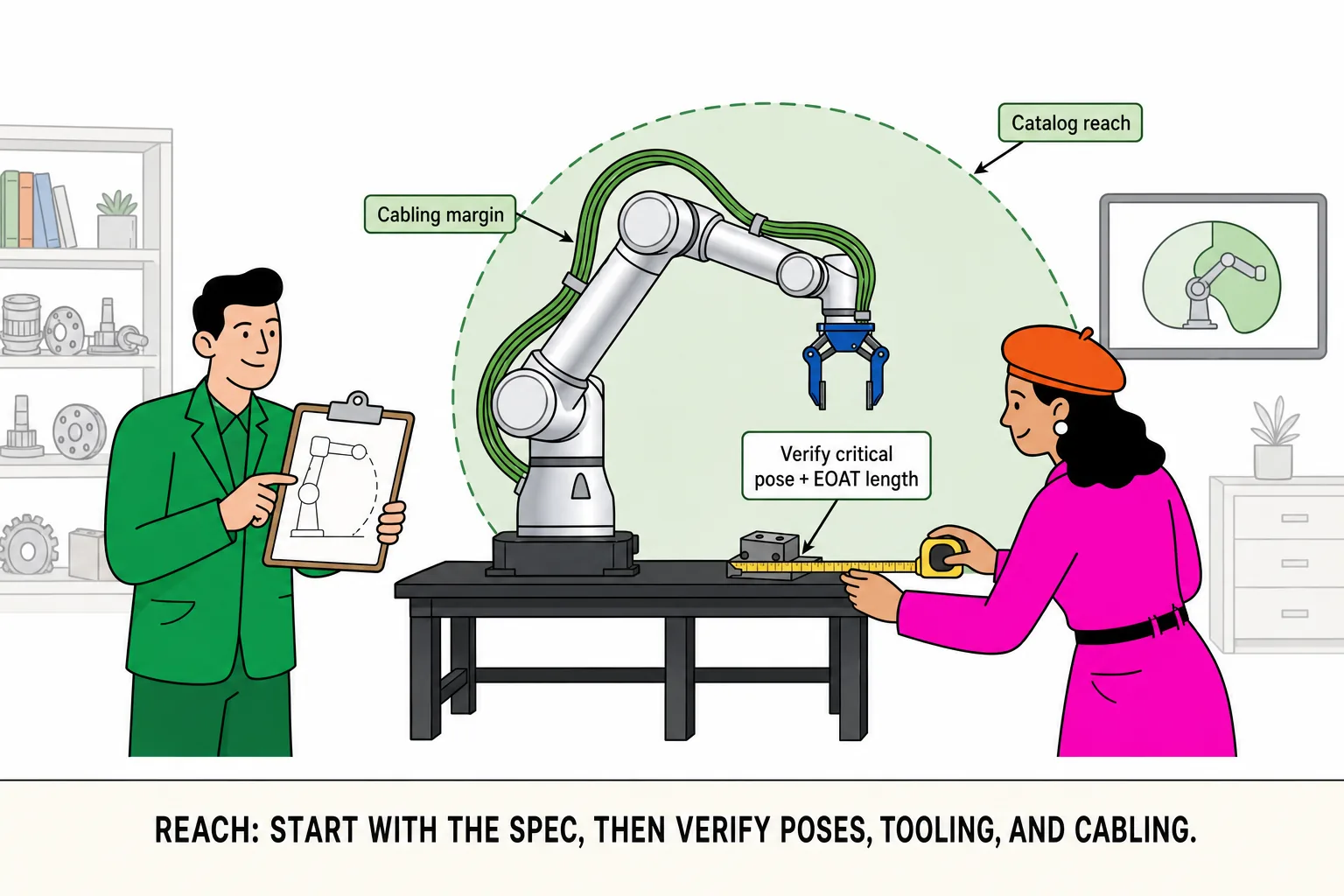
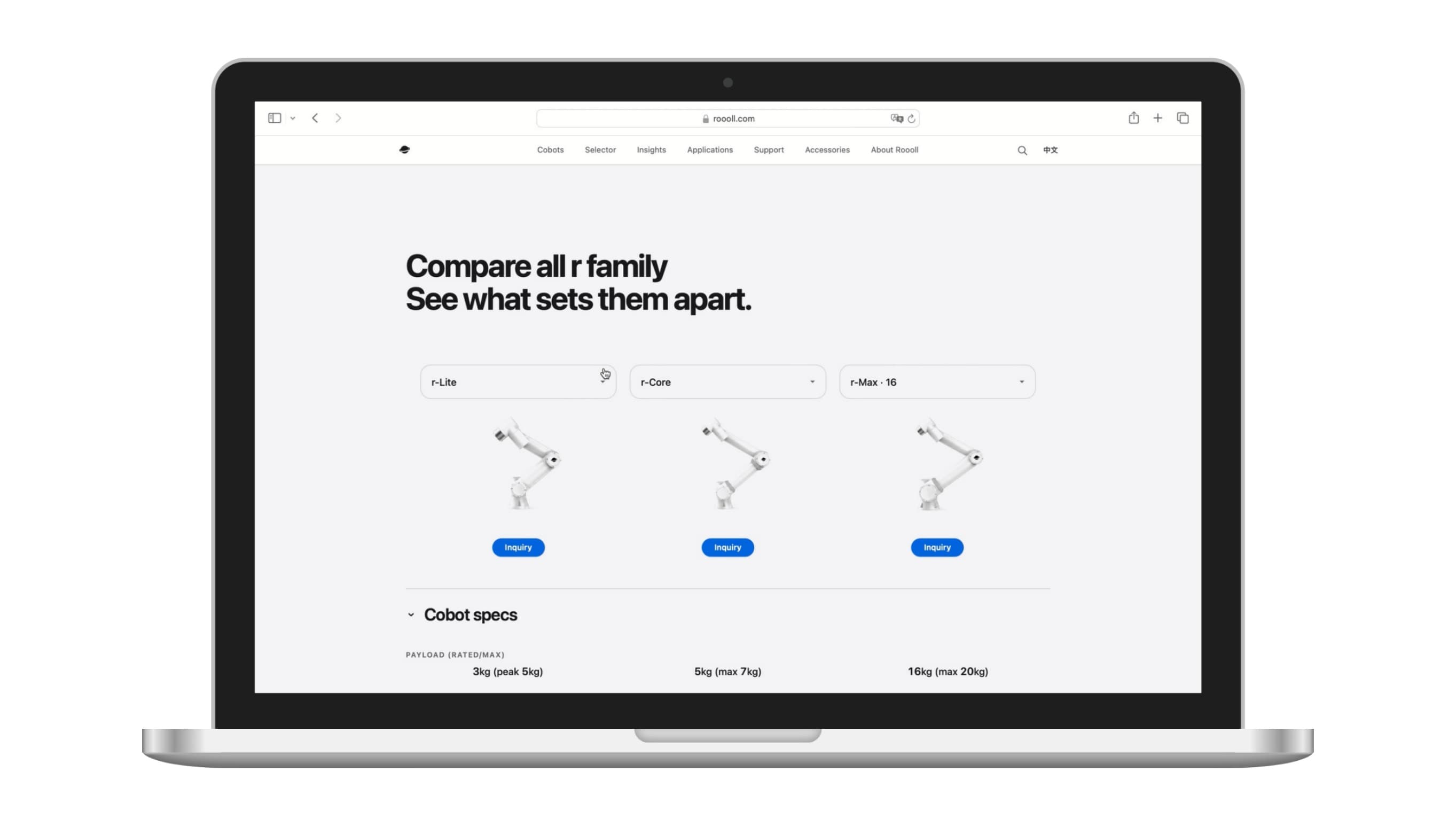
Electric/pneumatic drivers plus bit and cable often scale 0.3–1.5 kg—usually under r-Lite (~3 kg rated) and r-Core (~5 kg rated). Validate wrist pose at approach, cable clearance, and whether reaction shifts the board. Shortlist both in Side-by-Side Comparison; if the scene is still fuzzy, Product Advisor. Footprint: True-scale AR.
Worked A — eight flat M3, approach ±10°: driver ~0.9 kg → payload is not the story. Review feed vs takt and reaction shift.
Worked B — deep + multi-side: if the wrist cannot hold the drive axis, prefer floating head or fixture lead-in—fastening rarely jumps to heavy payload tiers.
Hybrid human–robot split (often stabler than “fully automatic”)
ASSEMBLY / integrator voices often suggest: humans on easy holes or hand-starts, cobot on hard approaches or final torque—so human takt rises instead of demanding zero touch on day one. Write 100% programmed paths vs human touch-up holes into the pilot freeze page.
Three common failure modes
Teach production paths before hole tolerance is contractual — second-lot hole drift looks like “robot inaccuracy.”
Count only drive seconds, ignore feed and changeover — blow vs pick-and-drive is seconds per screw and decides cell output.
Sell yourself a certified unmanned station — without first-article sign-off and strip stop authority, escapes are hard to own.
When not to force collaborative screw driving
Only two screws in a four-minute loop—fastening labor share too low
Torque sits well above the cobot-friendly band without reaction/safety budget
Hole location needs per-part hand alignment—no controlled tolerance
Takt needs multi-spindle on a long single-SKU run
Customer rules exclude collaborative proximity or demand a fully unmanned fastening package
Pilot sequence
Freeze screw specs, torque/angle window, hole tolerance, sequence, and acceptance
Trial on real parts and real fasteners; lock feed method and seconds-per-screw target
Fixture and approach envelope; layout via the workcell layout guide
Teach main path; write strip/high-screw stop policy into the program
First-article sign-off; list human touch-up holes
After PO: RooollTrack · bit service via Care