Quick answer
Most commissioning surprises come from the same pre-purchase gaps: spec-only shopping, missing EOAT/dynamic headroom, and teams that never aligned on one layout/comparison link
Run the 5-mistake table: payload definition, critical TCP poses, EOAT path choices, rated vs peak for daily cycles, and one shared comparison link
Validate one worst-case floor vignette with real changeover and real takt (including waits/interlocks); any fail sends you back to the matching how-to
Turn outcomes into PO-ready acceptance language: worst TCP load, EOAT envelope for critical poses, and a named owner for pass/fail
Day three of commissioning: payload checked, the comparison table picked a tier, the PO is signed. The first production shift still hits protective stops—the tray station that looked covered on the spec sheet never cleared the critical pick angle. Most surprises trace back to the same pre-purchase gaps, not the robot brand.
This is a quick audit before you quote: five mistakes that show up on almost every project, what breaks on the floor, and where to go deeper.
Five mistakes that change projects
| Mistake | What breaks on the floor | Next step |
|---|---|---|
| Part weight only — EOAT and dynamics ignored | Drops, protective stops, takt drift | Part + EOAT + rated headroom → Payload guide |
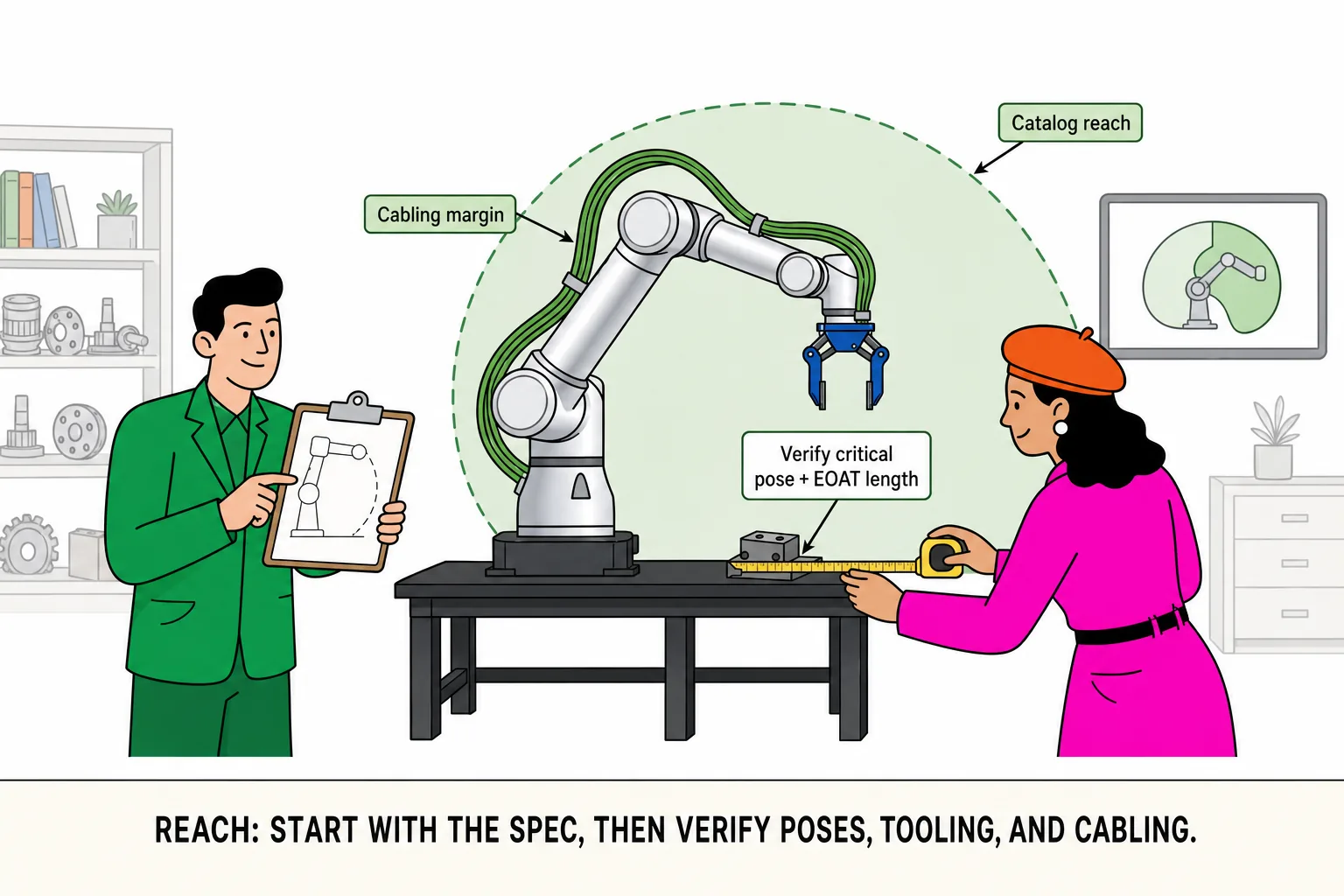
| Catalog reach on paper — TCP, pose, and cabling skipped | Key pose unreachable at commissioning | TCP + critical pose + retract path → Reach guide |
| Robot picked before the hand — EOAT path undecided | First cycle slips or cannot meet takt | Pick grip / vacuum / fixture path first → End-effector guide |
| Peak treated as daily load | Stable in demo, unstable in production | Use rated payload for everyday cycles → Payload guide |
| Three spec stories — teams never aligned on one link | Procurement, engineering, and floor quote different numbers | Share one comparison URL before PO → Side-by-Side Comparison guide |
Evidence: why spec-only breaks on the floor
| Evidence | Published range / what it implies | Source |
|---|---|---|
| EOAT vs rated payload | ~30–70% can be consumed by EOAT before usable payload is left | Ocean Player · AMD Machines |
| Robot hardware share in TCO | ~25–40% | AMD Machines TCO |
| Integration share in TCO | ~30–50% | AMD Machines TCO |
| EOAT cost level | $2k–$40k+ | Robolist TCO model |
| Integration engineering cost level | $8k–$60k | Robolist TCO model |
When mistakes stack: one floor vignette
A PCB tray pick at a ~900 mm station: the team short-listed r-Core because catalog reach cleared the center distance. Vacuum tooling and valve stack added TCP extension; a side approach meant the wrist could not stay extended; cable dress burned margin before the arm hit its limit. Each item looked fine alone—combined, the cell needed rework. The lesson is not pick a bigger arm first—it is validate the worst beat, not the best-case dimension on the PDF.
Three-minute pre-quote audit
| Check | Why it matters |
|---|---|
| Worst-case TCP load = part + EOAT + dynamic margin (rated, not peak) | Stops drops and repeat protective halts |
| Critical pick/place pose checked with EOAT envelope | Paper reach ≠ usable reach |
| EOAT path chosen or marked TBD on site | Hand and arm get quoted together |
| One comparison link shared with procurement, engineering, and floor | One spec story before PO |
| Tool I/O and safety scope noted in the quote package | No surprise cabinet or PLC work |
Floor signals: what these symptoms usually mean
| Floor signal | Usually maps to | What to ask next |
|---|---|---|
| Drops / protective stops get worse after changeover | Part weight only | Did EOAT push the worst TCP load beyond usable headroom |
| Protective stops repeat at full extension | Catalog reach only | Do you have farthest TCP, retract path, and cable-bend margin inside the envelope |
| Demo looks stable, production takt drifts | Peak treated as daily | Are daily cycles actually rated-load math (incl. waits/interlocks) |
| Contract signed, but I/O integration gets budget-added | Three spec stories | Did everyone share one I/O/safety scope and acceptance rule before PO |
| It misses by a few millimeters at the key pose | Arm first, hand later | Is EOAT stick-out and TCP definition locked in the comparison sheet |
Acceptance template: make the mistakes auditable
| Module | What to fill in | Common gap |
|---|---|---|
| Worst part & slowest shift | Named samples/batches and boundary conditions | Ideal parts replace worst-case parts |
| Critical poses & EOAT envelope | Farthest TCP point + EOAT stick-out range | Only flange-center distance |
| Payload definition & margin | Rate daily cycles on rated payload with margin | Peak treated as daily load |
| Interfaces & acceptance boundary | I/O list, e-stop topology, pass/fail rule | Assuming “it is inside the arm” |
The lesson is not “buy a bigger arm.” It is validate the worst loop: swap “farthest point” from catalog reach to TCP, use the EOAT you will actually mount, then include waits and changeover in cycle-time decomposition. That is how one station stays consistent between commissioning and production.
How to verify each of the five mistakes
Mistake 1: part weight only
Rewrite the load as worst-case TCP load: part + EOAT + dynamic headroom. Ask for EOAT mass/stick-out in the quote and check daily cycles on rated payload (not peaks used as a shortcut).
Mistake 2: catalog reach on paper
Upgrade “center distance clears” into “critical pick/place poses clear.” You need the farthest TCP point, a safe retract path, and the cable-bend margin. Reach images without pose and retract are not RFQ-ready.
Mistake 3: arm first, hand later
If EOAT is TBD, mark it as “site validation required” and make “EOAT finalized → re-check TCP/envelope” an acceptance milestone. Otherwise the arm is selected without the hand and you will pay to rework.
Mistake 4: peak treated as daily load
Demand comparison math for daily cycles on rated payload with headroom. Peak is a short-time ceiling, not a takt promise.
Mistake 5: mismatched comparison sheets
Standardize before PO: one Side-by-Side / Advisor output, and the same worst parts, critical TCP poses, and margin logic in one PDF. Different sheets mean different questions.
Mini example: 900 mm station turns into rework
A small origin shift plus additional EOAT stick-out can push the wrist into the protective zone at full extension. Upgrading the arm may look quick, but the cheaper fix is to correct TCP margin and EOAT path assumptions first.
Where to fix first to save cost
If you can only fix one gap early, start with:
Protective stops at full extension → correct EOAT/TCP margin and cable-bend margin
Demo is stable, production takt drifts → update cycle-time decomposition and include waits/interlocks
Only after both are fixed should you upgrade the class, not mask wrong inputs with a bigger arm
Paste these three lines into your acceptance email so the team does not “mask inputs with a bigger arm”:
Critical pose: farthest TCP + safe retract path checked
Load definition: rated-load daily cycles with EOAT included
Takt definition: segment timing (incl. waits/interlocks) <= takt
If you can only share one figure first, mark the critical TCP point and safe retract path on the same image.
With these three points done, the audit stops being “by vibe.”