Mall kiosks, stalls, and tiny tea shops often offer only 600–800 mm of counter depth—then ice machine, sink, walk path, and fridge behind. Owners want repeat motion automated but ask first: “Where does the base go? Where is the cabinet? Where do guests queue?” Collaborative arms in tight retail win by compact, integrated form reclaiming bench space—motion can be simple, but footprint and traffic must pass before payload debates.
What a compact retail cell actually does on a narrow counter
A typical loop (tea example; analogous elsewhere):
Nest — cup or ingredient at a fixed island
Core move — one to three repeat actions (pour, stir, transfer)
Hand off — to pickup or next human step
Reset — next cup; bottleneck is often queue space, not arm kg
Design priority: base envelope < reach < payload—opposite of factory logistics lines.
What compact cobots usually buy in small-footprint stores
Reclaimed bench depth. The integrated-base story on the r-Lite product page pulls the control cabinet into the pedestal—one less “equipment shelf.”
Plannable traffic. A fixed island lets you draw staff and guest paths instead of everyone fighting the same depth for repeat motion.
Longer span without jumping weight class. Deep-but-narrow counters can compare r-Lite mobile long-reach specs (~922 mm reach, still 3 kg rated)—not r-Max for front-house load.
SKU changes mean programs. Right for bounded menus at one stall pilot.
People stay on guest interaction. Ordering, topping, cleaning—tiny shops need face time more than they need another mechanical motion.
Footprint and reach: measure base before payload
Mark in CAD or photos: base diameter/footprint, service door swing, guest queue band
When 622 mm rows fall short, compare r-Lite WML specs then r-Core—still light front-house; not r-Max
TCP almost always 0.5–2 kg—payload rarely kills; island and aisle kill first
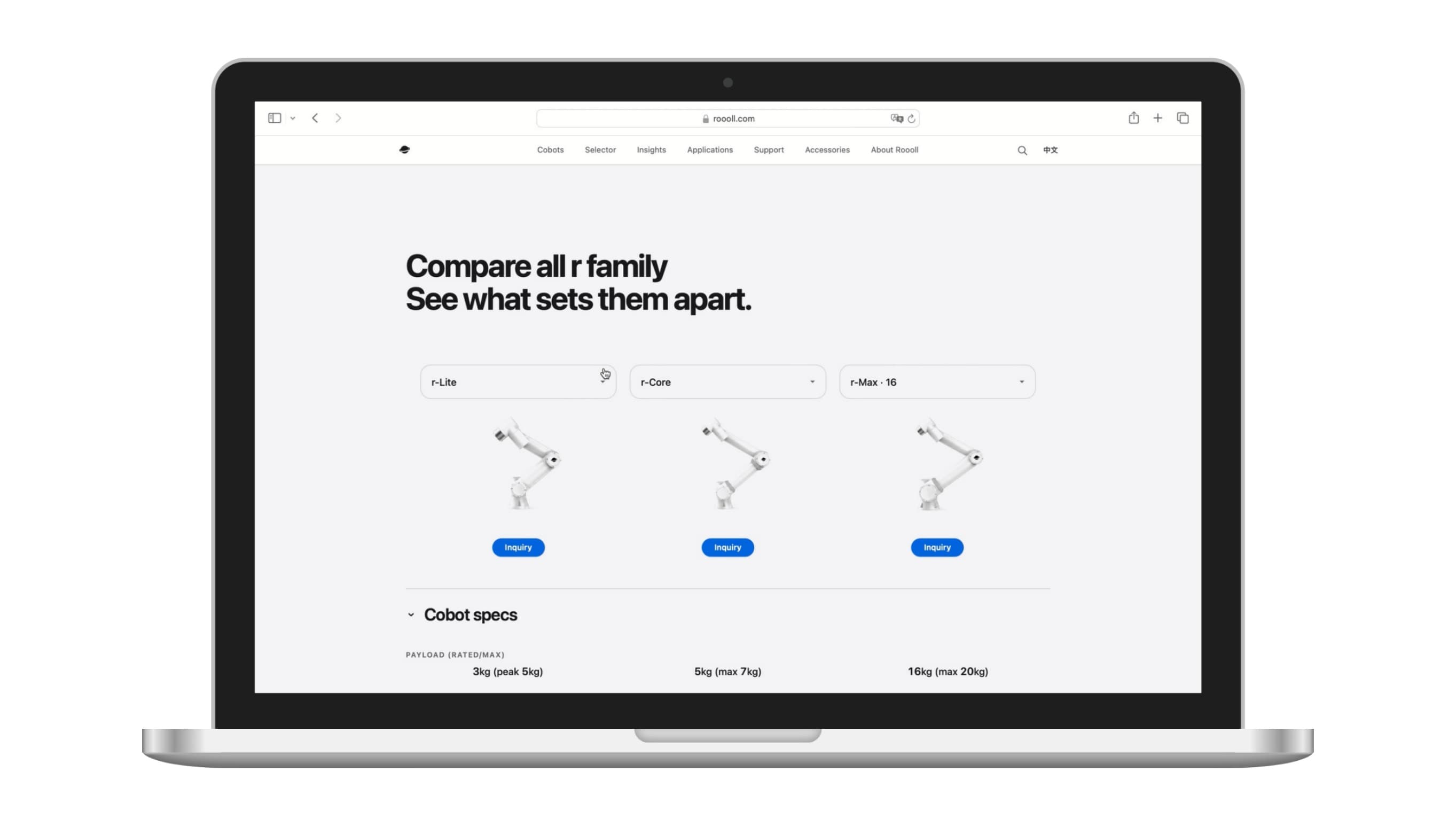
Compare together: Side-by-Side Comparison
Layout method: Workcell layout guide.
Two floor vignettes (illustrative)
Vignette A — 600 mm deep kiosk, single island, 0.7 kg tool: r-Lite standard row flush-mounted. Review guest queue radius and night cleaning aisle.
Vignette B — 700 mm deep but 850 mm hopper span: put r-Lite WML in the set—still 3 kg rated, not a heavy series swap.
Three ways tight-counter projects stumble
Reach measured; cabinet service space ignored. Integrated base still needs door swing and cable bend radius.
Island eats the only guest standing zone. Draw queue lines before fixing the base.
Oversized arm for “looks impressive.” Front-house light loads—r-Max only grows footprint and guarding cost.
When not to force compact automation
No fixed island—layout changes daily
Fire/egress rules cannot be satisfied
Menu cannot be recipe-structured
Expectation is unattended operation without remote support
Integrator review checklist (tight retail)
| Check | What it tells you |
|---|---|
| Base envelope + service clearance | Before TCP kg |
| Reach span vs counter depth | 622 vs WML vs r-Core |
| Guest queue and staff aisle | Peak-hour standing room |
| TCP load | Almost always r-Lite tier |
| SKU/recipe count | Changeover |
| Cleaning and night SOP | Can you maintain after close |