Quick answer
Yes, with gates: published guides often cite 2–3 nearby CNCs on one cobot; part cycles often need more than about 3 minutes, and machines must be close
Close the math: shorter cut time must cover “service the other machine + both door loops + blow-off/confirm”—if travel erases the gain, do not force a second machine
Doors and I/O on every machine: one manual door pulls the whole cell back to waiting on people
Infeed must cover the unmanned window: size magazines/trays for both machines, not a single-machine demo
Stabilize one machine first: do not sign “one arm, two machines, lights-out” on day one
“Can one cobot tend two CNC machines?” is not an arm-speed slogan. It is whether multi-machine takt closes: enough cut idle for travel, auto-doors and interlocks on both machines, and infeed that covers the unmanned window.
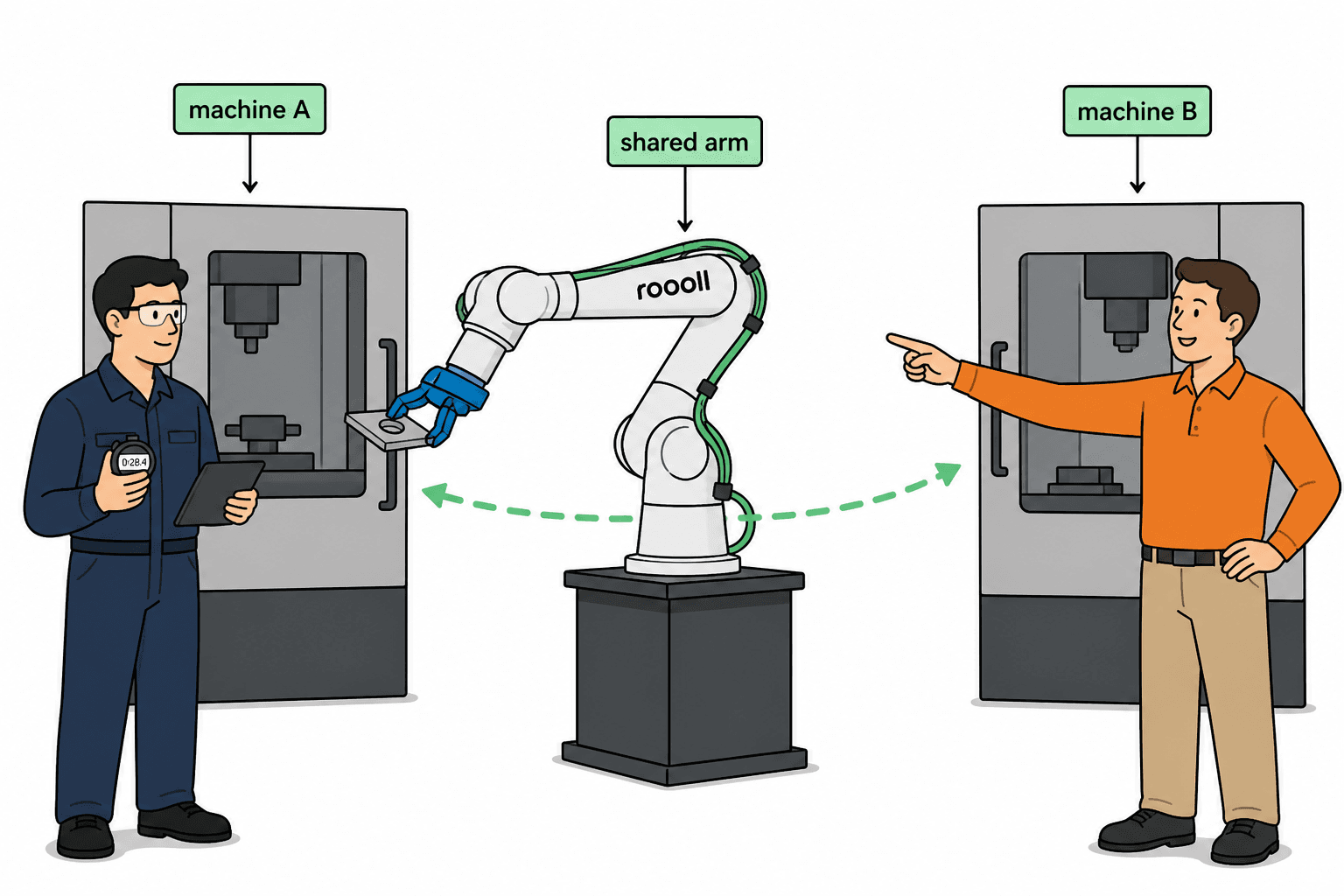
Multi-machine / dual CNC cobot tending means one collaborative arm loads and unloads two (sometimes three) machines in turn—servicing B while A cuts, then returning to A. Marketing often says 2–3 machines. EasyRobotics CNC tending states one mobile workstation can tend two or three nearby CNCs depending on cycle time and distance. Robotomated frames multi-machine as usually needing more than about 3 minutes per part. Broader industrial cells (EVS) cite 2–4 machines and utilization from about 60–65% to 85%+—that band includes industrial-robot cells; cobot pilots must re-check with plant cut and door data.
Single-machine tending and spindle-utilization bands sit in the CNC tending guide (manual often 40–65% → tended often 80–95%). This page answers only: when a second machine is worth adding to the same arm.
What dual-machine adds versus one
| Item | Single-machine tending | One arm, two machines |
|---|---|---|
| Doors & interlocks | One auto-door + I/O set | Both machines need reliable auto-doors and interlocks |
| Travel | Mostly at the door | Travel on every loop between doors |
| Infeed | One magazine window | Two blank/finished buffers sized for the unmanned window |
| Fault domain | One machine stops the arm | One alarm often disrupts service cadence for both |
| Teach / changeover | One in-door path family | Two fixture/door corner sets plus shared-arm clearance |
Published multi-machine bands
| Source | Published band | How to use it |
|---|---|---|
| EasyRobotics | 2–3 nearby CNCs; longer cuts free time for a second machine | Measure door-to-door distance and cut minutes before layout talks |
| Robotomated | Multi-machine often needs >~3 minutes/part | Do not promise dual-machine on short cuts |
| EVS | Often 2–4 machines; ~60–65%→85%+ utilization (industrial-inclusive) | Sanity check only for cobot pilots—not a contract number |
| UR × Bernacki | Three UR10e arms across seven adapted machines, three shifts; ~12-month payback on the third arm | Proves multi-machine shops work—as multi-arm, not one arm forcing seven machines |
Gates before you talk two machines
Do not open the meeting with “can we put dual-machine in the PO.” Freeze the five gates below as measured plant data. If the data is missing, the right move is to go time the machines—not to let a supplier substitute “we have done two machines elsewhere.”
Cut idle — Take the shorter `T_cut`. It must cover a full service of the other machine (door → swap → close → start) + round-trip travel + blow-off/confirm. Negative slack means reject the second machine—not “try a faster speed.” When slack is only a few seconds, one chip jam or retry makes the other spindle wait, and both utilization numbers fall together.
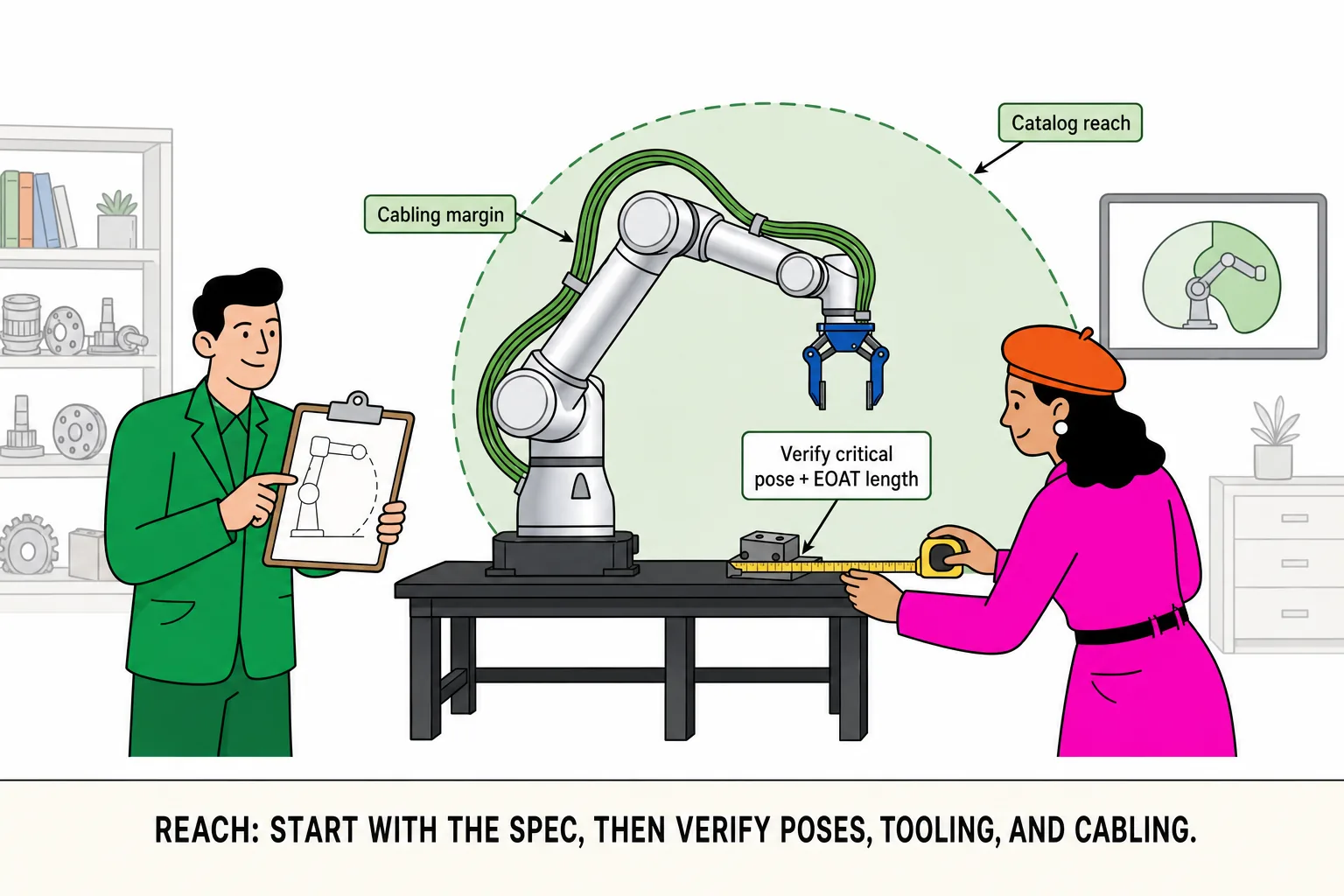
Distance and reach — Both doors must sit inside the reach and pose envelope of the chosen base. Chronic over-reach, weaving around columns, or flange scrape on a full-open door means rail or a second arm—not twisting joints to the stop. How to mark the farthest TCP: reach guide.
Doors and I/O complete — Per machine at least: permit-enter, clamp confirm, cycle-complete/alarm, cycle start. Missing any one pulls that machine back to waiting on people. Scope: Safety & I/O guide; collaborative cells often reference ISO 10218 / ISO/TS 15066.
Infeed covers the unmanned window — For the target unmanned window, neither blank nor finished buffer may depend on a person feeding every cycle. A single-machine demo magazine that “runs an hour” is not sized for two machines consuming at once—capacity must cover both streams plus retry slack.
Single-machine already stable — Measured utilization, door-cycle seconds, and gripper yield exist before you stack machine B. Signing “one arm, two machines, lights-out” on day one parks unproven travel, interlocking, and exception logic in the contract.
Takt split (paste into the review sheet)
Log five segments per machine: `T_cut`, `T_door`, `T_swap`, `T_travel`, `T_aux` (blow-off, vision confirm, retry reserve). Do not merge “arm flying in air” with “in-door swap” into one stopwatch number—when something slips, you cannot tell whether to move the machines or change the gripper.
Shared-arm rule of thumb:
If `T_cut_A ≥ T_travel + T_door_B + T_swap_B + T_aux_B`, the arm has slack to serve B while A cuts
Check B→A the same way (bottleneck on the shorter cut)
Either side fails chronically → a second machine does not “buy” utilization; it adds wait on both
Segment method and common omissions: cycle time guide. On the floor, sample 20–30 consecutive loops and keep P50/P90—not the one clean cut that looked good on video.
Worked order-of-magnitude example (not a quote)
Door-to-door ~2.5 m; one-way travel ~6 s including accel and pre-door align. Per machine: `T_door=8 s`, `T_swap=20 s`, `T_aux=6 s` → ~34 s at one door; round-trip travel 12 s → ~46 s to fully service the other machine.
If shorter `T_cut = 90 s` → slack 90 − 46 = 44 s. Dual-machine is plausible on paper—still prove chips do not inflate door dwell, dual-grip clears the door, and magazines cover the unmanned window.
If `T_cut = 35 s` → negative slack. Promising one arm for two machines only writes takt penalties into the PO; keep single-machine, shorten travel, or add a second arm.
Swapping this example for your measured seconds beats citing any brochure “2–3 machines” band in a review meeting.
Layout options
Pedestal, floor rail, and mobile base can all “look like” a dual-machine cell; the failure modes are different.
| Option | Fits when | Risk |
|---|---|---|
| Pedestal between machines | Machines already adjacent, longer cuts | Over-reach; hard to move when the line shifts |
| Floor rail / 7th axis | Larger spacing, still one arm | Cost, safety zones, and teach-point count grow |
| Mobile base (locked while running) | Day on A, night on B, or redeploy | Must anchor while running; high base accel trips protective stops |
Draw pedestrian paths and door sweeps before arm paths—many shops fail because carts block the short travel line, not because the arm cannot reach. Footprint: workcell layout. Door interference: true-scale AR before you buy a rail.
Payload and grippers
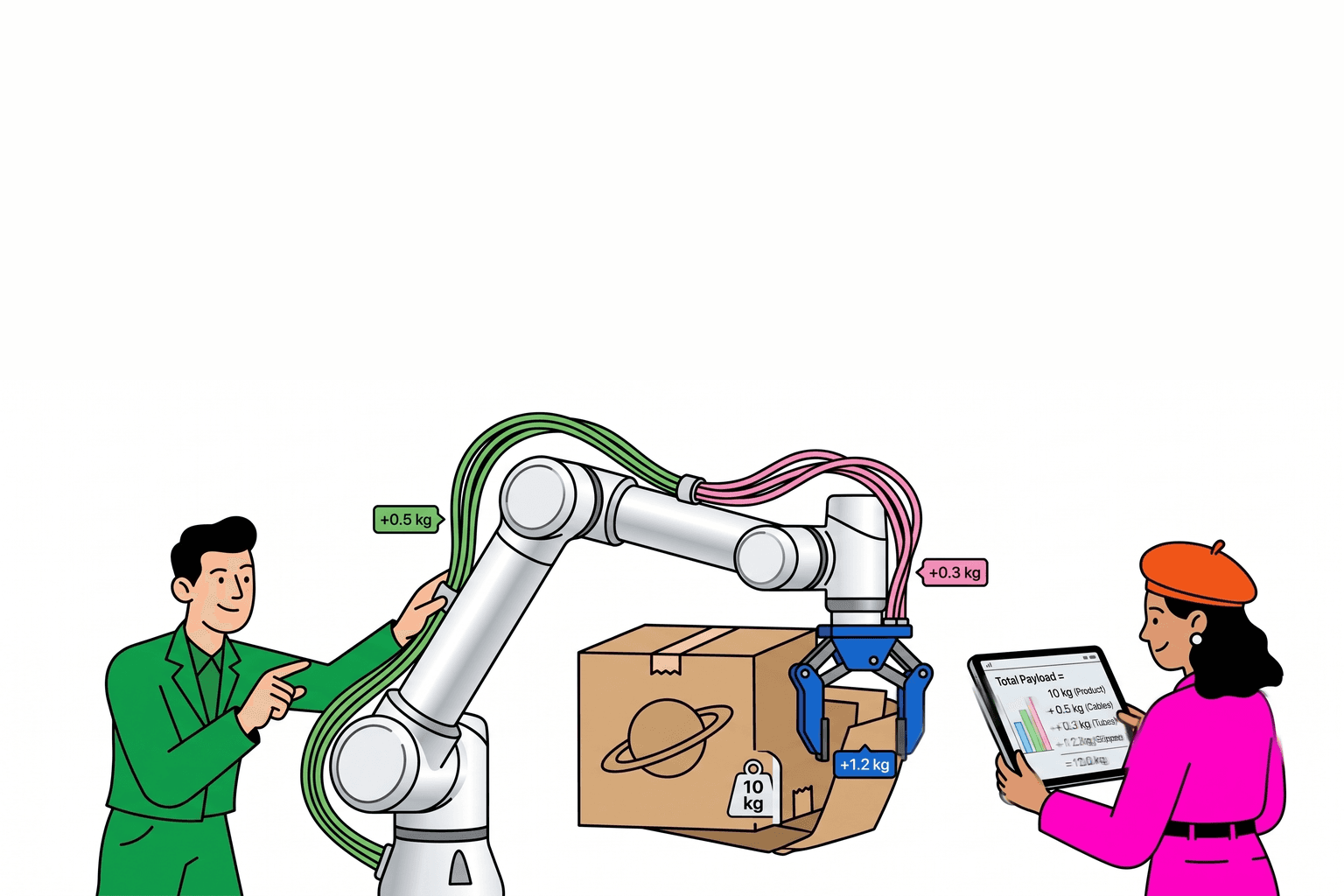
If part families differ, size on heaviest part + heaviest gripper (including dual-grip)—not the average part and not “the part on machine A.” Dual-grip may cut ~30–40% of tending motion on one machine (Robotomated) but adds mass and door interference when shared, and changeover may force a retreat to single-grip—re-check payload and inertia. Start with payload guide. Compact doors: r-Core; heavier blanks: r-Reach via Comparison; unclear scenes: Product Advisor before dual-machine talks harden.
Hard no-gos
If any line below is true, pull “one arm, two machines” out of this phase and keep single-machine stability or two arms—cheaper than unwinding a PO.
Shorter cut chronically under ~2–3 minutes, with no way to shrink travel or door time. Brochure “2–3 machines” does not cover that takt.
Only one machine has a reliable auto-door and interlock; the other still waits on a person—the slow door erases the theoretical gain.
Infeed still assumes one person feeding or clearing both machines every cycle—that turns the operator into the material bus, not an unmanned window.
No written behavior when one machine alarms: may the arm keep serving the other, how is the magazine isolated, who resets—until that is in the interlock logic, do not write lights-out.
The contract says cross-shift unmanned without a week of dual-path proof under real chips, coolant, and cable dress. Clean day-shift empty-air runs are not night-shift chip runs.
When two arms beat one arm on two machines
RoboJob’s post states the vendor can build one-robot/two-CNC cells but does not recommend them—citing lost machinist access, longer arms, gripper/programming complexity, slower changeover, and total cost often above one robot per machine. Put that counter-case on the review sheet; do not only hear “save one arm.”
Reconcile with three checks, not gut feel:
Human access — After the arm sits between two doors, can people still reach for tool changes, chip clear, and first-article without parking both spindles? If every shift walks around the arm or stops both machines to enter a door, maintenance windows erase the utilization math.
Changeover and part families — Widely different parts make dual-grip/dual programs approach two single-machine teaches; changeover hours × shifts often cost more than depreciating a second arm.
Fault isolation — Write the interlock: on A alarm, does the arm hold a safe pose or keep serving B? Are magazines isolated? Who resets? If “one fault stops both” and that is not priced, dual-machine availability can lose to two parallel arms.
Order-of-magnitude: price a second arm + second door-side teach against three-year cost of rail/extra-long arm + dual interlocks + changeover overtime + one fault idling two spindles. Slack inequality can pass while access and changeover still say two arms—or stay single-machine first.
Keep serving one machine on alarm (interlock sketch)
Put this in I/O and the safety file—not as a hallway agreement:
A `alarm` / `estop` → arm leaves A’s door sweep to a named safe point; default: no re-entry to A until human reset and permit-enter return
If policy allows continued service of B: B’s permit-enter, clamp, and door interlocks must be independent, and the arm must not pick from A’s magazine by mistake
Person inside A for a tool change: motion into A forbidden; whether motion to B is still allowed is a risk-assessment decision—do not assume “collaborative means full speed to B beside a person at A”
SAT must inject one A alarm and record whether B follows the written continue/stop policy
Pilot order
Close single-machine — door, I/O, utilization, gripper yield (CNC tending guide).
Measure machine B — both `T_cut` values, door cycles, door spacing and obstacles; fill the slack inequality before buying a rail.
Lock layout and infeed — pedestal/rail/mobile and both magazine capacities in one write-up; moving the base later usually costs more than retouching teach points.
Supervised day shifts on A↔B — log jams, retries, and alarm behavior before cross-shift or headcount claims.
After PO — milestones in RooollTrack; spares and response via Care.