Quick answer
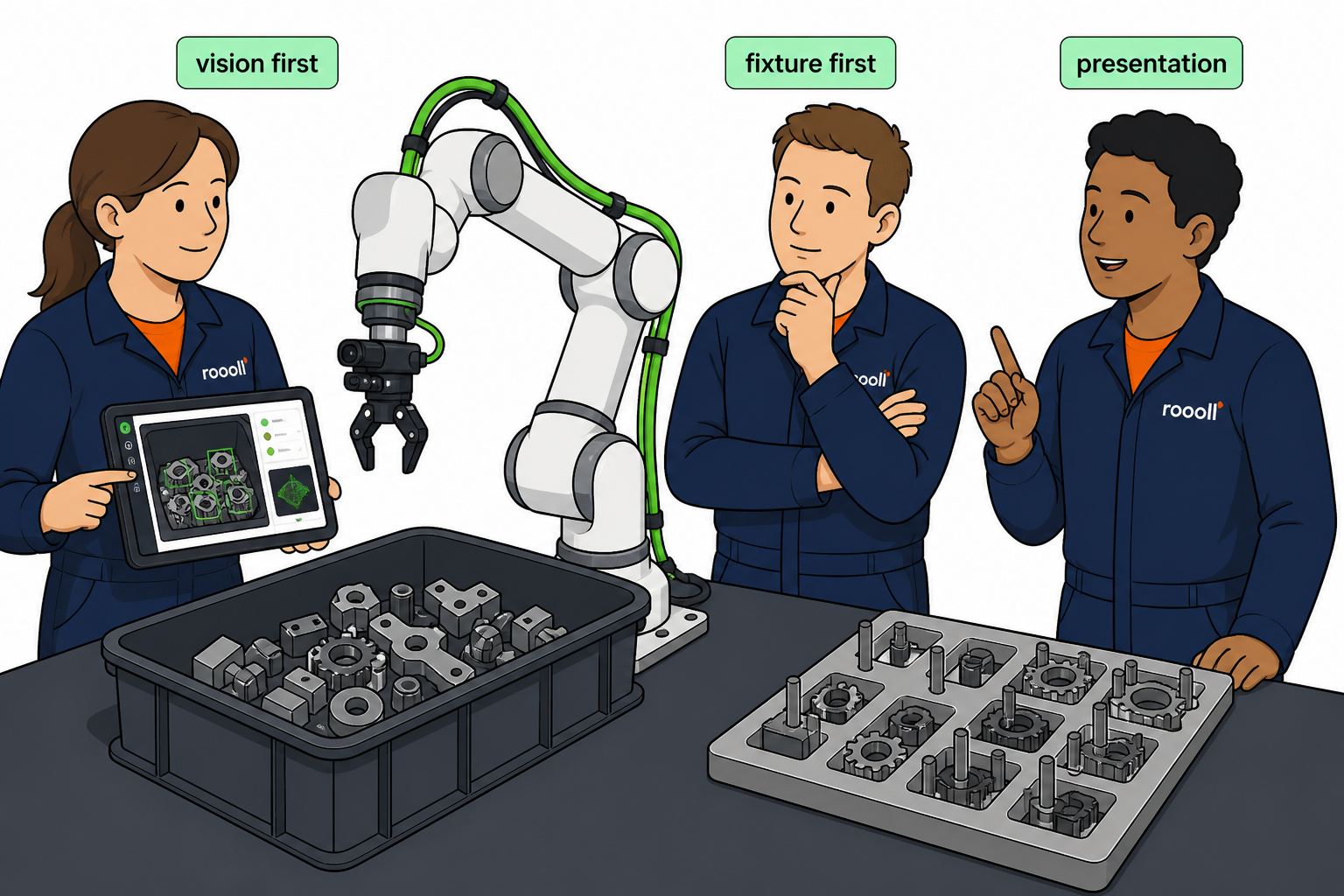
Ask presentation before models: chaotic totes are a vision problem and a singulation/fixture problem—many phase-one projects should not buy 3D
Cost bands (aligned with our cost guide): 2D often ~$3k–$6k; 3D/bin often ~$8k–$20k+, plus longer tune
Vision-first when: huge SKU count, fixture change costs more than vision, or upstream cannot singulate
Fixture/nest-first when: stops to mm–low-cm, nest swaps OK, and you still need to prove pick-place pays
Chain: Pick-and-place when it pays · End-effector · Cycle time · Cost
“Add vision” sounds like progress. On the floor it often becomes: camera purchased, grips still fail, and a brochure 6 s becomes 14 s. The first bin-picking question is not “which 3D camera,” but whether phase one can make presentation honest.
What cobot bin picking is
The arm detects, plans a grasp, extracts from a tote or pile, and places to a fixed station. The stack usually includes 2D/3D vision, grasp planning, collision models, EOAT, and a place-side fixture. Versus nested pick-and-place, the difference is not the arm—it is an extra layer of miss / empty grasp / collision retry on every cycle.
Decision frame: vision-first or fixture-first
| Question | Leans fixture / singulate first | Leans vision first |
|---|---|---|
| SKU count | Few; nest swaps OK | Many; nest cost explodes |
| Upstream | Vibrator / stop / hand-align possible | Logistics cannot change |
| Takt | Needs stable 4–10 s class | Can absorb detect + retry tax |
| Surface | Gloss/transparent hard to image | Enough texture, stable contrast |
| Budget | Prove pick-place ROI first | Already accepts ~$8k–$20k+ vision band |
Same rule as the pick-and-place guide: kill with fixtures what phase one can kill. Prove place accuracy and grip, then treat vision as SKU-expansion phase two. Baseline: Pick-and-place.
2D vs 3D: what the money buys
| Option | Published cost band | Good at | Weak at |
|---|---|---|---|
| 2D | ~$3k–$6k | Planar arrays, clear contrast | Height stack, heavy occlusion |
| 3D / bin | ~$8k–$20k+ | Pose in a pile, height | Long tune; gloss/dust sensitive |
Bands match the vision rows in the Cost guide as sanity checks. Quotes still add calibration hours, tote changes, IPC/GPU, and empty-grasp retry tax on takt.
Do not shop resolution alone. Send your hardest tote clip to an integrator and ask whether 2D is honestly enough. Buying 3D when 2D would do pays in debug weeks.
Takt tax (must be in the contract)
Chaotic pick cycles are rarely “arm flies once.” Segment: capture → infer → grasp plan → approach → grip/vacuum → lift (maybe slip check) → place → fail retry. Brochure 6 s and production 12–15 s are common. Method: Cycle time.
Acceptance should state success rate over N consecutive totes and P90 takt—not one perfect demo. Sketch: if detect+plan averages 1.8 s, retry rate 12%, and each retry adds 4 s, effective takt stretches fast—write that into the contract instead of arguing “slow robot” later.
Common grasp-planning failure modes
Occlusion: top parts hide lower ones; planner returns unreachable grasps
Gloss/transparent: pose noise, gripper slip
Collision: tote wall or neighbors block approach
Vacuum/grip: bad CoG estimate, drop on lift
Place side: chaotic pick succeeds, fixed station still misplaces—vision did not replace the place fixture
Each failure needs: retry cap, timeout clear-tote ownership, and whether retries count in contracted takt. Put it in the SOW so night shift does not retry forever.
When nested pick-and-place wins
If parts can nest or hard-stop to mm–low-cm, prove pick-place ROI before chaotic vision. Many “must bin-pick” briefs are really upstream refusing cheap singulation. Put singulation cost next to the 3D vision band on one sheet. Whole-cell safety still applies—Safety & I/O.
Pilot order
Film the hardest tote and surface; decide if 2D is enough
If fixtures work, run nested pick-place through the place side first
Add vision: N-tote success rate + P90 takt acceptance
Freeze retry / clear-tote ownership
Re-calibrate and re-accept checklist when SKUs change
Model shortlist: Comparison · Product Advisor. EOAT: End-effector.