Quick answer
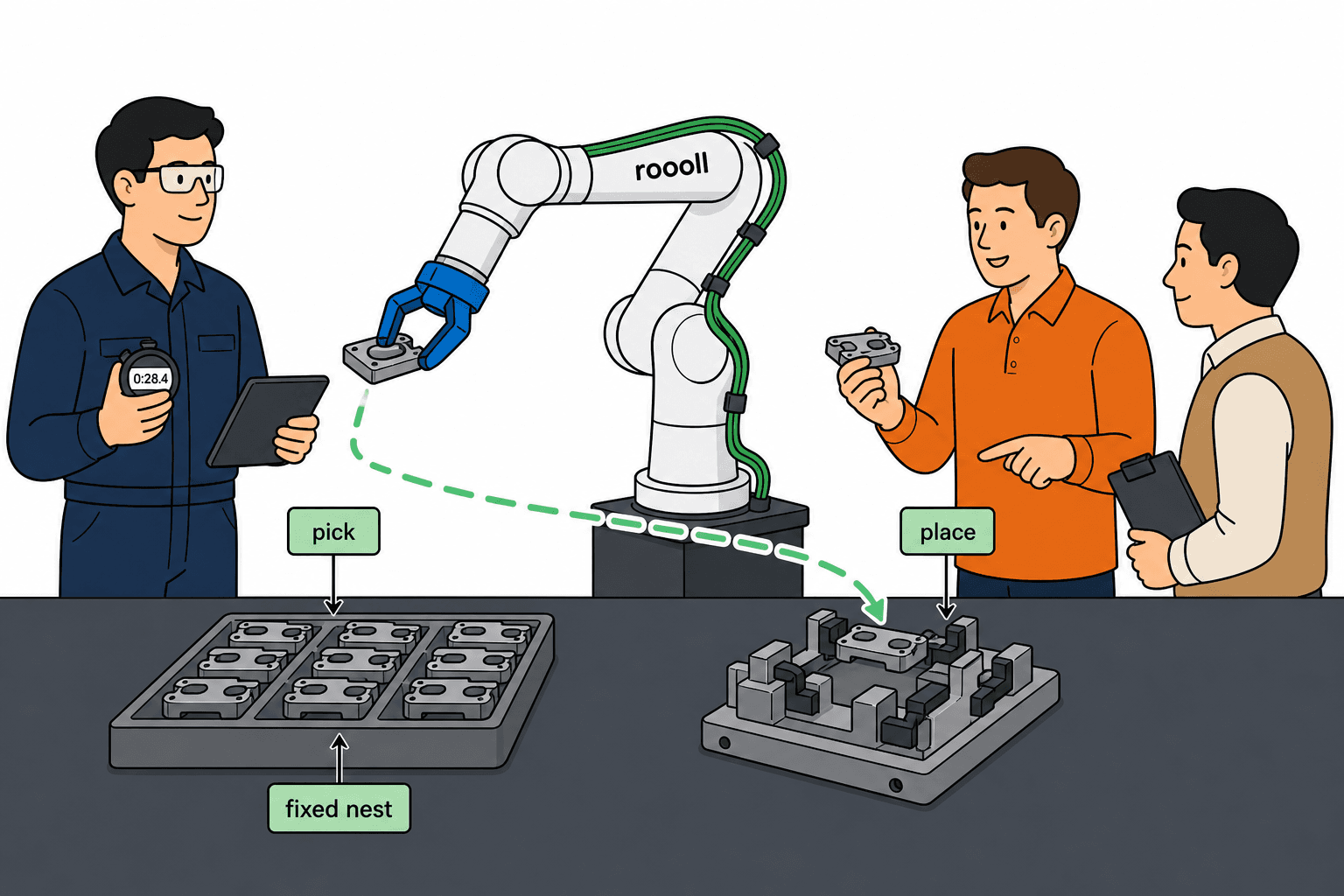
Definition: pick from a fixed nest/tray/stop, place into a fixture, pack, or next station—repeatable, short travel, teachable poses
Typical window: guides often cite ~4–8 s/cycle; also ~8–15 s and ~400–800 picks/hour—verify with a segmented beat sheet
When it pays: hours/shift of the same path, locatable infeed, takt not sub-2–3 s, payload inside rated after tooling
When not: sustained <2–3 s, chaotic bins with no presentation budget, or packaging rates that need delta/SCARA
Cell band: simple pick-place often ~$35k–$75k; vision/multi-station climbs → Cost guide
Pick-and-place is often a plant’s first cobot application because the motion is short, teaching is fast, and failure modes are relatively readable. What usually breaks the project is not that “the arm cannot move,” but that infeed tolerance never entered the contract, open/close or vacuum time never entered the beat sheet, or a cobot was asked to win a speed fight that belongs to a delta or high-speed SCARA.
What cobot pick-and-place is
In a programmed loop, a collaborative arm approaches, grips or vacuums, lifts, transfers, places, releases, and returns to idle. A typical cell is built from four blocks: the arm itself, the end effector, part presentation, and the place-side fixture or downstream interface. After risk assessment, people can still load, clear exceptions, or stand beside the cell—which is a different bet from a fenced industrial arm or parallel robot chasing extreme takt.
Why pick-and-place is automated early
Sorting, pre-pack transfer, and station-to-station handoffs rarely add much product value, yet they quietly consume hours every shift. Late-shift fatigue also turns misplaces and drops into a quality cost that programmed points do not inherit. Changeover, for many scenes, is a teach-point or recipe edit rather than rebuilding a dedicated machine, which is why high-mix SME lines favor it as a first station. CobotFinder’s manufacturing guide therefore treats pick-and-place as a common first app and cites about 4–8 s/cycle and roughly ±0.5 mm place accuracy with vision—useful as sanity checks, still re-timed against your nest tolerance and EOAT open/close.
Manual vs cobot (when “it pays”)
“It pays” is less a slogan than a stack of floor signals: whether repetition is long enough, whether infeed can be located, whether takt sits inside a cobot window, whether payload still has margin after tooling, and whether misplaces or drops already carry real cost.
| Signal | Leans cobot pick-place | Leans manual or another robot class |
|---|---|---|
| Repetition | Hours/shift on one path | Sporadic, a few times per hour |
| Infeed | Peg board / hard stop to mm–low-cm | Chaotic bin, no presentation budget |
| Takt | Stable in ~4–15 s/cycle | Sustained <2–3 s or >1,500/hour |
| Payload | Margin after tooling | Chronic edge-of-rated or over-reach |
| Quality | Misplaces/drops have cost | Manual already excellent and labor is cheap |
Do not stop the gain ledger at “save one person.” Rework, late-shift loss, and ergonomics often feel more real to finance; how to spread the sheet is in the ROI guide.
Takt windows: cobot, SCARA, delta
Before arguing grippers, confirm which speed fight you are trying to win. Most manufacturing and packaging still sit in the cobot window; delta or high-speed SCARA become honest only when light picking truly needs dozens of cycles per minute.
| Class | Published throughput / takt | Fits |
|---|---|---|
| 6-axis cobot | ~400–800/hour; or ~4–15 s/cycle | Reorient needed, mix, people beside |
| SCARA | Often ~800–1,500/hour | Mostly planar, faster, less pose need |
| Delta / parallel | ~1,500–6,000/hour (light) | Ultra-high-speed pack picking |
That is the rough split in Blue Sky on high-speed pick-place. Robotomated’s buy table lists pick-place around 8–15 s and 3–16 kg—same order of magnitude. If your line needs 18+/min sustained with short travel and tiny mass, compare SCARA or delta before forcing a cobot to “go faster.”
Segment the beat (worked example)
Brochure numbers almost always describe the flying segment. In review, it is safer to split approach, jaw open/close or vacuum build/vent, lift and transfer, place align, release and return, plus waits for upstream or downstream readiness—otherwise contracted pieces/hour miss from week one.
As an order-of-magnitude example: transfer 3.0 s, vacuum build/vent 1.0 s, place trim 0.8 s, and return 1.2 s total about 6.0 s/cycle, or roughly 600/hour before any waits. Add waits and a “4–8 s” brochure becomes 10 s or more. Full method: Cycle time guide. Pneumatic jaws often take 100–300 ms; vacuum depends on pump and seal, so budget it at selection time rather than trusting a demo that only proves “it sticks.”
Part presentation (usually decides success more than arm speed)
Many pick-place projects fail not because the arm is slow, but because presentation was never treated as a design object. Fixed nests or peg boards are excellent for vision-free pilots, though SKU changes often need nest changes. Hard stops with centering suit conveyors if stop tolerance is contractual. Magazines or tray arrays can cover short unmanned windows if you size how many hours a full load lasts. 2D/3D vision tolerates scatter, and usually adds about $3k–$20k+ plus longer tune time.
| Option | Upside | Cost |
|---|---|---|
| Fixed nest / peg board | Reliable; vision-free pilots | Nest change on SKU change |
| Hard stop + center | Conveyor-friendly | Stop tolerance in the contract |
| Magazine / tray array | Short unmanned windows | Size hours of coverage |
| 2D/3D vision | Tolerates scatter | Often +$3k–$20k+; longer tune |
A practical rule: if a fixture can remove vision in phase one, remove it. “Vision will save us” fails often because vision fixes location, not fixture crashes or over-payload; ±3 mm versus ±20 mm stop tolerance is already two scopes and two prices.
End-effector choice
Choose EOAT from part surface and changeover rhythm, not from catalog art. Flat sealed faces usually start with vacuum—subtract tool mass from rated payload and put vent time in the beat. Rigid odd shapes more often want parallel jaws, with tip force and geometry in the risk file. High-mix shapes may justify adaptive or soft grippers that cost more up front but shrink changeover. Insert or compliance work already sits outside a “pure pick-place” budget.
| Part | Often start with | Watch |
|---|---|---|
| Flat sealed face | Vacuum | Subtract tool mass; vent time in takt |
| Rigid odd shape | Parallel jaws | Tip force/geometry in risk file |
| High-mix shapes | Adaptive/soft | Costlier; changeover cheaper |
| Insert / compliance | Force / compliance | Beyond “pure pick-place” budget |
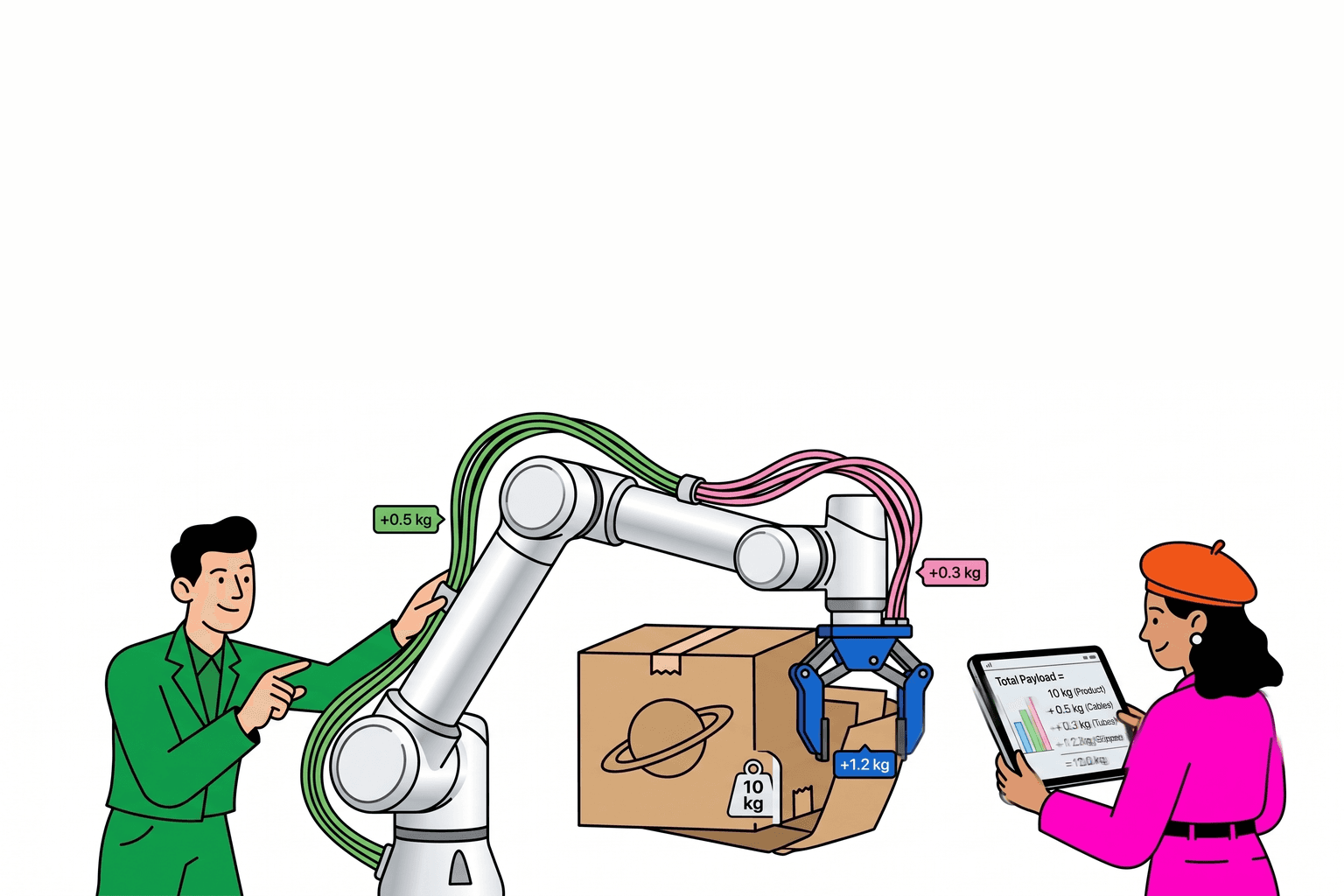
Worst TCP is always heaviest part + tool + adapter; see Payload and End-effector. Dual-grip can remove a second entry on swap tasks, but only after mass and door/fixture interference clear—the dual-grip logic in the CNC guide applies the same way on a pick-place station.
Safety notes
Force limiting is not zero risk. Moving parts, grip force, and drop zones still enter the assessment; collaborative cells often reference ISO 10218 / ISO/TS 15066, with scope in Safety & I/O. Layout and human zones return to Workcell layout.
Cost and payback (pick-place specific)
Among cobot applications, simple pick-and-place usually sits toward the lower end of the cost curve: published simple cells often land around $35k–$75k, and ultra-lean self-integrate can undershoot if acceptance scope stays honest. Line-item math lives in the Cost guide. CobotFinder also frames pick-place as a frequent first app with multi-day deploy potential—only after infeed and fixtures are frozen.
r-Series shortlist
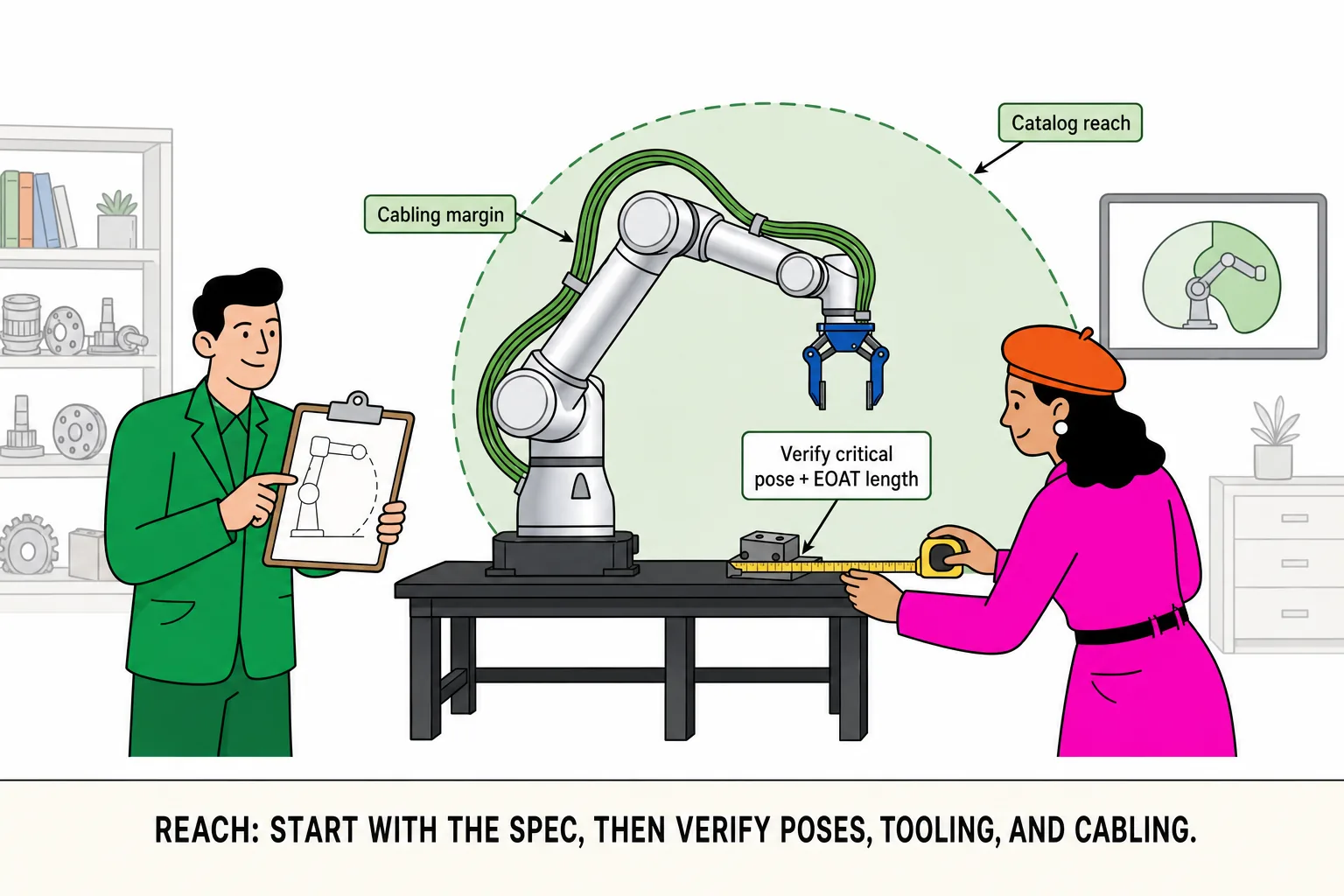
For light parts and short travel, r-Lite and r-Core often make the finalist set; heavier parts or farther place corners bring longer-reach rows into Comparison. If the scene is still fuzzy, narrow it with Product Advisor; if footprint or door interference is unclear, check AR first.
Common failures
Pick-place failures are rarely “the arm suddenly cannot move.” More often the pilot only demoed empty air, so production tolerance and late-shift drift appear later; the beat sheet omitted open/close or vacuum, so contracted rate misses from week one; infeed tolerance stayed verbal, so vision arrives after signature as cost and delay; or a cobot was forced into delta takt—the wrong robot class, not a tuning problem.
Pilot order
A stable pilot cadence is: freeze part size, pick/place frames, target pieces/hour, and stop tolerance; weigh the heaviest part, choose EOAT, and compute TCP after tooling; lay out pick, place, people, and drop zones; run a segmented beat for 20–30 loops and keep P50/P90; save the changeover recipe and sign first article; after PO, track delivery in RooollTrack and spares through Care.