Quick answer
Definition: a cobot moves a camera or scanner to repeatable poses, applies one pass/fail recipe, and logs a traceable result
When it pays: high cost of a miss, defects you can write as thresholds, multi-shift sampling that fails at night, and known-good/bad samples that lock the edge cases
When not: defects that only live as “looks wrong,” low single-shift volume, or pose/lighting you cannot freeze
Published bands: EVST powertrain note cites full inspection vs sampling with ~+30% inspection throughput; UR QI page cites ~195-day average payback; Comprehensive Logistics case ~4 months (arm) / 7 months (full app)
Split: multi-face, high-mix → cobot; fixed face + extreme takt → fixed AOI / dedicated → Cost guide
Sampling survives in many plants not because standards are unknown, but because the standard lives in people. Shift changes, night fatigue, and a lower sample rate let misses walk out the door. Cobot vision inspection answers a narrower question than “can a camera take a picture?”: can the same defect definition repeat on every part, every shift—and what does one escape cost? Write those three lines into the project brief before anyone argues camera brands.
What cobot vision QC is
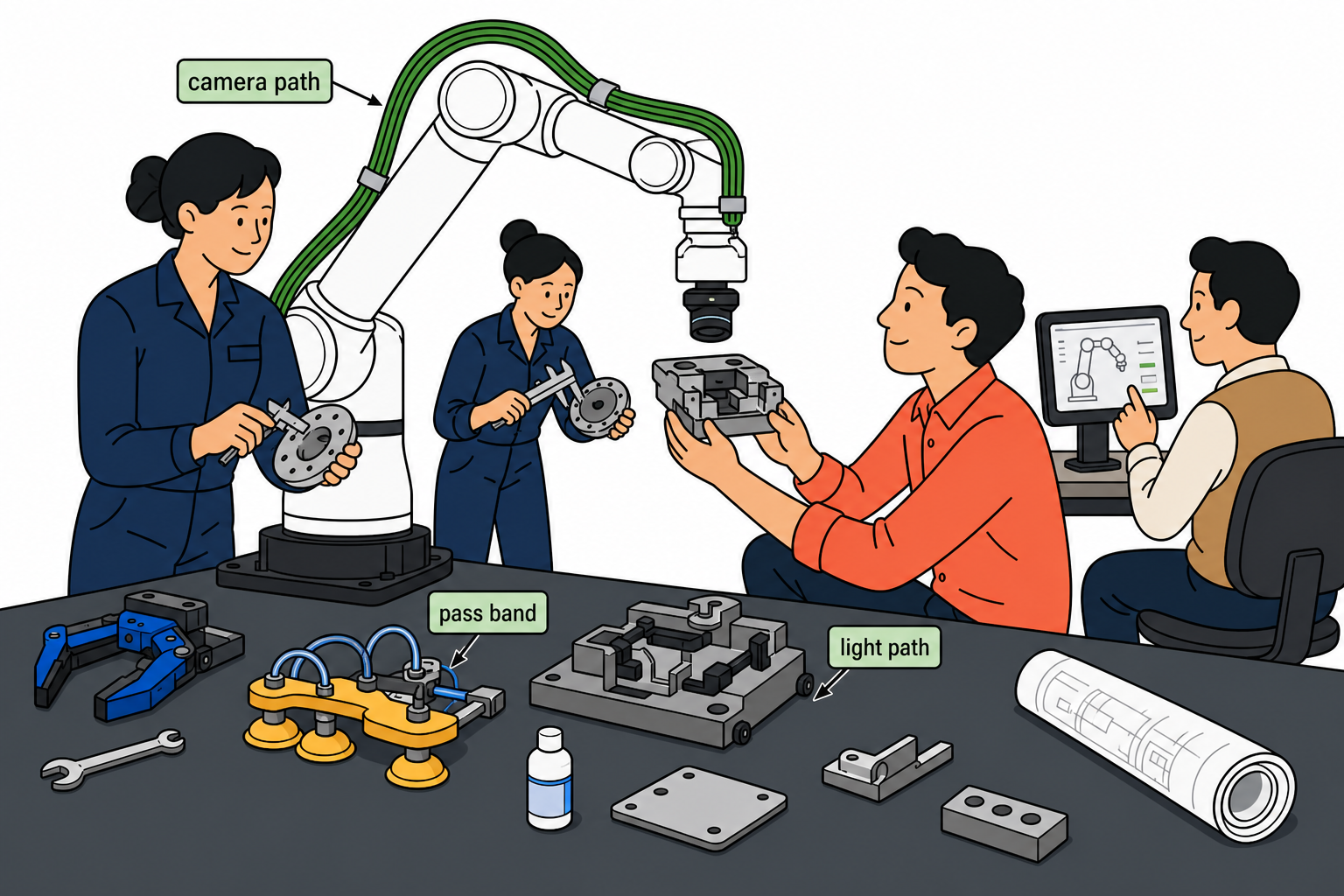
A typical cell stacks the arm, camera or scanner, lighting, part presentation (fixture / hard stop / slow conveyor), and an interface that writes results into MES or traceability. The arm’s job is repeatable sensor pose. Detection rate is usually decided by lighting geometry, exposure, thresholds, and whether known-good/bad samples cover edge defects.
UR’s quality narrative also frames cobots as positioning, tending, or camera-holding helpers while people can still own hard judgment calls—that is not the same claim as “replace every inspector.” Freeze one of three work-splits before you buy hardware:
| Split | Arm does | People still do | Fits when |
|---|---|---|---|
| Camera-in-hand patrol | Multi-face capture + decision | Changeover, exception review | High mix, multi-face, sampling fails |
| Part-to-fixed camera | Present part into a light box | Load/unload or clear exceptions | Light box stable, part graspable |
| Tend + upgrade sampling | Mostly tend; occasional full check | Hard calls stay manual | Prove presentation before vision |
Buying the “best 3D” into the wrong light path is how debug weeks erase half a brochure payback.
Manual sampling vs cobot full check
People still win at explanation: crack direction, “acceptable” color bands, feel-based gaps. Cobots win at repetition: same exposure, same thresholds, same mark logic across three shifts. The point is not to erase people—it is to move standardizable defects off humans and leave judgment calls with them.
| Dimension | Manual sampling reality | Cobot full-check reality |
|---|---|---|
| Coverage | Rate-based; nights often sample less | Per-part possible, limited by takt/presentation |
| Consistency | Shift, fatigue, training drift | After freeze, drift is mostly lamp/presentation |
| Traceability | Paper or sample logs | Easier to bind part/batch/timestamp |
| Year 0 | Low | Arm + vision + light + fixture + tune |
| Hidden cost | Escapes, complaints, re-check spikes | False fails, recipe ownership, retrain on changeover |
If finance only sees “save one inspector,” you often end up with a camera that still samples. Put escape penalties, recall-drill hours, and customer chargebacks on the same sheet—method in the ROI guide.
Full inspection vs sampling (when full check pays)
Sampling is statistically honest only when escapes are cheap, the process is stable, and defects are well defined. Recalls, customer penalties, safety-part traceability, or nights that cannot sample at all turn sampling into a bet.
| Signal | Leans cobot full inspection | Leans keep sampling / manual |
|---|---|---|
| Cost of a miss | Recall / penalty / safety part | Cheap to miss |
| Defect definition | Pixel / size / contrast thresholds | Verbal “looks wrong” |
| Shifts | Multi-shift or unreliable nights | Single shift, low volume, strong eyes |
| Presentation | Fixture or stop to mm–low-cm | Chaotic pose, no presentation budget |
| Takt | Inspection does not kill the line | Sub-second checks on a fixed face |
| False-fail tolerance | Secondary review lane exists | False fails would choke the line |
EVST’s vision inspection note is blunt: low volume, hard-to-standardize defects, and a single day shift often still favor manual. Do not stop the gain ledger at headcount.
One switch teams forget: a false-fail lane. Full check runs every part through the camera. If thresholds are tight and there is no review spur, “suspect” parts pile up and kill throughput. Full check without a review path can hurt capacity more than sampling.
Published evidence (separate the frames)
| Metric | Published band | Source |
|---|---|---|
| Full check + throughput | Powertrain cell cites ~+30% inspection throughput | EVST · 3D vision cell |
| Average payback (UR QI page) | About 195 days | UR Quality Inspection |
| Named case payback | About 4 months (arm) / 7 months (full app, three shifts) | UR · Comprehensive Logistics |
| Metrology vendor narrative | Inspection speed gains up to ~83% (that vendor’s product-line story) | UR Quality Inspection |
Read three frames, not one promise: EVST’s +30% is that published cell; UR’s 195 days is an application-page average; Comprehensive Logistics is one named plant. Fill your shifts, escape cost, and presentation maturity before you trust any of those day counts.
System stack: what each buy fails on
| Module | What you are buying | Common failure |
|---|---|---|
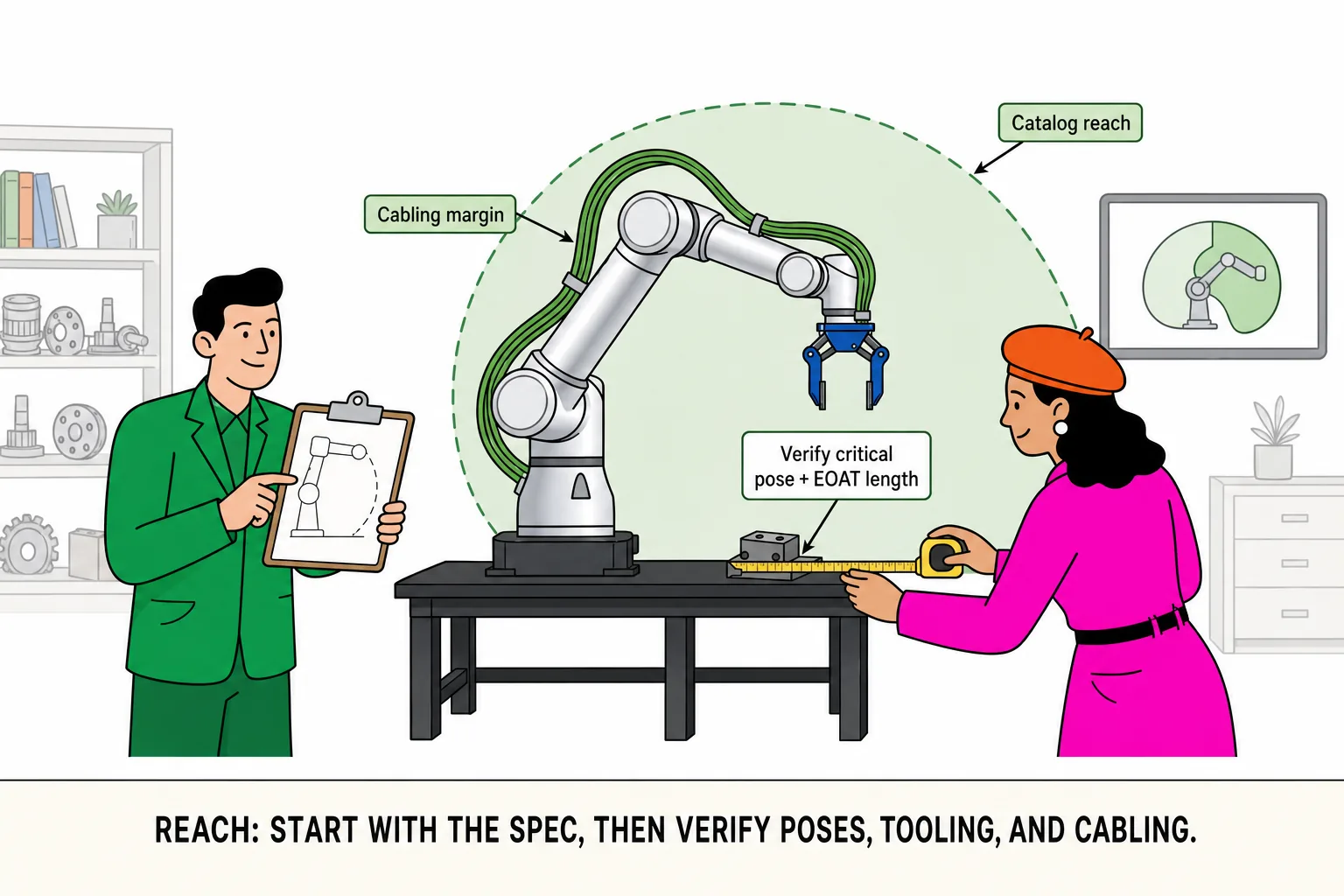
| Arm + controller | Repeatable pose, I/O, safety firmware | Payload debates with no reach margin to the check pose |
| Camera / lens / scanner | Resolution, depth of field, working distance | DoF too thin; changeover goes soft |
| Lighting | Side / coaxial / backlight geometry | Office lights treated as process lights |
| Presentation | Fixture, stop, slow conveyor, grip | Buy 3D first; parts still tumble on the belt |
| Recipe | Thresholds, ROI, mark logic | Demo parts only; no boundary bads |
| Traceability | Part/batch into MES | Photos that never enter the quality system |
| Safety + dress | Assessment, cable management, e-stop | Camera whip/cable snag never scoped |
Published cost bands often put vision near $3k–$6k (2D) to $8k–$20k+ (3D/bin-class)—see the Cost guide. The camera is one line; fixtures and tune weeks are often larger.
Defect thresholds, lighting, known-good/bad samples
Vision projects rarely fail because the arm cannot move. They fail because the defect dictionary never froze. Before PO, freeze at least: the defect dictionary (missing material, burr, color, dimensional out-of-spec), thresholds (pass/fail edges), and enough known-good/bad samples to cover boundary cases. Quoting a detection rate with no samples usually only delays acceptance into week one of production.
Known-good/bad is not “a few nice parts.” Cover standard good, borderline good, borderline bad, typical bad, and post-changeover pose. The two borderline classes decide whether you prefer false fails or misses—that is a quality-manager signature, not a vision engineer quietly twisting thresholds.
Lighting is not an accessory. Side light catches surface defects; coaxial light helps edges; backlight helps silhouette—changing the lamp changes the recipe. Accept camera pose and lighting together: if the same part passes on shift A and fails on shift B, check lamp and exposure drift before blaming force limiting. Lamp heat, dusty covers, and daylight through a window all change decisions when “the recipe did not change.”
Presentation and takt: fixture first, camera second
As with pick-and-place, presentation often decides success more than arm speed. Fixed nests suit vision-light pilots; hard stops suit conveyors; chaotic pose is when 2D/3D enters. Spend budget to present the part honestly before arguing 2D vs 3D—usually cheaper than two debug months the other way around.
Segment the beat into acceptance: approach, focus/exposure, capture, inference, mark/reject, return. Brochure “second-class inspection” often times only the capture slice. If inference queues on the IPC or the reject stroke is long, published “seconds” will not match line balance. Method: Cycle time.
False fail, miss, and the review lane
After go-live, quality and production will argue two numbers: misses and false fails. Agree before PO:
Misses: how you sample-audit, how many, who signs threshold changes
False fails: where the review spur sits, max WIP, timeout isolate vs release rules
Recipe change: whether lamp, lens, or fixture change triggers retrain and re-accept
Without those three, the vision cell becomes expensive electronic sampling—tight by day, loose by night.
When fixed AOI wins
Cobots fit multi-face checks, high mix, and people still loading or clearing exceptions. Fixed AOI / dedicated machines fit a single face, extreme takt, and a sealed light-controlled booth. If the line is already high-speed packaging or semiconductor-style fixed pose, forcing a cobot to hold a camera is often paying a flexibility tax for speed you will not get. Class split: Cobot or industrial.
Fenceless cell caveats
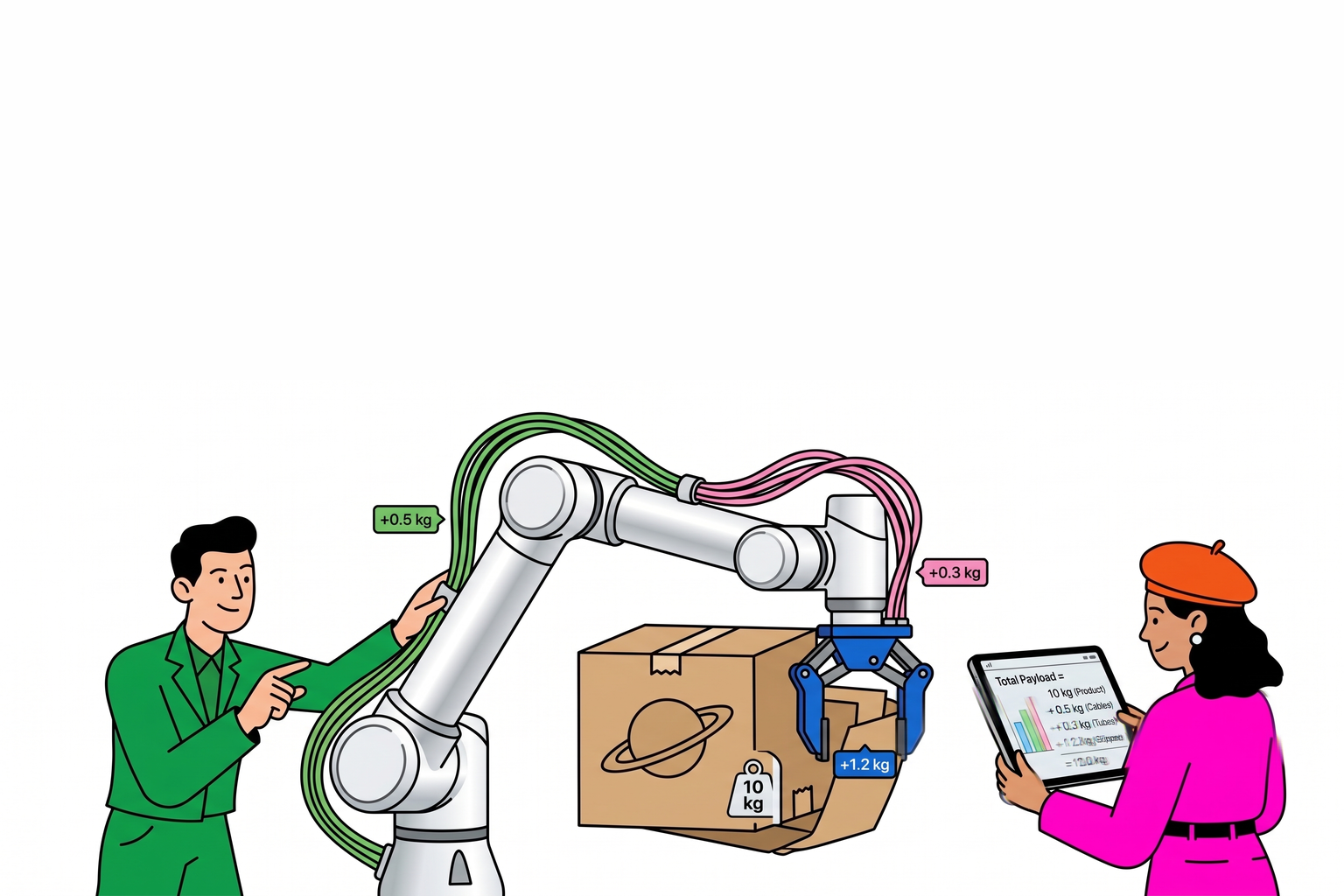
Moving cameras or parts still put grip force, drop zones, and cable snag risk into the assessment. “Collaborative” is not zero risk; cells beside people often reference ISO 10218 / ISO/TS 15066, with purchase scope in Safety & I/O. Subtract tool mass from rated payload—End-effector.
Cost and payback (worked sketch)
Year 0 usually includes arm and controller, camera/lens, lighting, fixtures, integration and recipe tune, traceability I/O, and risk work. Put avoided escapes, re-check hours, and night-shift quality drift on the gain side—not only headcount.
Sketch only (replace with your numbers): Year 0 vision cell ~$70k (arm + 2D + light + fixture + integration); annual escape-related cost (penalties + re-check + complaints) ~$90k, of which full check might avoid ~60% → ~$54k/yr, nominal payback ~16 months. Add ~$30k/yr of night-shift sampling drift and the payback moves forward. Published cases can land in a few months when defects standardize and presentation is frozen; otherwise debug weeks eat the brochure payback.
Pilot order (put it in the SOW)
Freeze defect dictionary, threshold policy, and miss-vs-false-fail priority (quality manager signs)
Gather known-good/bad set including borderlines; define top-up rules after changeover
Lock presentation and lighting geometry; run nests/stops before chaotic pose
Run boundary parts; log false fail/miss; tune thresholds before buying a dearer camera
Connect traceability and the review lane; then raise full-inspection share
Changeover drill: re-accept checklist after fixture/lamp swaps
Skipping 1–3 and buying 3D first is the expensive path most plants take once.
r-Series and pilot tools
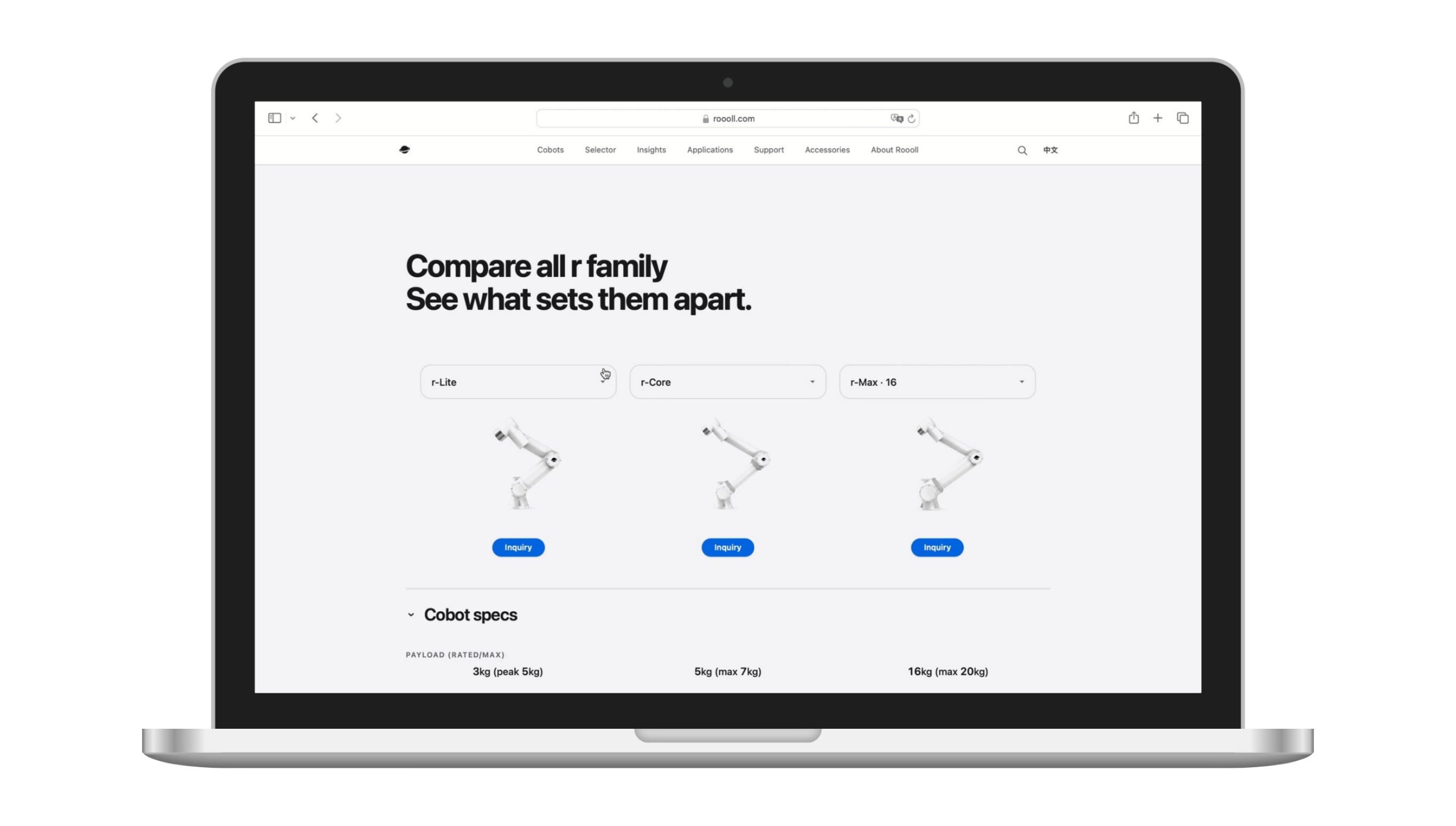
Light cameras and short travel often shortlist r-Lite / r-Core; multi-face or far corners bring longer reach into Comparison. Fuzzy scenes: Product Advisor. When you need to see whether the arm and light path fit the station, AR preview beats brochure reach alone. Line context: Manufacturing applications.