Quick answer
Name the bet, not the brand: shared workspace, takt pressure, changeover frequency, and real worst-case TCP usually split the class
Full-cell bands: published SMB comparisons often cite cobot cells ~$40k–$120k vs industrial ~$100k–$300k+ (integration and guarding included—not arm price alone)
Footprint and deploy: often ~20–40 sq ft vs ~60–120 sq ft; deployment often ~2–8 weeks vs ~8–20 weeks
Payback bands: cobots often ~10–18 months, industrial often ~16–30 months under the same labor-save assumption—verify on your ledger
Fast split: people beside the cell + high mix → cobot; unmanned + extreme takt/heavy load → industrial or dedicated machine
In procurement, someone plays an industrial video—fast takt, heavy payload. Someone else pushes a cobot—small footprint, operator nearby. Both can be right for different lines. The practical move is to name two different bets, split with floor questions, then sanity-check full-cell math—not arm list price alone.
Published evidence bands (cobot vs industrial)
| Metric | Cobot (as published) | Industrial (as published) | Source |
|---|---|---|---|
| Full cell cost | About $40k–$120k | About $100k–$300k+ | Robotomated SMB comparison |
| Typical payload | About 3–16 kg (common band) | About 5–2,300 kg | Robotomated SMB comparison |
| Footprint | About 20–40 sq ft | About 60–120 sq ft (with guarding) | Robotomated SMB comparison |
| Deployment time | About 2–8 weeks | About 8–20 weeks | Robotomated SMB comparison |
| Typical payback | About 10–18 months | About 16–30 months | Robotomated SMB comparison |
| Guarding add-on (industrial side) | Risk assessment may allow fenceless | Often $10k–$30k fencing/light curtains | Robotomated SMB comparison |
Read bands as buyer-guide sanity checks—not quote commitments. High speed, heavy TCP, or sharp tooling can force guarding on cobot cells too and narrow the gap. Size on your takt, payload, and floor plan.
Question one: do people work in the same station?
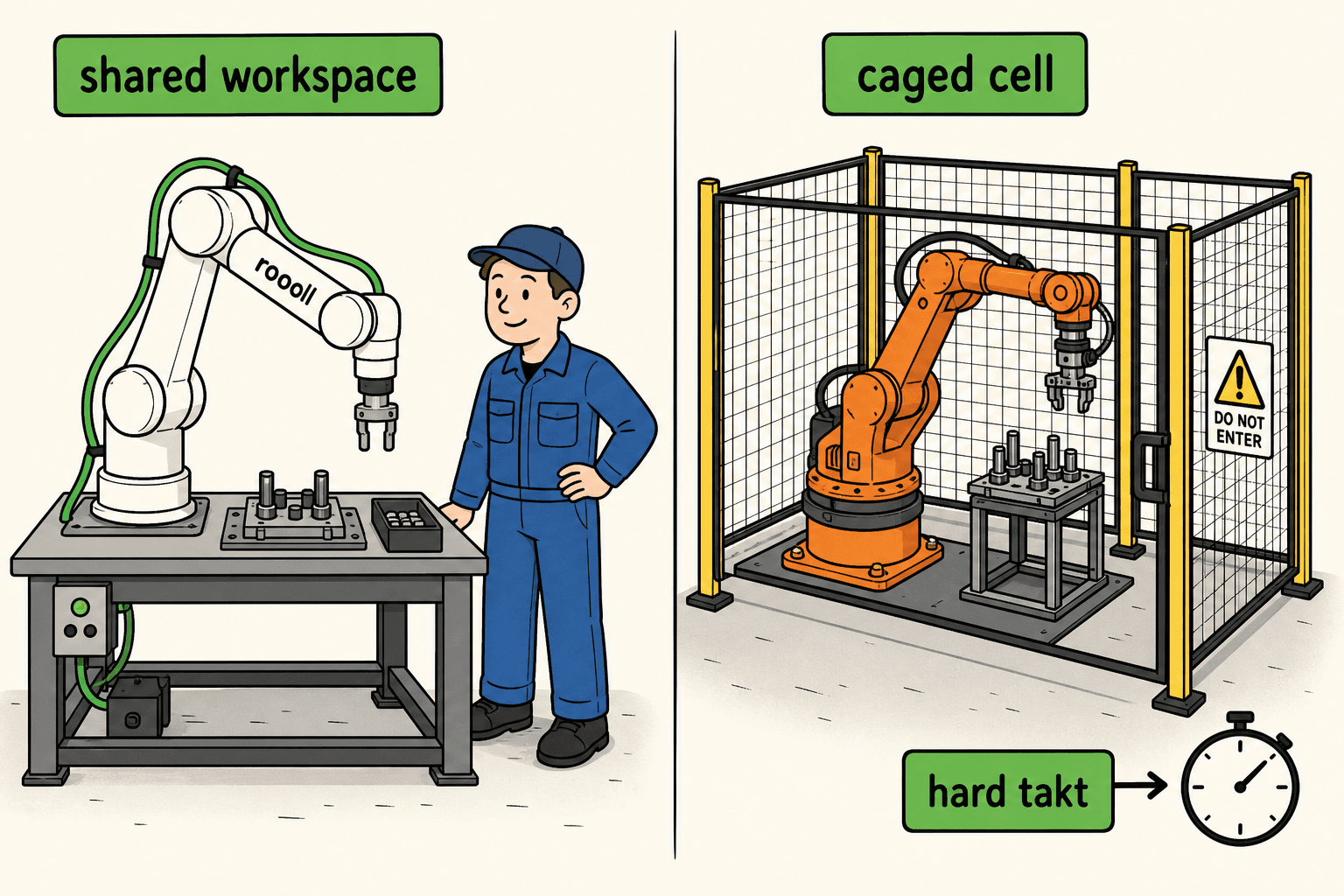
Collaborative arms assume a shared workspace—loading, alignment, inspection, and exceptions beside the arm, not outside a cage. Traditional industrial arms usually sit in a guarded cell. Every human entry stops or slows the cycle.
| Your floor | Often leans toward |
|---|---|
| People load, tend, or inspect beside the arm | Cobot → What is a collaborative robot (cobot)? |
| People can leave for fully unmanned runs | Caged industrial arm |
| “Unmanned on paper, people every peak shift” | Size for the worst shift |
Collaborative does not skip safety → Safety & I/O guide (often referenced against ISO 10218 / ISO/TS 15066). Class choice still needs each vendor’s published datasheet. Compare r-Series rows → Side-by-Side Comparison
Question two: how hard is takt?
Published comparisons often cite cobots around 0.5–2.0 m/s vs industrial 2–10 m/s—but stable cycle time still splits the classes:
Cobots: moderate repeatable loops—seconds to low teens, with a person for exceptions
Industrial: when takt sits in the 1–3 s range, three shifts, little room to wait on people, dedicated automation often wins
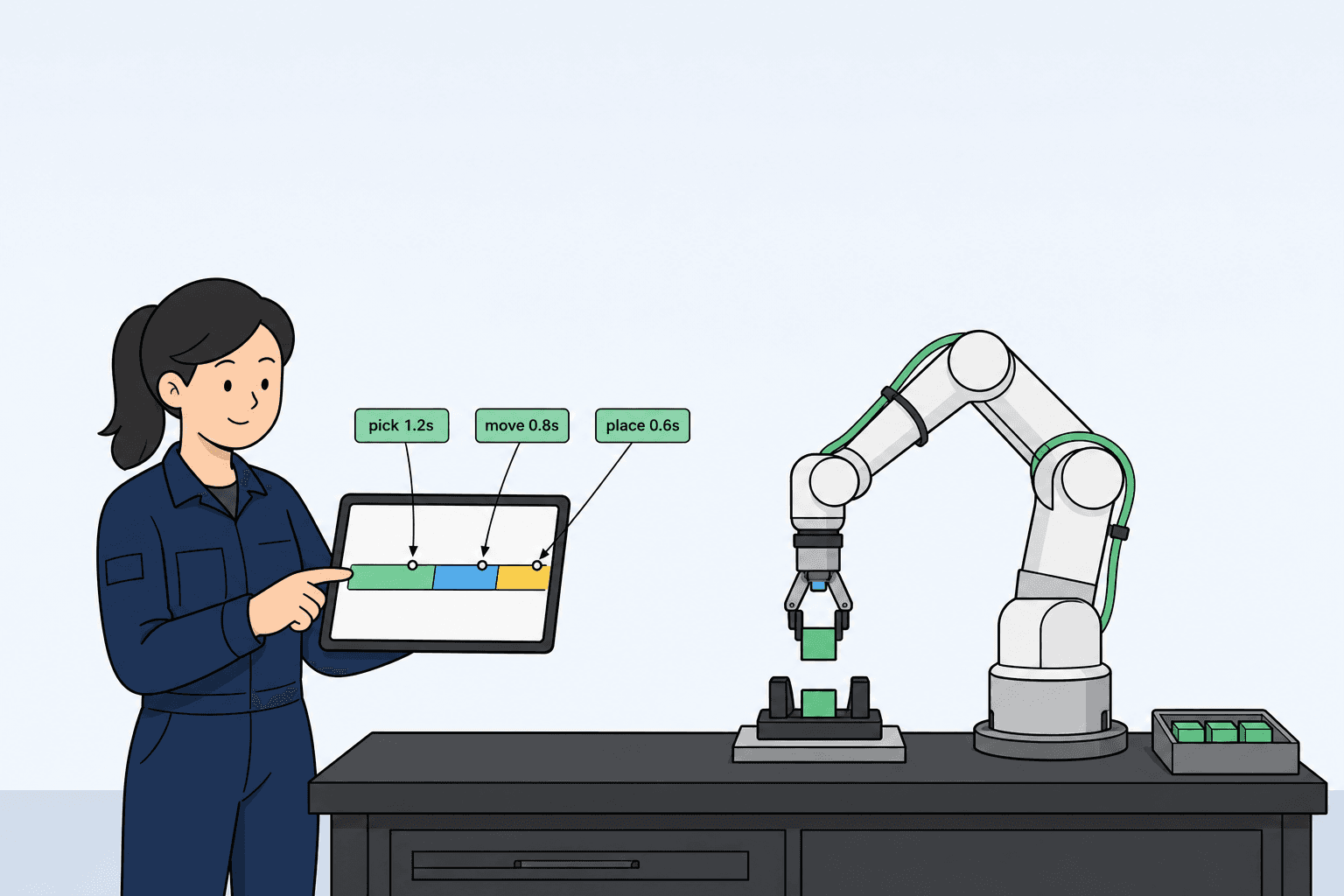
Break the beat into segments → Cycle time guide. “Wait for the CNC door” or “wait for vision OK” will not be fixed by a bigger arm.
Question three: how often do SKUs change?
Many SKUs, small batches, frequent program edits → cobot retool often minutes to hours (teach/drag)
One SKU for years, takt maxed → dedicated industrial line may pencil better
Question four: are payload and reach real?
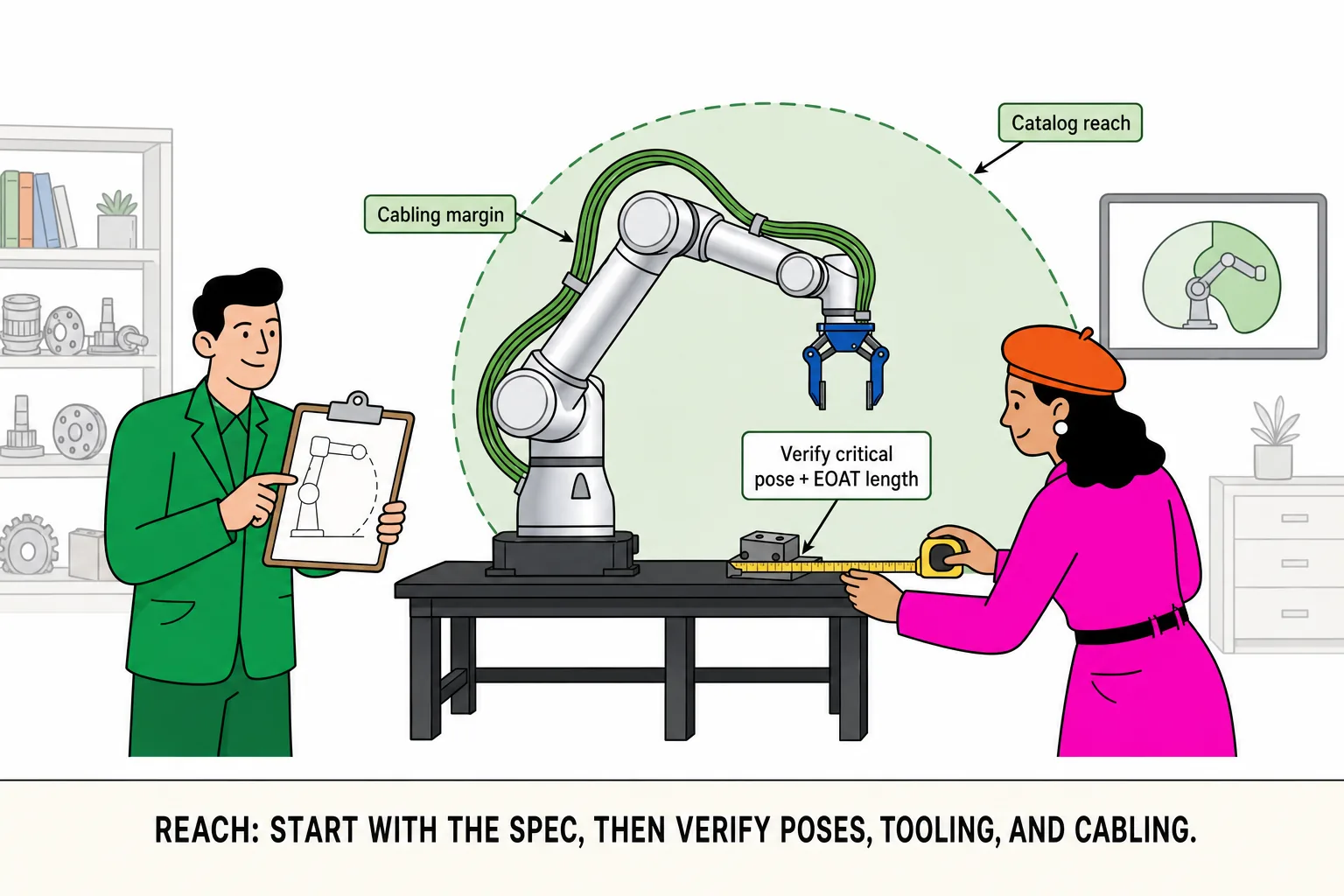
Both classes need worst-case TCP on rated payload. Published cobot sweet spots often sit around ≤~20 kg—still verify weigh and pose → Payload guide · Reach guide · Workcell layout guide · End-effector guide
Full-cell TCO: why “industrial looks more serious” still mis-bets
KUKA’s cobot vs robot knowledge page and integrator buyer guides stress model the cell, not the arm—industrial guarding and floor perimeter raise TCO; cobot cells that need speed, heavy parts, or sharp tools may need added guarding too. We often see: industrial chosen, but three manual changeovers a day eat the takt win—or cobot chosen to skip guarding when takt is four seconds and there is no room for a person. Wrong class is usually a wrong bet—not the wrong brand.
Quick split
| Signal | Often start with |
|---|---|
| Shared station, many changeovers, reversible pilot | Cobot (r-Lite / r-Core / r-Reach) |
| Unmanned, extreme takt, heavy continuous run | Industrial arm or dedicated machine |
| Payload/reach at cobot rated edge | Side-by-Side Comparison for r-Max / r-Ultra |
| Task not defined yet | Task readiness guide |
Footprint: True-scale AR; fuzzy scene: Product Advisor.