Quick answer
“When do we ship?” means signed acceptance—not the first jog after power-up—EOAT, fixtures, PLC, and run-off lock the calendar
Plan by complexity: standardized simple cells often ~6–10 weeks; engineered (custom EOAT / one machine interface) ~10–16; vision, multi-interface, or heavy validation ~16–20+ (published deployment bands)
Hours–1 day after delivery only covers a skilled team’s simple pick-place first path—no PLC, no worst-part acceptance
Published cobot vs industrial cell bands often sit near ~2–8 weeks vs ~8–20 weeks—fences, dedicated tooling, and unfinished parallel work still dominate
Send stage-0 fields once (payload, takt, layout, PLC, environment, production window) and write acceptance into the SOW before you try to compress weeks
Integrators say the arm is the fastest line to ship. That is a freight sentence, not a project sentence: the arm can arrive while the gripper is unordered, the bench undrilled, and the door interlock still missing from the PLC. Buyer deployment guides such as Ocean Player’s five-phase timeline keep repeating the same point: you are scheduling application acceptance, not bolt-down days. The stages below turn that into a quote-to-production checklist—use it as an inquiry pack or a pre-PO alignment agenda.
Published evidence (weeks and cost-side context)
| Metric | Published band | Source / how to use |
|---|---|---|
| Simple / standardized task | About 6–10 weeks | Ocean Player deployment timeline |
| Engineered cell (custom EOAT / one machine interface) | About 10–16 weeks | Same |
| Complex (vision, multi-interface, heavy validation) | About 16–20+ weeks | Same |
| Cobot vs industrial full cell | About 2–8 vs 8–20 weeks | Robotomated · cobot vs industrial |
| CNC tending / palletizing (manufacturing cobot) | About 6–10 weeks order of magnitude post-PO | Robotomated deployment guide; fixtures and door signals still swing it |
| Welding-class path processes | About 8–14 weeks order of magnitude | Same; path programs and fixtures stretch tune |
| Plant-manager PO→production (straightforward) | About 8–12 weeks; custom fixtures 12–20 | KGT plant-manager guide |
| Integration share of project cash | About 30–50% | AMD Machines · TCO |
| Simple full-cell cost band | About $45k–$75k | Robotomated cost guide; line items in the Cost guide |
Read the table with two caveats: first jog ≠ signed production, and published weeks are planning bands—supplier lead time, downtime windows, and scope changes slide the whole strip. Ocean Player-style notes also imply a ~10–20% contingency habit on first deployments; writing “four-week freight” as “four-week production” is how calendars lie.
First split: which calendar did you buy?
One inquiry email usually stacks three clocks:
Arm and catalog logistics — the lead-time row on the quote
Cell readiness — whether fixtures, EOAT, cable ways, door interlocks, and risk assessment run in parallel with the arm
Acceptance clock — worst-part loops, takt and quality sign-off, training and rollback named
Compress clock 1 while ignoring 2 and 3 and the project looks “fast on freight” while the floor waits on holes, grippers, and PLC. How money should land in the SOW: ROI guide and Hidden cost of integration.
Pick a complexity band (for the capex meeting)
| Complexity | Rough planning band | Typical shape | Calendar usually sticks on |
|---|---|---|---|
| Simple / standardized | 6–10 weeks | One task, stable nests, little or no vision, few interfaces | Incomplete stage-0 fields → extra quote loops |
| Engineered | 10–16 weeks | Custom EOAT, one machine door/I/O, formal run-off | EOAT lead time and PLC work not parallel |
| Complex | 16–20+ weeks | Vision/multi-sensor, multi-machine or MES, heavy validation and training | Scope still changing after design freeze |
“Hours to jog after delivery” is only a stage-3 slice of the simple path—do not paste it across the table. If the task itself is still unproven, run Task readiness before you burn weeks on the wrong station.
By application (same complexity band, different skew)
| Application | Published-order band | What stretches it |
|---|---|---|
| Simple pick-place / light pack | Toward the 6–10 week band | Whether stops are tight; whether vision can wait → Pick-and-place guide |
| CNC tending | About 6–10 weeks (common manufacturing-cobot notes) | Auto-door, blow-off, dual-grip mass, chips/coolant → CNC guide; dual machine → One cobot, two CNCs |
| End-of-line palletizing | About 6–10 weeks order of magnitude | Patterns, pallet in/out, vacuum mass vs payload → Palletizing guide |
| Welding-assist / path processes | About 8–14 weeks order of magnitude | Path programs, fixtures, fume and safety zoning → Welding assist |
When the application is still fuzzy, narrow the arm with Product Advisor or Comparison before freezing EOAT lead times—reverse that order and stage 2 waits empty-handed.
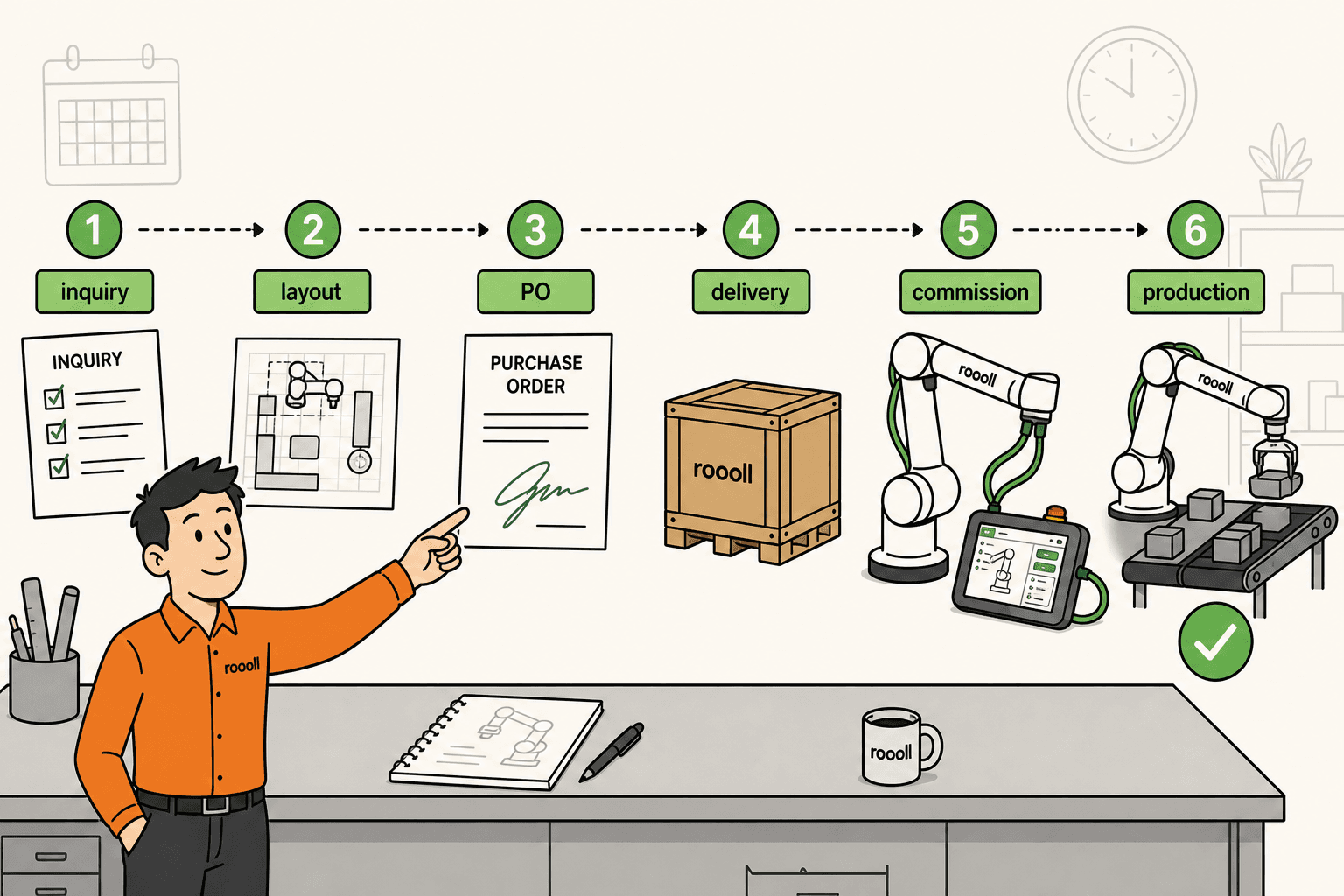
Six stages: inquiry to stable production
Map assessment → selection → integration → validation → launch into six buyer-executable stages. Each stage ends on a gate—do not pretend the next stage started if the gate is open.
Stage 0 — Inquiry alignment (~day 0–7, can overlap assessment)
Send once (what Contact us and the RFQ checklist want most):
| Field | Why now |
|---|---|
| Part photos / weight / infeed | → End-effector guide |
| Worst-case TCP load | → Payload guide |
| Top-view sketch or station video | → Workcell layout; footprint fuzzy → AR |
| Target cycle time (s/piece) | → Cycle time guide |
| PLC brand / protocol | → Safety & I/O guide |
| Environment (dust, fluid, clean) | IP and dress → IP guide |
| Target production window / downtime days | Drives freight and tune windows |
Gate: 2–3 candidates plus Comparison/Advisor links in hand; do not force a hard date from the integrator while fields are missing.
Stage 1 — Proposal and quote (~1–3 weeks)
One SOW for above-waterline (arm, cabinet/integrated control, pendant) and below (EOAT lead time, fixtures, I/O, e-stop topology, risk-assessment scope, acceptance: takt, yield, run hours). Payback assumptions in parallel → ROI guide.
Gate: acceptance language says “worst-part N loops” or “empty-air demo”—those two dates differ by weeks.
Stage 2 — PO and delivery (~3–8 weeks, lead-time dependent)
While the arm ships, run in parallel: bench holes, EOAT/fixture POs, PLC skeleton, named trainees, accessory boundary (vision/changer this phase or not) → Accessories checklist. Classic failure: arm on the dock, holes undrilled, gripper still TBD.
Gate: mechanical and electrical prep lists checked before arrival week; track milestones in RooollTrack.
Stage 3 — Mount and power-up (~1–5 days)
Base, dress, tool, TCP, first jog. Skilled teams often land a simple pick-place first path in hours to one day—empty or ideal infeed, not production. How to structure the day: Demo Day.
Gate: safety loop and baseline I/O live; still forbid quoting capacity from empty-air takt.
Stage 4 — Integration tune (~1–4 weeks, widest spread)
Real parts, real takt, real handshakes: fixture trim, door/clamp interlocks, safety speeds, average and slowest loops logged. Vision in scope often consumes a full strip of calendar. Failure patterns: Selection mistakes.
Gate: worst-part continuous run clears; drop and protective-stop drills done.
Stage 5 — Run-off and handover (~3–10 days)
SOPs, spares, owner after the integrator leaves, rollback to manual if the pilot fails. Plant-manager notes often keep about 1–2 weeks of supervised parallel running—put it in the plan, not in the slogan.
Gate: signed acceptance plus a named rollback owner.
Stage 6 — Stable production (30–90 days after go-live)
Cup/gripper PM, path tweaks, changeover recipes archived, spares response → Care. Task fit shows here, not in the empty-air demo.
Why calendars slip—and how to compress without cheating
The usual failure is not “freight lied.” It is SKU or people-zoning changes after design freeze, arm and gripper ordered in series, verbal acceptance, downtime and tune fighting for the same week, and vision pulled into phase one when fixtures could wait. Compression is boring on purpose: complete stage 0 once; one SOW above and below waterline; parallel-order EOAT/fixtures with the arm; write worst-part acceptance; park non-essential vision as excluded or TBD-capped.
Cobot vs industrial: do not only compare “who bolts down faster”
Published comparisons often land cobot deploy near ~2–8 weeks and industrial near ~8–20 weeks, mostly because of fencing civil work, dedicated tooling, and heavier safety engineering—not because one flange spins on faster. Whether collaborative class belongs at all: Cobot or industrial arm. First-cell cadence for SMEs: First cobot for small manufacturers.
Where Roooll sits on this chain
We make arm specs and supply predictable; fixtures, PLC, on-site integration, and acceptance stay project scope. Send payload, reach, takt, flange context, and the production window once so week two is not a surprise party. After PO, watch stage gates in RooollTrack—not only the tracking number.