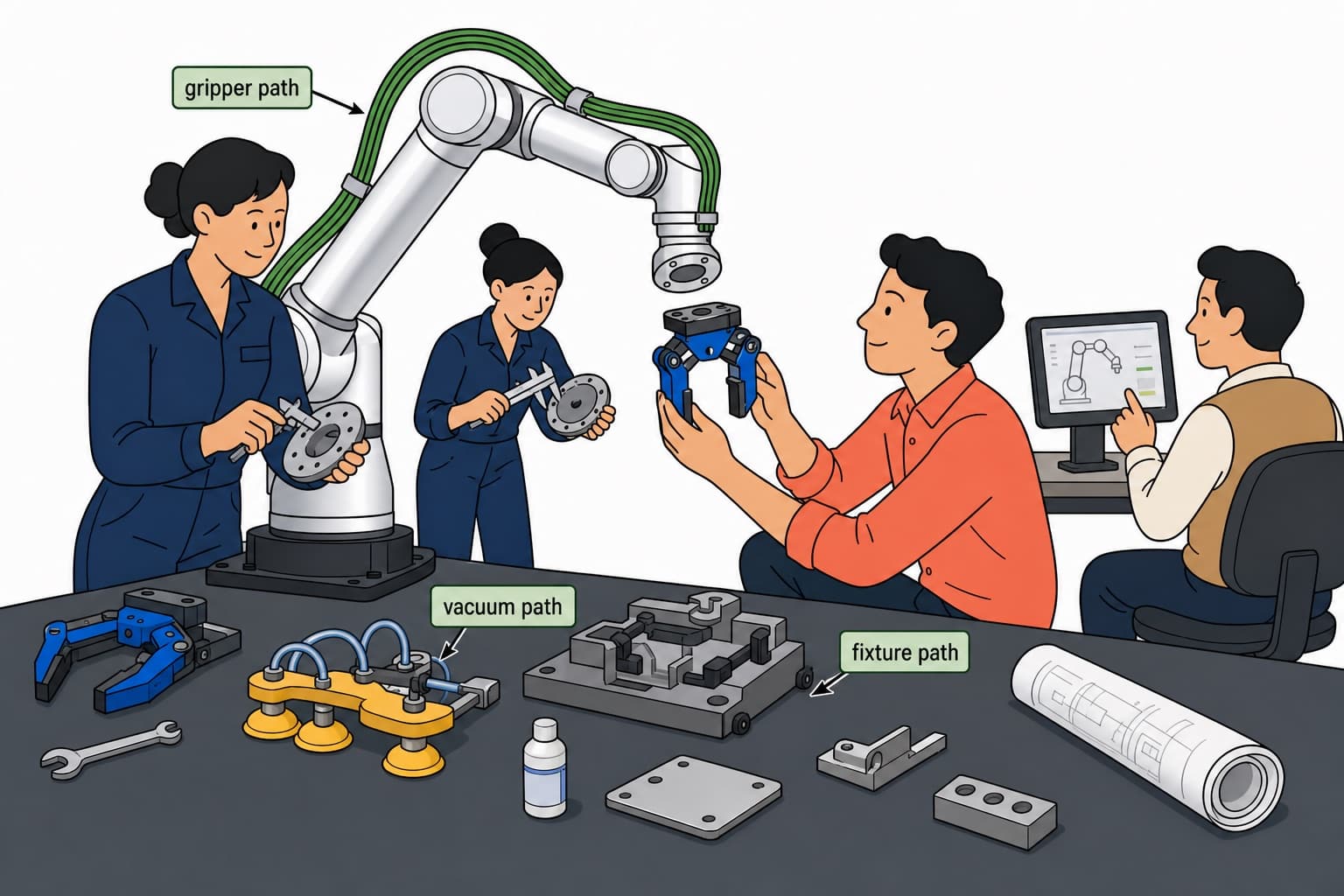
Many teams treat demo day as “go see if the arm is impressive.” What they get: empty grips, master-block picks, flattering light, nods in the meeting room—then their own incoming parts will not hold a cycle. The failure is rarely the demo itself. It is allowing the demo to answer a question that was too easy.
Evidence: why demo day needs worst-case parts
| Cost item | Published range / what it implies | Source |
|---|---|---|
| Robot hardware (system hardware) | ~25–40% | AMD Machines |
| Integration engineering | ~30–50% | AMD Machines |
| EOAT (end-of-arm tooling) | $2k–$40k+ | Robolist TCO model |
| Integration engineering (scale) | $8k–$60k | Robolist TCO model |
Lock the purpose before you walk in
Demo day is not about liking the arm. It is about whether this arm clears your constraints. Bring at least three things:
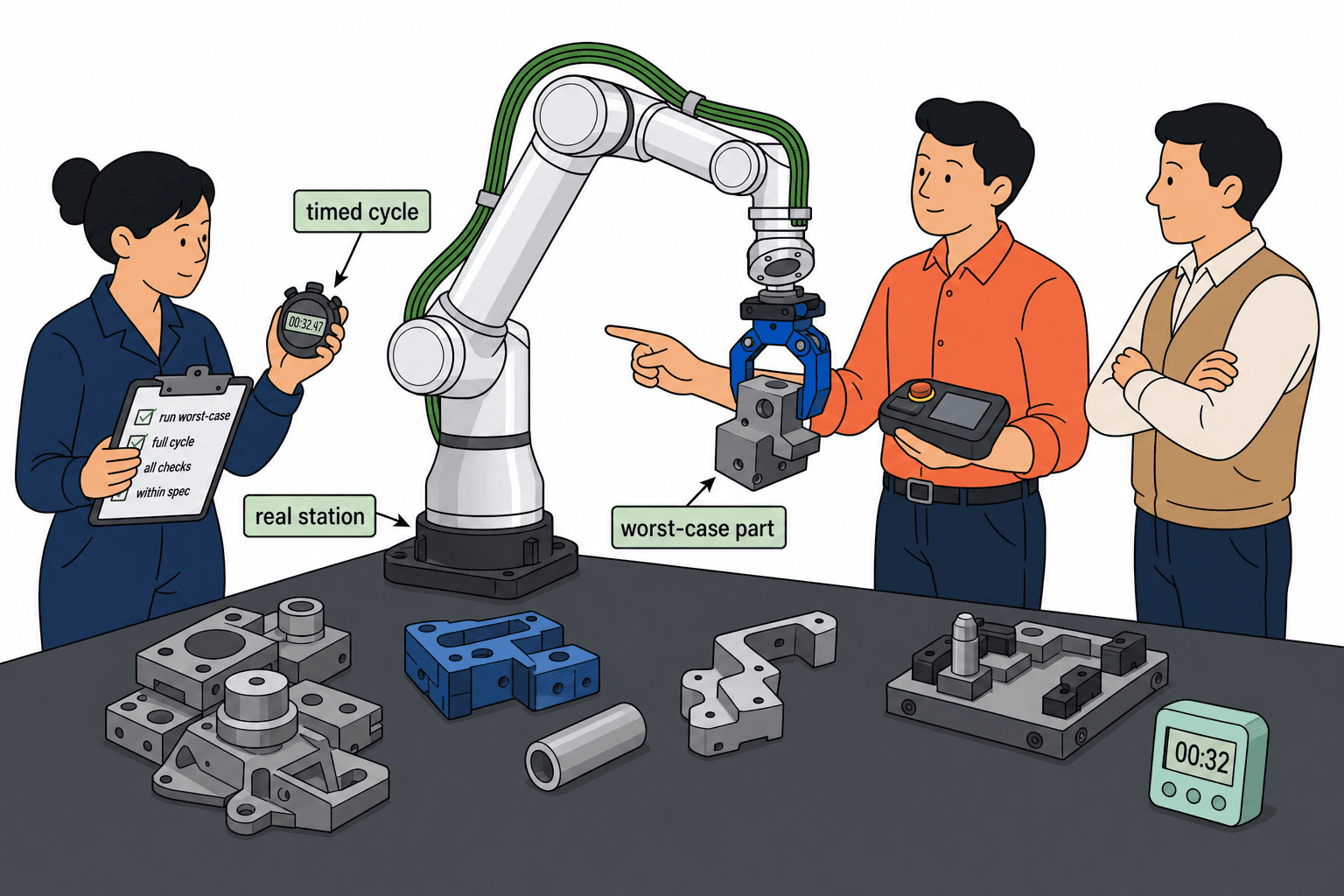
Worst-case parts — burrs, warp, tolerance edges; not only pretty samples
A takt target — spoken or written, but a number
Who may say “fail” — without a floor owner, applause decides for you
Before you start: what you will not compare
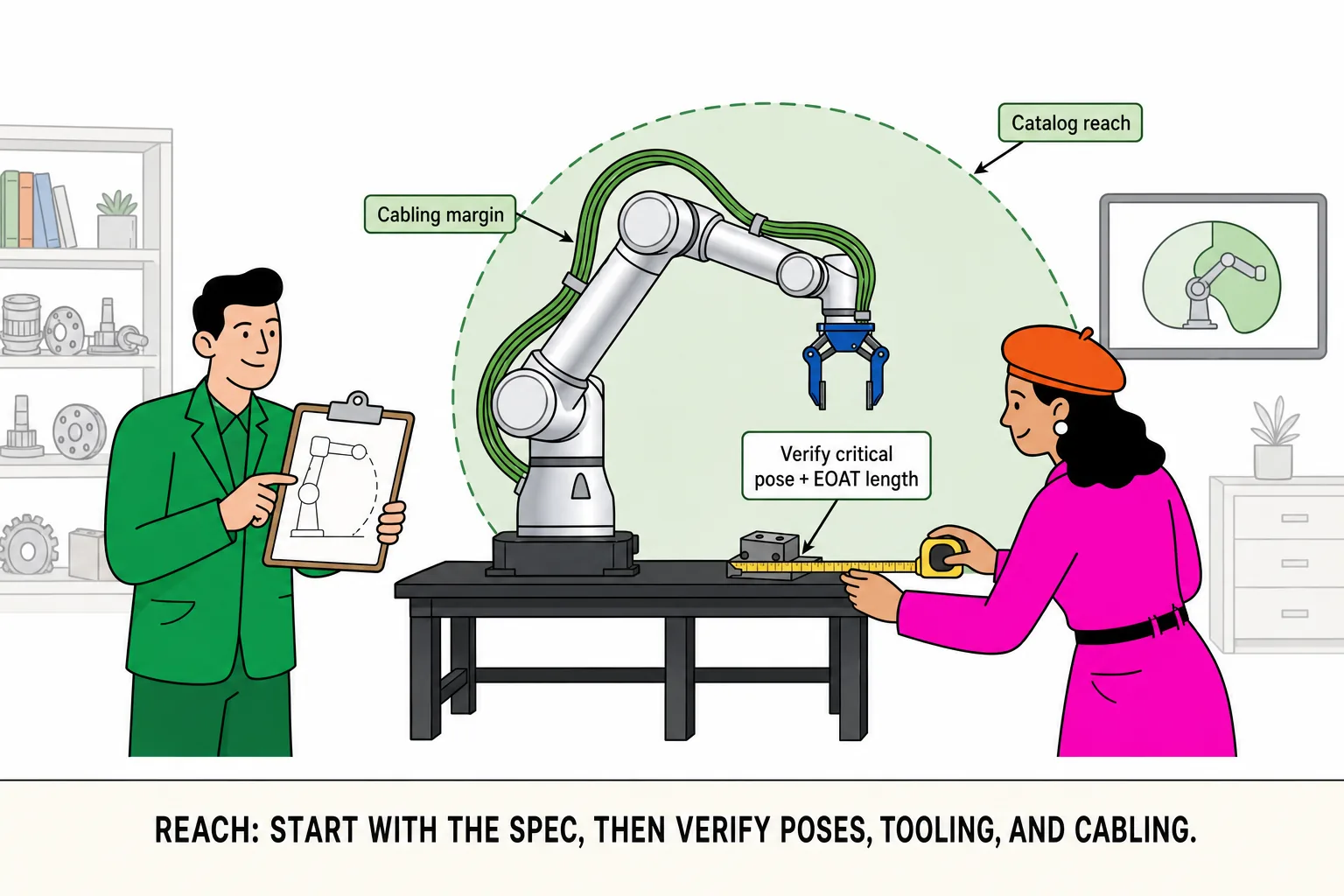
Not brochure peak speed. Not empty-air flourish paths. Not protections turned off for the camera. Compare whether your parts stay gripped; whether a timed loop meets takt; whether the key pose reaches; whether protective stops become daily life if people share the station.
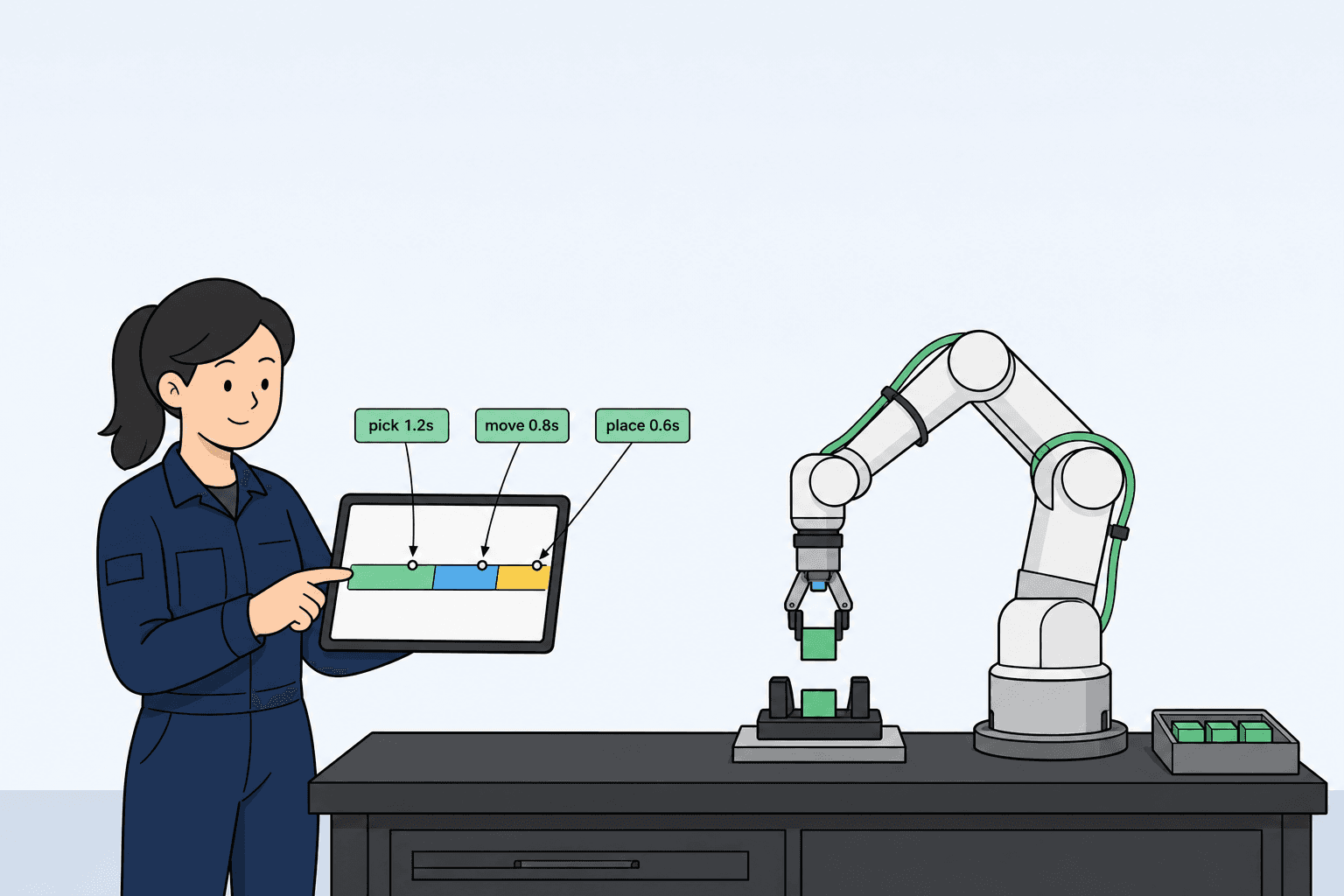
If payload and reach were never rough-checked on paper, the demo becomes a make-up class → Payload · Reach. How to break a cycle into pick, move, place, gripper, and waits → Cycle time.
How to run the floor
Use a stopwatch, not a vibe. Run the same worst part enough times; one lucky pick is not a pass. If changeover will happen in production, do the shortest real changeover on site—do not accept “it will be fast later.”
An empty-grip demo from sales or applications can take thirty seconds for intuition; the signature must come from your parts. If they will only run master blocks, you are allowed to write “demo did not cover worst case.” That is not hostility. It protects next year’s budget meeting.
If cobot versus industrial is still open, do not pretend the demo settled it → Cobot or industrial robot arm. If you worry the catalog hero is solving a dirty job → Why factories buy the wrong robot.
Leave with one of three outcomes
Pass — enter quoting with measured numbers
Change — name whether gripper, fixture, vision, or takt definition is missing for the next round
Stop — task or constraints are not ready; go back to task readiness
The dangerous fourth is “felt good, let’s keep looking.” It sounds gentle and freezes a soft impression while delaying the decision forever.
Demo day runbook: from “showable” to “verifiable”
Align the rule first (10 minutes)
Post the worst-part list on the station (burrs, warp, tolerance edges)
Write the takt target as a number and state your cycle decomposition (pick/move/place/gripper/waits/interlocks)
Name the owner who can say pass/fail—without an owner, applause decides
Validate loops (1–3 hours on the floor)
Warm-up is not a pass: empty-air/ideal parts only check envelopes and your timing chain
Run the same critical loop on worst parts: if you see drops, protective stops, or upstream waits, log the gap immediately
If production will changeover: run the shortest real changeover on site, not “we will do it fast later”
Produce decisions (15 minutes before leaving)
Pass: enter quoting with measured numbers
Change: state what is missing—EOAT, fixture, vision, or takt definition
Stop: constraints are not ready; go back to task readiness
One-page pass rule (paste into acceptance)
| Acceptance check | Pass standard | Evidence you should deliver |
|---|---|---|
| Worst-part coverage of critical poses | No drops and no repeat protective stops on the critical pose | Worst SKU list + video/stopwatch |
| Worst loop meets takt | Segment sums do not exceed takt (including waits/interlocks) | Segment timing table or time-coded video |
| EOAT/TCP and I/O are landed | EOAT does not blow through TCP; I/O and e-stop interlocks work | I/O list, e-stop topology, key interlock proof |