Quick answer
Definition: a cobot tends an injection press in the mold-open window and often runs degate, drill, or tray pack in the same plasticize/cool window
Vs sprue picker: pickers win fixed-path fast extract; cobots win changeover, pose variety, and secondary ops in one cycle
Named public case: UR · Midgard cites ~1500 run-hours payback (~3 months continuous), ~30% lower part cost, scrap near zero—that plant’s published story, not your guarantee
When gantry / industrial extract wins: ultra-short cycles, very high mass, or multi-press lines that need a truss
Read with: CNC handshake logic in CNC tending · Dual CNC
Molding shops often say “we already have a picker.” Cobot tending is not a race to yank a sprue faster. It wins when changeovers move every week, secondary ops still sit on people, and presses idle waiting for a door. Put those three lines in the brief before arguing brands.
What cobot IMM tending is
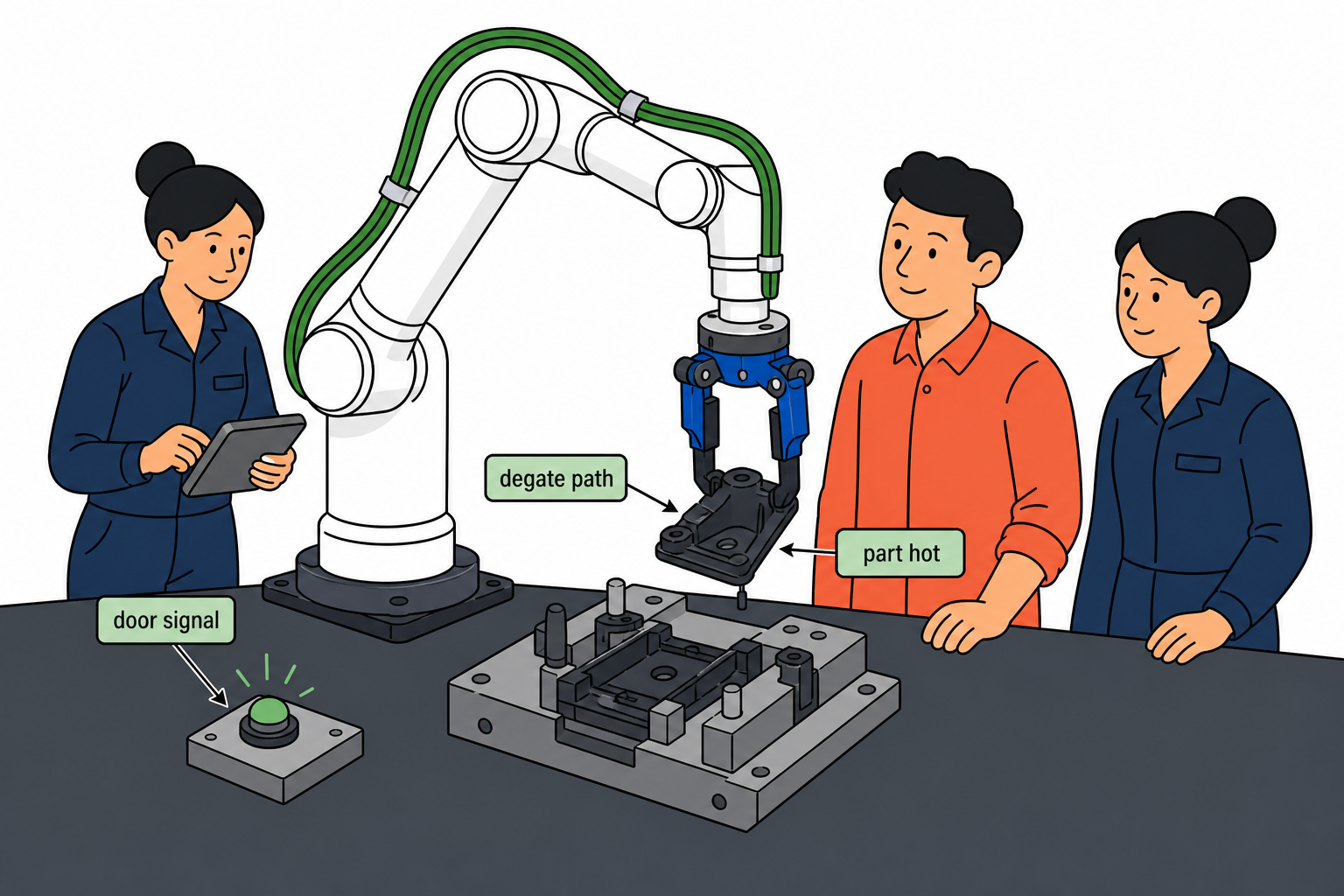
A typical loop: wait for enter-ok → enter the mold area to extract or place an insert → exit and close / allow clamp → degate, cool-nest, or pack beside the press. The arm may sit on the floor beside the press or, as in Midgard’s narrative, above the press—layout follows door swing, hot runners, and walkways, not brochure art.
It shares CNC tending’s “machine allows → arm enters → clear → machine continues” skeleton. It differs on hot parts, gate geometry, plasticize windows, and whether secondary work fits the same cycle. CNC guides spindle utilization; this page covers mold-open windows and secondary saturation—read them together instead of copying a published payback day count.
Press signals: door and Euromap-class handshake (intent, not a brand lock)
Safety and takt both hang on who is allowed to move. High-level intents (names vary by press brand; this is not a trademarked protocol claim):
| Intent | Arm needs | Failure mode |
|---|---|---|
| Enter mold OK | Mold-open / mold-open-complete class signal | Enter on a timer only |
| Clamp OK | Arm outside and gripper clear | Clamp with a dropped part in the mold |
| E-stop | Interlocked with press safety circuit | Stop the arm only; pumps/heaters keep running |
| Auto door | Door open before enter; arm clear before close | Door stroke vs TCP never checked |
Wiring, safety rating, and purchase scope live in Safety & I/O. Euromap-style robot interfaces on European presses are best read as an intent checklist—not “buy this card and skip assessment.”
Signal acceptance should at least: correlate mold-open-complete vs enter-ok on a log or scope; prove clamp stays locked on a simulated drop; confirm e-stop stops pumps/heaters with the arm. Without those three, demos run on timers and production runs on luck.
In-cycle secondary ops: where payback actually accelerates
Extract-only cobots rarely beat a dedicated picker. Degate, trim, drill, slide assist, and tray pack in the same cycle keep the arm busy. Midgard’s UR story puts a UR10e (often narrated today as UR12e-class) above the press for auto extract plus secondary work; the published quote is ~1500 run-hours payback (~3 months continuous), ~30% part-cost cut, and roughly “half the people, twice the business”—all as that plant/publisher story.
Write secondary ops into the SOW as an acceptance list, not “trim if we have time”:
| Secondary | Belongs in-cycle when | Common failure |
|---|---|---|
| Degate / trim | Gate geometry stable, tool life measurable | Gate drift into gripper |
| Drill / tap assist | Hole tolerance and grip stiffness hold | Soft hot part, hole wander |
| Tray / pack | Nest repeatable | Shrink after cool, parts won’t seat |
| Insert place | Insert feed reliable, anti-drop | Crooked insert still clamps |
Long plasticize windows make secondary work “free.” Short plasticize turns secondary into the takt killer—cut scope or move to a faster dedicated tool instead of stuffing the path.
Hot parts, gates, EOAT
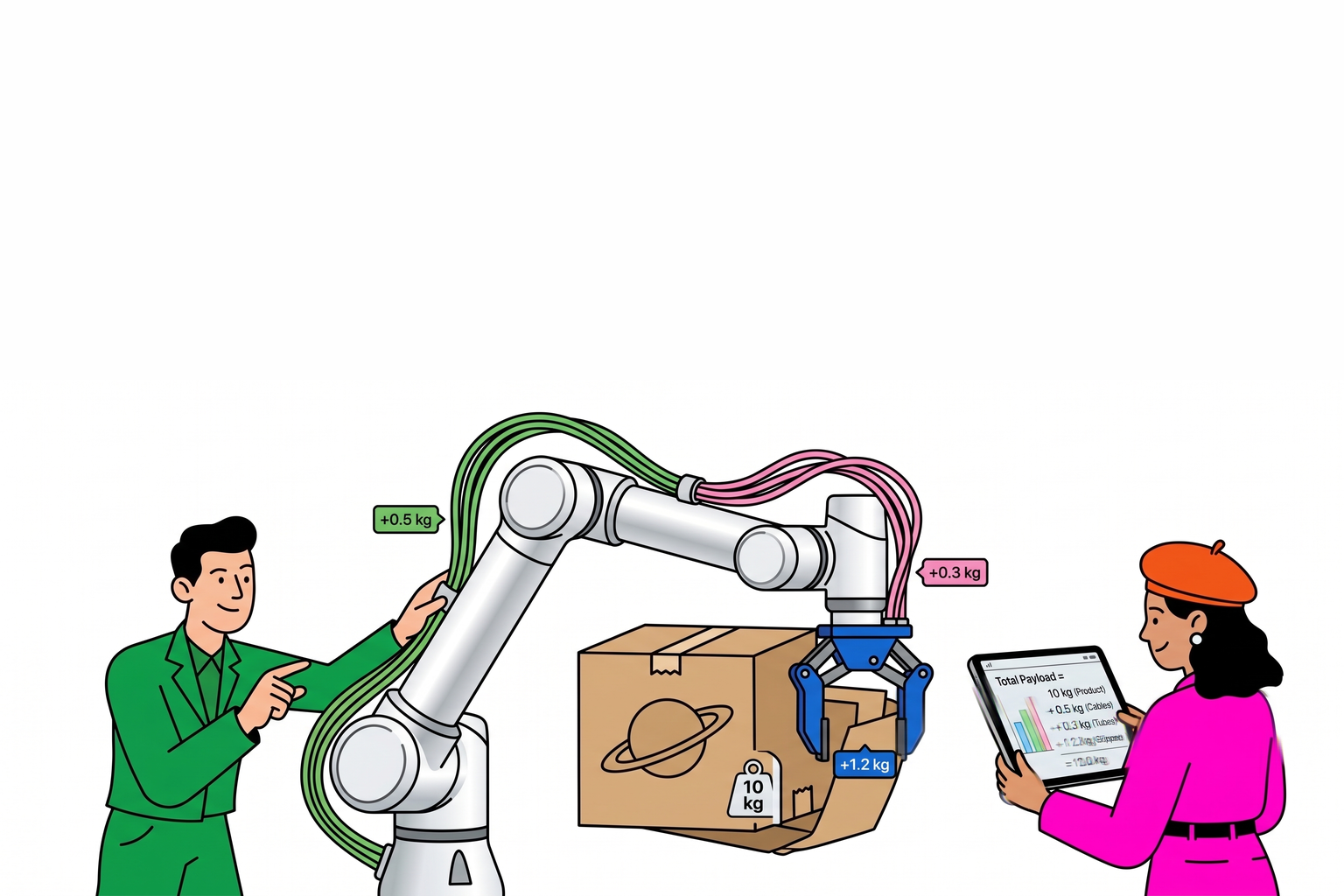
Fresh parts can be hot, soft, and mark-prone. Vacuum cups need temperature and release force; grippers need fingertip marks and residual gate geometry. Subtract tool mass from rated payload—End-effector. Segment the beat: wait mold-open, enter, grip, exit, secondary, place—Cycle time.
Do not accept EOAT on cold demos only. Run 30–50 real hot shots and watch cup aging, marks, and drops. Release agents, high-gloss faces, and thin walls turn “cold grip works” into “hot grip fails.”
When a sprue picker or gantry is more honest
| Scene | Leans |
|---|---|
| Ultra-short cycle, fixed path, extract only | Pneumatic / servo picker |
| Multi-press row, heavy truss cover | Industrial gantry / truss |
| High-mix changeover, inserts, in-cycle secondary, people beside | Cobot |
| Deep cavity + complex pose + secondary mill | Cobot (check heat and interference) |
Class split: Cobot or industrial. Honest line: if the pain is “0.8 s sprue yank,” a cobot is rarely the answer; if the pain is “weekly changeover + secondary still manual,” cobots enter the final.
Cost and payback (worked sketch)
Year 0 usually includes arm, EOAT, floor or on-press mount, door/interface integration, secondary tools (air knife, drill), guarding, and assessment. Gain side: waiting on people, secondary labor, scrap, overtime. Simple tending cells often sit near the ~$50k–$120k CNC band in public cost talk; molding adds heat and interface variance—lines in the Cost guide, sheet method in the ROI guide.
Sketch only (replace with plant numbers): Year 0 ~$85k; 1.5 fewer wait-hours/day × $180/hour × 250 days ≈ $67.5k/year; plus ~$35k/year secondary labor. With scrap/overtime, payback can land near 10–14 months—if signals and secondary lists are in acceptance. Midgard’s ~3 months is a named story, not a default contract clause.
Pilot order (put it in the SOW)
Freeze part mass, gate, mold-open seconds, secondary list, enter-ok definition, hot-handle limits
Run one press, one recipe for a full shift; log drops, door interference, secondary timeouts
Accept EOAT on real hot parts before cloning to a second press
Changeover drill: re-check signals and paths after a mold swap
After PO, keep schedule honest with RooollTrack; spares and checks via Care
Models and layout
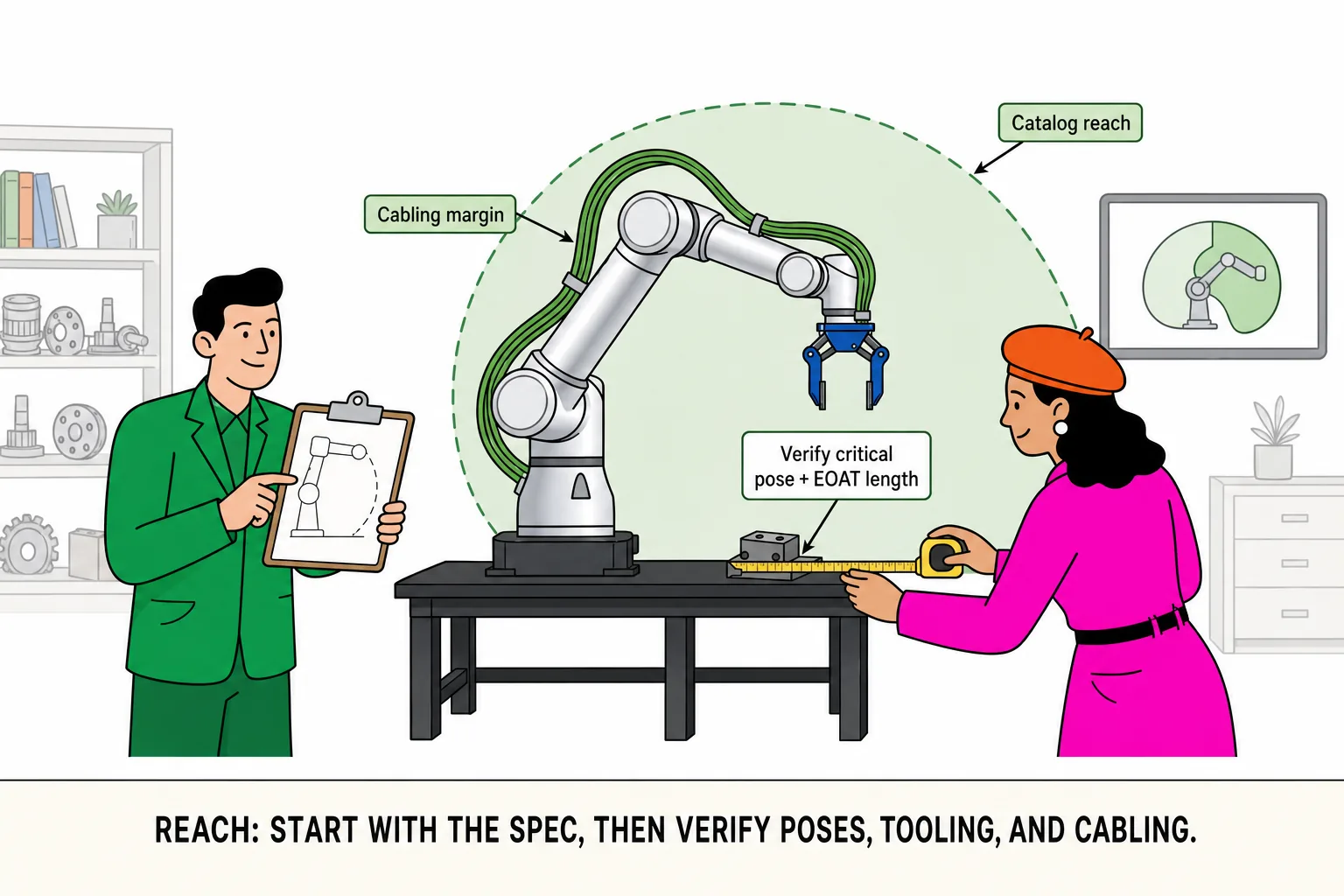
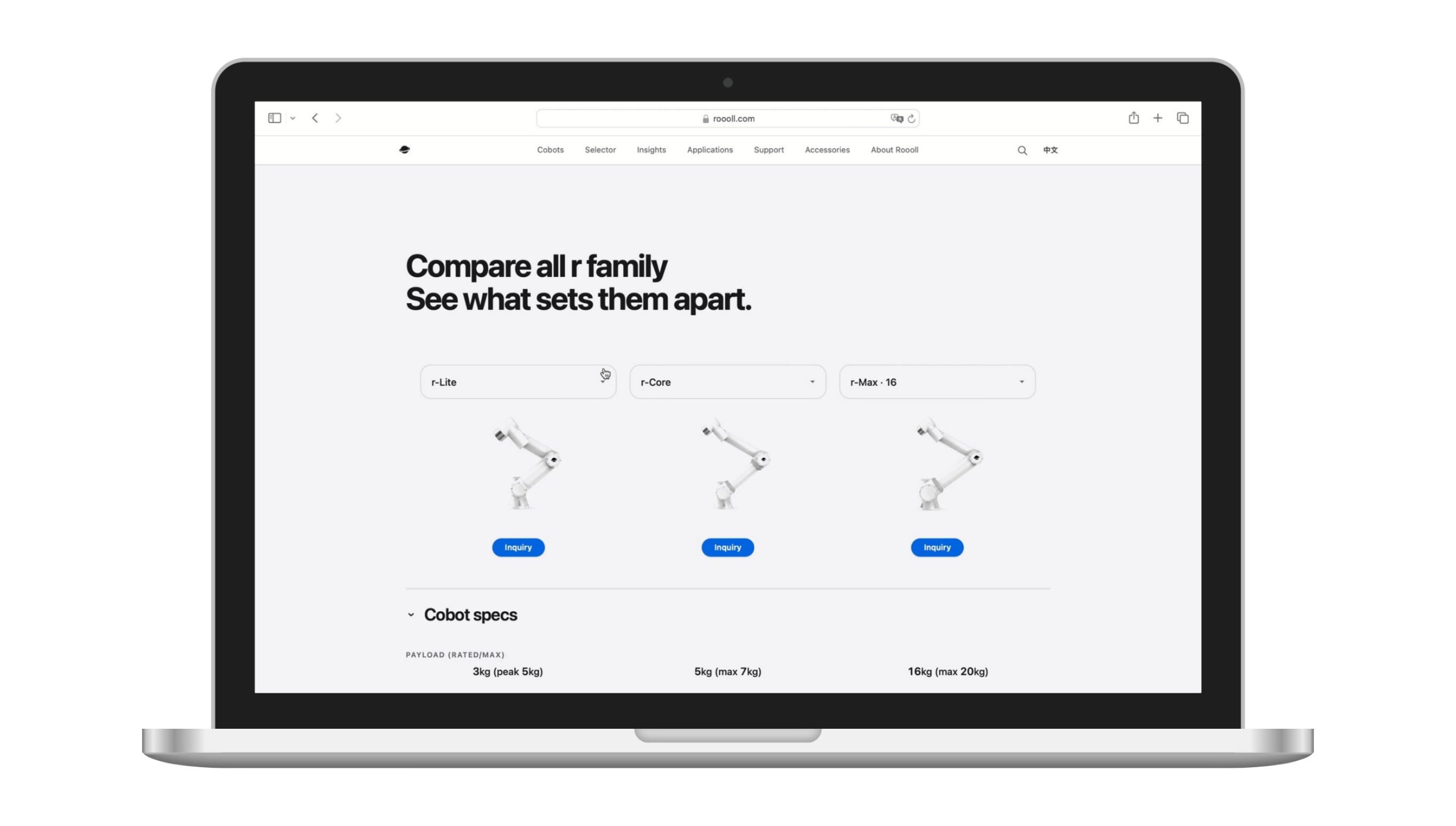
Light parts and short travel often shortlist r-Lite / r-Core; heavier or far corners go to Comparison. Fuzzy scenes: Product Advisor. Tight press-side space: AR preview for reach and door clash. Line context: Manufacturing applications.