Quick answer
Bound the process first: where the arm’s responsibility starts and ends—vague boundaries make the lowest price the bid with the most hidden assumptions
Part family beats slogans: weight (with gripper margin), size, surface, and changeover count drive payload and EOAT
Takt must be measurable: parts/hour or seconds/loop, stating whether doors, waits, and inspection are included
I/O and safety on one page: machine/line signal list plus human-in-cell assumptions—or do not compare “turnkey” totals
Acceptance belongs in the RFQ: FAT/SAT/runoff criteria and exclusions—or SAT becomes a renegotiation
“Please quote a cobot” almost always returns incomparable numbers. A usable cobot RFQ checklist makes suppliers bid on the same constraints: process boundary, parts, takt, interfaces, IP, safety, and acceptance.
Generic automation RFQ mistakes—empty specs, no evaluation criteria, missing stakeholders—are covered in guides such as Qviro · How to write an RFQ and procurement checklists like RFQmatch’s robotics RFQ checklist. Full robot cells need scope before price (Industrial AI Robots · Robot cell RFQ scope). Below is a paste-ready collaborative-arm field set.
Minimum blocks for comparable quotes
| Block | What you provide | If missing |
|---|---|---|
| Process boundary | Arm start→end steps; what people still do | Upstream staging or downstream packing quietly included or excluded |
| Part family | Weight, size, material, surface, fragility, SKU count | Payload/EOAT quoted on the sample, not the production part |
| Takt & shifts | Target loop or parts/hour, shifts, uptime assumption | Empty-air demo takt treated as line takt |
| Interfaces | Machine/PLC/safety, recipes, data | Ladder or auto-door discovered after signature |
| Material flow | Presentation, how long a full magazine lasts, reject path | “Unmanned” in name only |
| Environment | Dust/mist/coolant, temperature; split IP needs | See IP rating guide |
| Safety & sharing | People beside the arm, tool hazards, fence/scanner assumptions | “Collaborative” misread as “no safety paperwork” |
| Acceptance | FAT/SAT/runoff standards, training, spares | SAT renegotiates price |
Why empty fields make the lowest price the riskiest
When the process boundary is vague, every supplier fills gaps with their favorite assumptions: one folds upstream staging into turnkey, another excludes the auto-door entirely, another shrinks runoff to a half-hour empty-air demo. Incomparable totals are not a mysterious market—they are missing shared constraints. The “empty spec / no evaluation criteria” warnings in Qviro- and RFQmatch-style procurement notes show up on cobots as: no part family and I/O map → no comparable payload, takt, or interface hours.
Takt drifts fastest. “As fast as possible” or “close to manual” invites a demo on the shortest empty path while the line still opens doors, waits on clamps, blows chips, and starves upstream—acceptance day then argues about RFQ wording, not arm speed. Industrial AI Robots puts acceptance and exclusions in tables before price for the same reason: so SAT is not a second commercial negotiation.
Paste-ready cobot RFQ fields
Paste all eight blocks into the email attachment or procurement system. Fill blanks with numbers and links; if a cell cannot be filled, write “TBD on site” and mark whether that blocks a turnkey bake-off.
1. Application & boundary
Task type: machine tending / palletizing / screw driving / dispensing / other: ___
Steps the arm owns (start→end): ___
Steps explicitly out of scope: ___
Prefer a boundary sentence like “pick from ___ to place at ___; people still do ___.” The shorter and fuzzier the sentence, the easier it is to stretch or shrink inside a quote. For multi-machine tending, state single-machine vs one-arm/two-machines—rules: one cobot, two CNCs.
2. Parts & EOAT
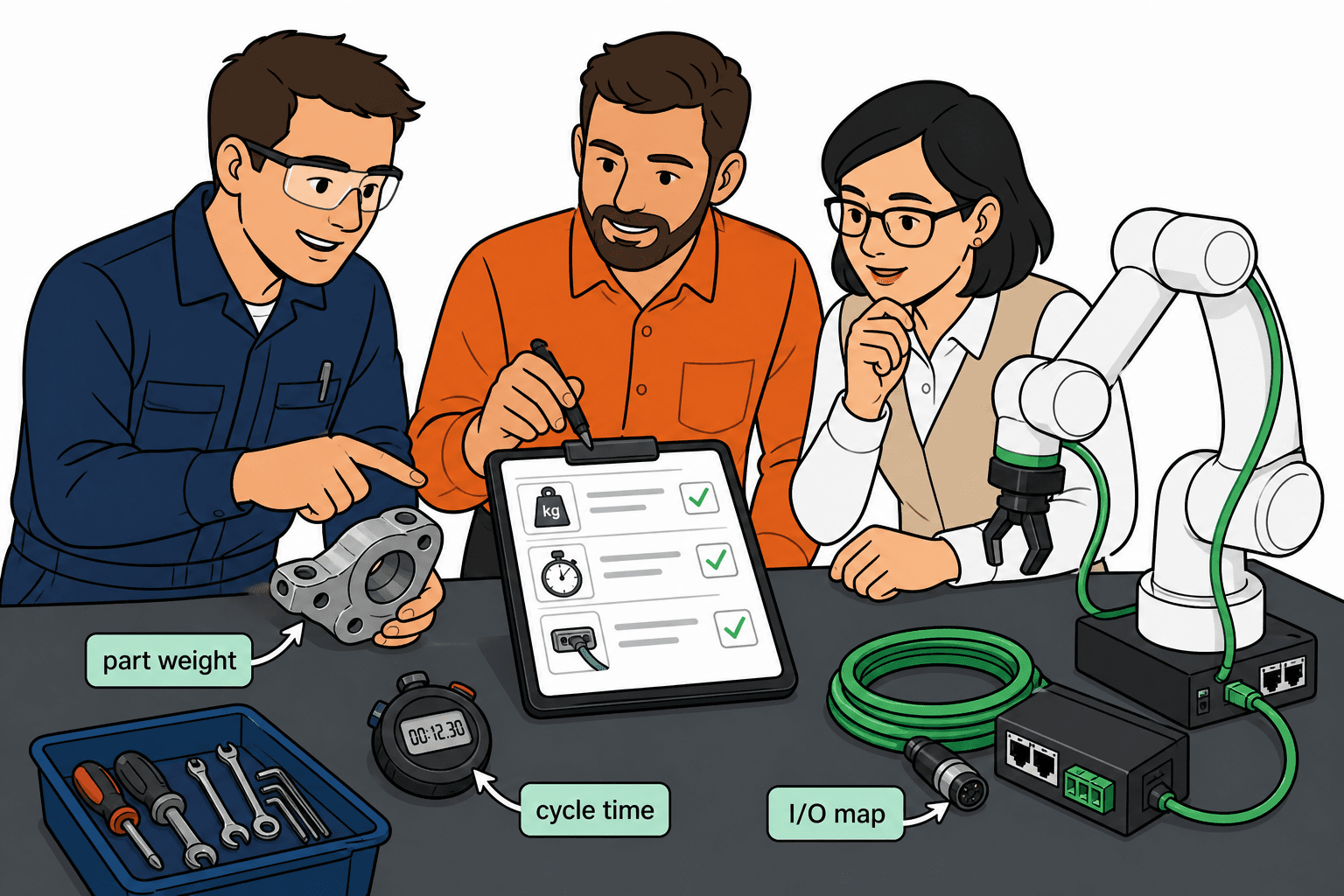
Heaviest part ___ kg; typical ___ kg; gripper/tool estimate ___ kg (or “to be designed”)
Shape and grip faces: photo/drawing links
Size payload as part + EOAT + 20–30% margin (payload guide)
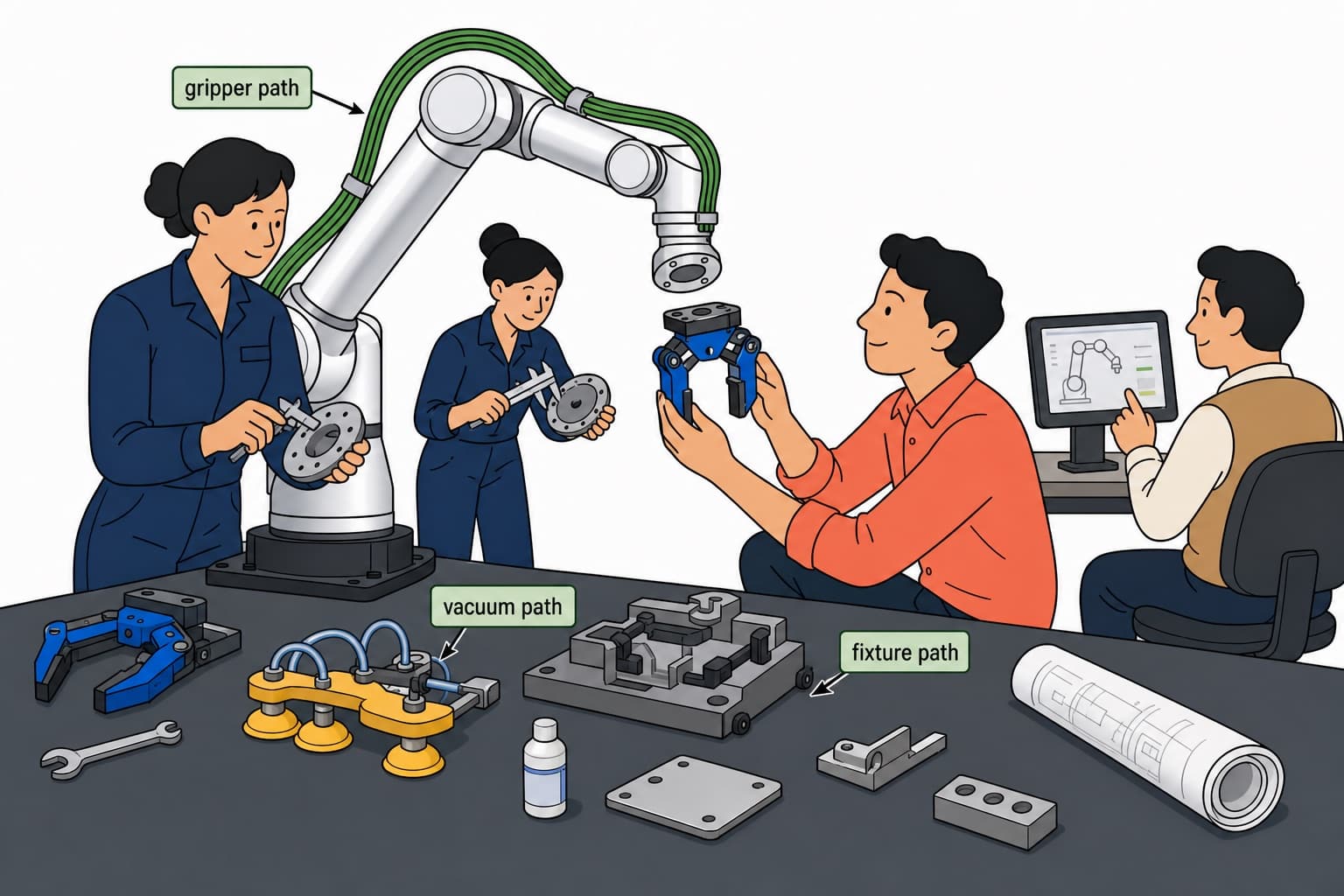
Grip path preference: gripper / vacuum / fixture (end-effector guide)
Send heaviest part and farthest grip point together. Shipping only the “pretty sample” while production adds ribs or longer blanks is how payload and reach both drift. SKU count matters too: more SKUs pull quick-change tooling and teach time into the quote—or into SAT extras if you omit them.
3. Takt & volume
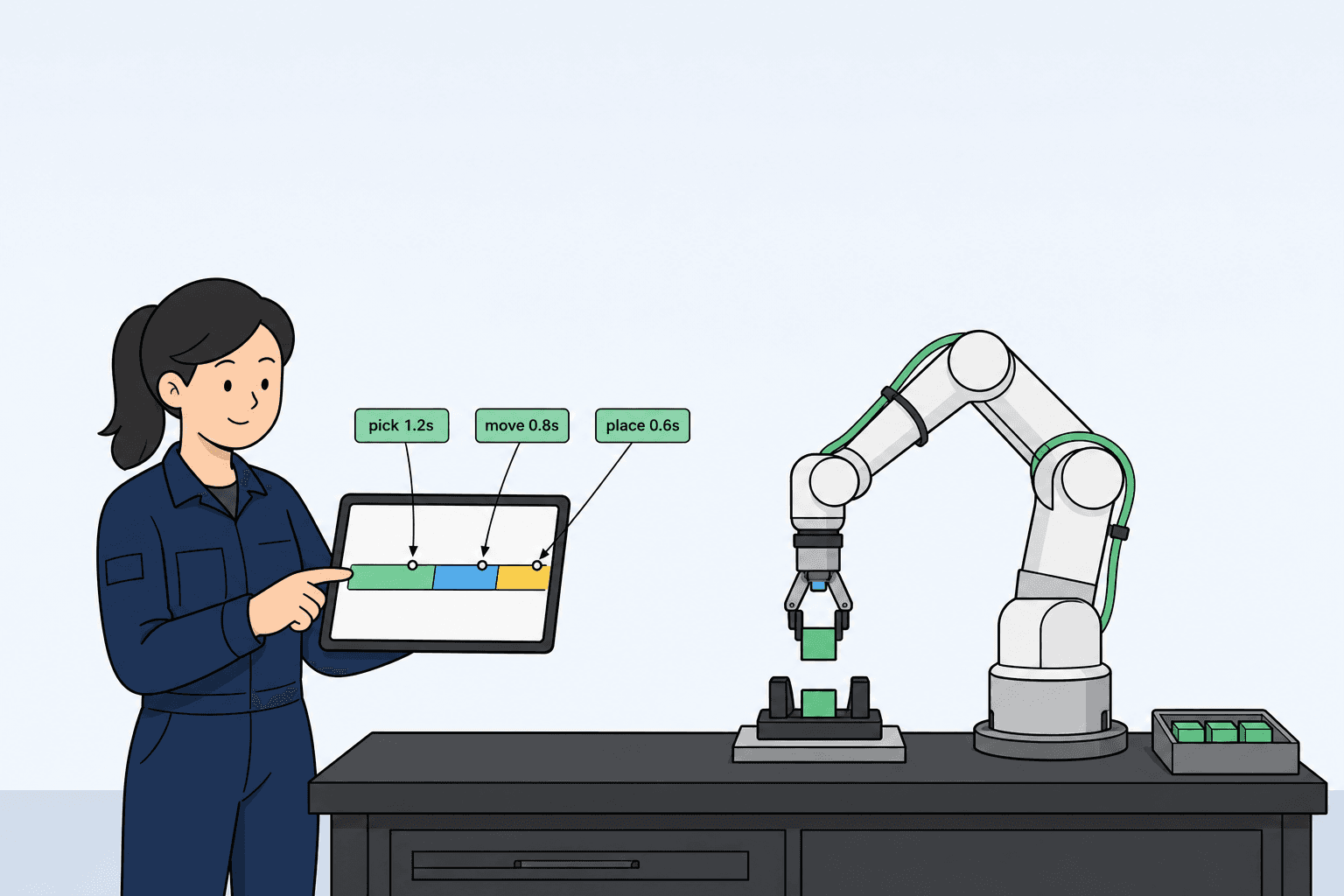
Target loop ___ s or ___ parts/hour
Includes: door, inspection, blow-off, upstream waits?
Shifts: ___; target utilization: ___
Segment method: cycle time guide
If you only have a manual stopwatch, attach a 30–60 s door-side video and state whether the target is “no slower than manual” or a fixed ___ s. Without video, at least declare a P50 target and whether P90 may exceed it.
4. Workspace & mounting
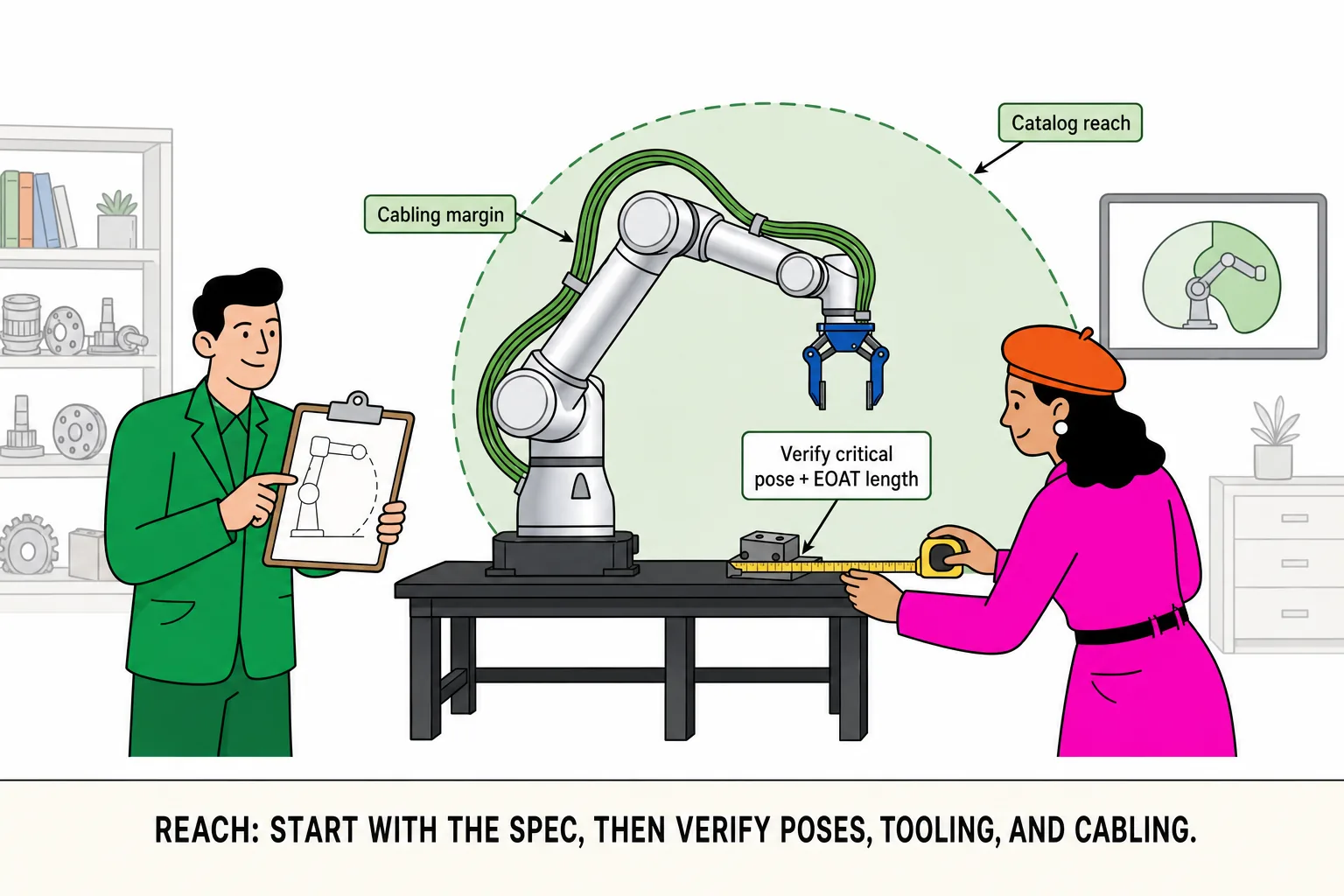
Farthest TCP sketch (in-door corner / pallet far corner) → reach guide
Mount: floor / table / ceiling / mobile (locked while running?)
Available footprint: ___ m²; pedestrian paths: ___
Sketches need not be pretty; mark columns, guards, and cart parking. If a mobile base must lock while running, say so—quotes that assume “roll while gripping” underprice controls and safety.
5. Machine & I/O
Equipment model: ___
Signals: permit-enter / clamp confirm / complete / alarm / start / other: ___
Auto-door: existing / quote required / not pursuing unmanned
Detail template: Safety & I/O
No auto-door plus “unmanned” forces a fork: leave opening to people, or bury door cost then exclude it later. The earlier the signal list appears, the more comparable ladder and debug hours become.
6. Environment & IP
Dust / mist / liquid: description + photos
Required split IP: body ___ / wrist ___ / cabinet ___
Split wording and common misreads: IP rating guide. Writing only “dust-proof” lets the quote default to the cheapest body IP and leave cabinet risk for the floor.
7. Safety assumptions
People enter the arm envelope during the cycle: yes / no
Sharp / hot / spinning tool on the flange: ___
Who performs and signs the risk assessment
People-beside cells often reference ISO 10218 / ISO/TS 15066—do not claim “full standard compliance” in the RFQ unless that certification scope is real
“Collaborative” is not “no fence, no paperwork.” Stating the shared-space assumption is how speed limits, scanners, and interlocks show up in the same quote instead of on SAT morning.
8. Acceptance & commercial
FAT: ___; SAT: ___; runoff: ___ hours/parts
Training headcount/language; spares list in price yes/no
Exclusions line by line (civil, legacy line mods, vision, etc.)
Need delivery visibility such as RooollTrack?
Acceptance criteria should be objective: what is measured, for how long, and what happens on fail. “Customer satisfaction” as the only runoff rule is how the lowest price becomes the highest dispute on site.
TCO line items (compare three years, not sticker price)
Ask every comparable bid to split at least these rows (mark “excluded / buyer-furnished” if missing)—or the lowest number is only hardware:
| Line | Ask | Often missing |
|---|---|---|
| Arm + cabinet + cables | Model and split IP | Arm quoted; cabinet upgrade omitted |
| EOAT / fixtures | Design + spare jaws included? | “Gripper TBD” |
| Auto-door / safety devices | Who supplies, installs, validates | Appears after signature |
| Integration & teach | Person-days, changeovers included | Hours sized on ideal parts |
| FAT/SAT/runoff | Duration and retest-on-fail rules | Shrunk to a half-day empty-air demo |
| Training & docs | Headcount, language, recording | Verbal walkthrough only |
| Maintenance / spares (years 1–3) | Response, wear parts list | Year-one warranty only |
| Software / upgrades | License renewals | Year-two invoice surprise |
Payback framing can sit beside this in the ROI guide; TCO answers “same scope?”, ROI answers “worth doing?”.
Bid scoring weights (example—edit freely)
Score only after scopes match—do not award on “felt solid in the meeting.” Example weights (sum 100):
| Dimension | Suggested weight | What you score |
|---|---|---|
| Scope completeness (vs this checklist + exclusions) | 25 | Missing door/runoff/split IP → hard deduct |
| Measurable takt & acceptance | 20 | Seconds stated, doors/aux included, fail rules clear |
| Interfaces & safety paperwork | 15 | I/O map and risk-assessment ownership clear |
| Three-year TCO (not hardware only) | 15 | Maintenance, spares, licenses written |
| Lead time & milestone visibility | 10 | Nodes like RooollTrack help governance |
| Similar-app evidence / worst-part demo | 10 | See demo day |
| Commercial terms (warranty, payment gates) | 5 | Match engineering risk |
If a bid fails “scope completeness,” do not soothe yourself with total-price rank—open a clarification round first.
15-minute self-check before you send
Would two suppliers draw the same process boundary and the same exclusion list from this email and attachment alone?
Do heaviest part and farthest TCP appear together—not in two “we will send later” messages?
Every sentence that says “unmanned / lights-out” — can you point to auto-door status and infeed capacity numbers?
Which objective rule triggers rework, concession, or reject at acceptance—and is it in the attachment?
Can every TCO row be ticked included / excluded / separately priced?
If you are unsure the task should be automated at all, run task readiness first; cobot vs industrial boundary: chooser. Those pages do not replace the RFQ; they keep obviously unfit scenes out of the bid pool.
Narrow with Roooll tools, then RFQ
Shortlist and true-scale checks exist so model/reach/footprint assumptions in the RFQ converge—not so tools replace the procurement packet.
Shortlist: Comparison · Product Advisor · Full lineup specs
Door/pallet footprint: true-scale AR
Worst-part validation day: Demo day guide