Quick answer
Pick station one before brand: the first cobot must prove automation works in *your* plant—not that a brochure looks best
SMEs are core buyers: published notes put SMEs at about 42% of cobot buyers—delays usually sit on station choice and hidden cost, not “no arms exist”
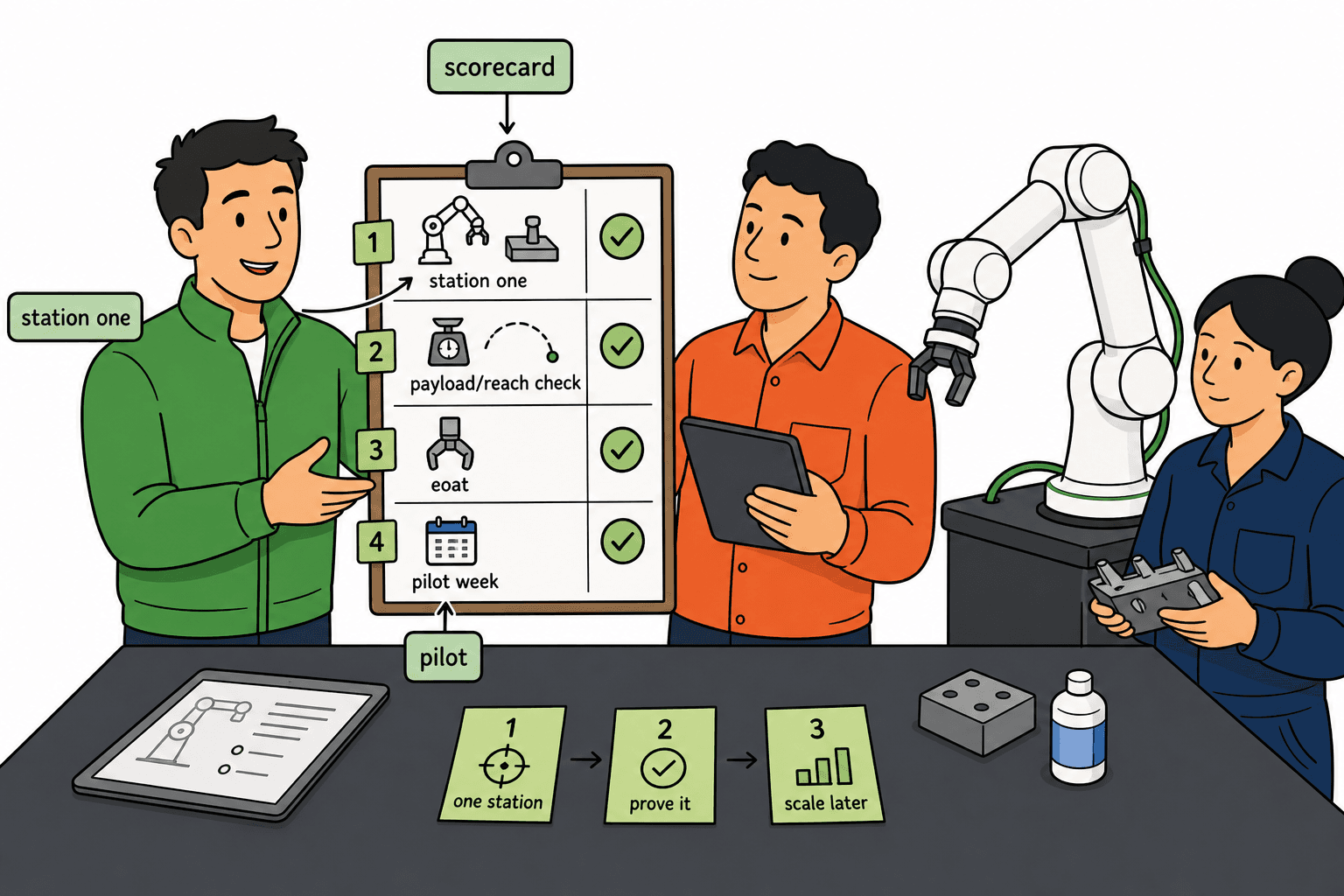
Four-box scorecard: task readiness → payload/reach → EOAT → pilot week; empty box → no PO
Budget bands: lean self-integrate ~$8k–$12k; professionally integrated simple pick-place/tending often ~$35k–$75k → Cost guide
Cadence: one station → prove it → scale later; model station two on station-one measured takt and utilization
When a small manufacturer buys its first cobot, the meeting often slides into a brand debate. The more expensive question—the one that usually decides whether the program survives—is which station deserves to be station one. If station one is the photogenic job that does not hurt the shift, finance will model station two from skewed data and the whole roadmap leans wrong; that story is unpacked in Why the first station is the wrong one. This page is a checkable scorecard. Brand rankings can wait for the quote round.
Published evidence (SME and first cell)
Putting public bands on one table is useful for two reasons: it shows SMEs are not a fringe cobot buyer segment, and it reminds everyone that a low list price is not automatically a turnkey total.
| Metric | Published band | Source |
|---|---|---|
| SME share of cobot buyers | About 42% | RobotSourced small-business guide |
| Simple full cell | About $35k–$75k | Robotomated cost guide |
| Budget self-integrate | About $8k–$12k | RobotSourced pricing / SMB |
| Single-shift payback | About 12–24 months | Robotomated cost guide |
| Typical pick-place takt | About 4–8 s/cycle | CobotFinder |
The sentence that matters most when you read the table: a $7k list arm is not a $7k turnkey. SME projects that actually stick almost always put EOAT, fixtures, and “who teaches / who owns month one” into phase-one scope.
What small shops need (different from OEM lines)
Small shops rarely have an automation PMO chasing below-waterline rows, and they rarely have a resident robotics engineer. SKUs change often and batches stay small, so dedicated machines seldom pencil. What the first cell needs instead is full-cell price clarity, teaching that existing crews can absorb, redeployability, safety language that can be explained to insurers and customers, and a pilot that can fail back to manual without locking the line for a decade. For hesitation and hidden-cost narrative, see Why SMEs hesitate and Hidden cost.
| Need | Why |
|---|---|
| Full-cell price clarity | No automation PMO to chase below-waterline rows |
| Teachable by existing staff | Rarely a resident robotics engineer |
| Redeployable | High mix, small batches—dedicated machines rarely pencil |
| Explainable safety | CE / force limits / risk file for insurers and customers |
| Reversible pilot | Fail back to manual without locking the line for a decade |
How to pick station one (one step past “the job we hate”)
“The job we hate” can be a candidate, but it is not enough. A good station one usually hits four conditions at once: the path repeats for hours each shift and pieces/hour are known; nest or stop tolerance can be written into a contract, not invented after the arm arrives; the pilot week can still run manual; and finance can feel at least one real pain in overtime, hiring, injury, or idle spindle minutes.
Bad station ones reverse those conditions: tour-photo cells, SKUs that rewrite weekly with no changeover budget, takt that belongs to a delta, or payload already at the rated edge while people stand beside at full speed. Whether the task should be automated at all belongs in Task readiness; if class is still open, start with Cobot or industrial.
Scorecard (four boxes before PO)
Copy the table into the capex memo. An empty box usually means it is too early to issue a PO—not that the arm list price needs another round of negotiation.
| Box | Pass rule | Links |
|---|---|---|
| Station one | Named station, pieces/hour, who stands beside, rollback path | Station rules above |
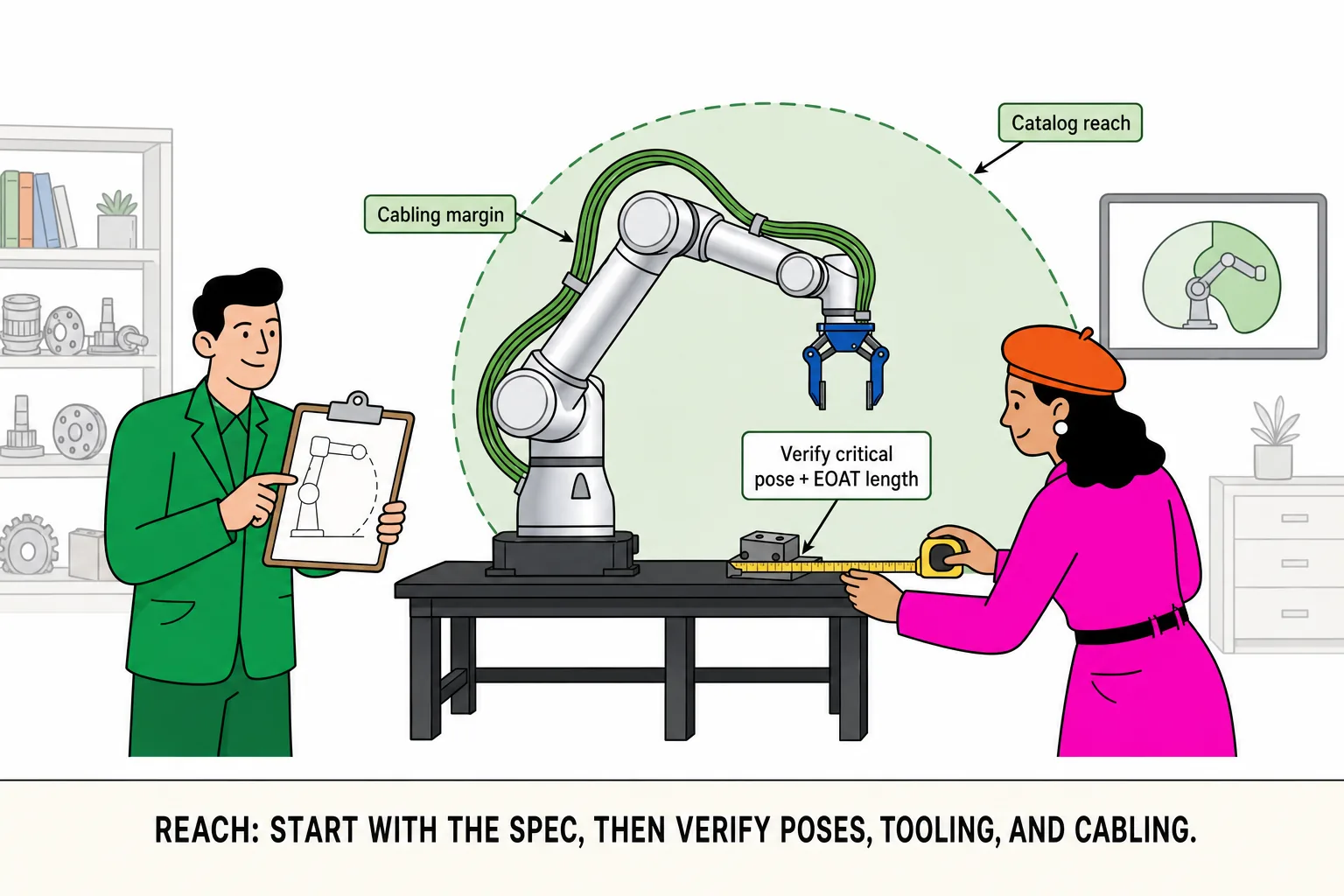
| Payload / reach | Heaviest part + EOAT weighed; farthest TCP on the layout | Payload · Reach |
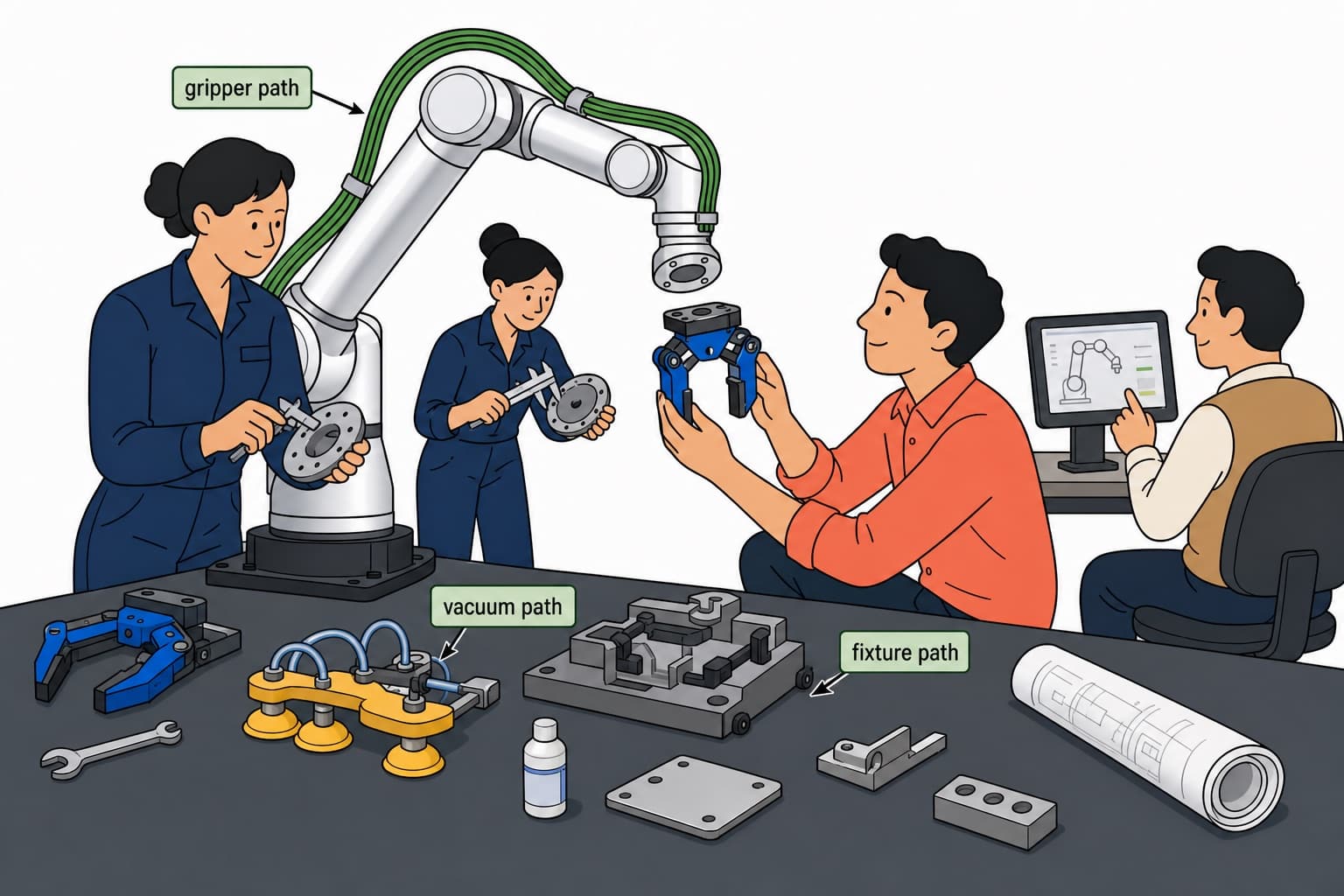
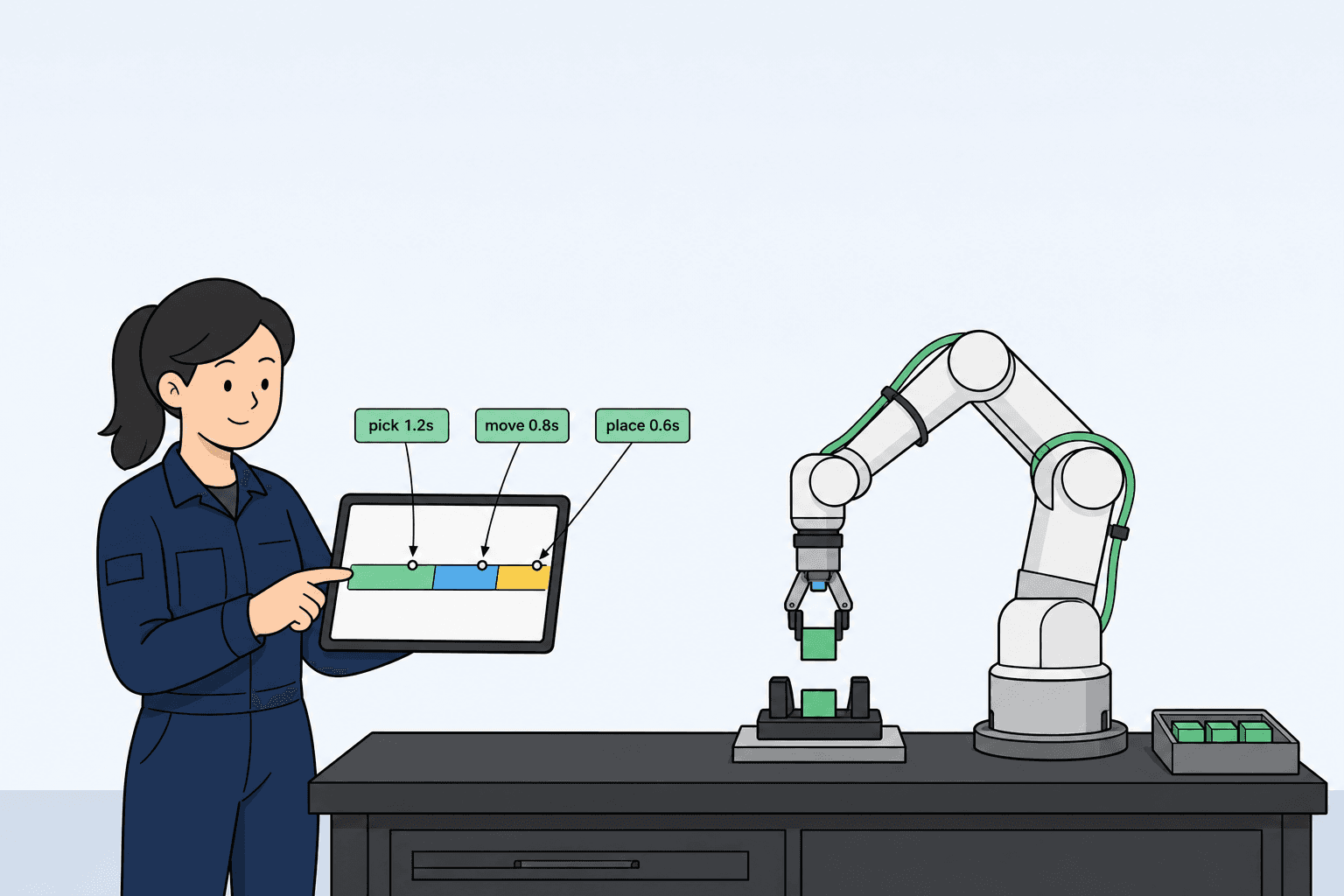
| EOAT | Gripper/vacuum path chosen; open/close in the beat sheet | End-effector |
| Pilot week | Target shifts run; acceptance uses worst part—not empty-air only | Demo day |
Pin three short strategy lines beside the scorecard to keep scope from swelling: phase one locks a single cell (one station); prove it with measured takt and utilization, not catalog claims; scale later by modeling station two on station-one books instead of buying “future maybe” payload early.
Budget frame (SME)
Budget talks should start from the cell, not the arm sticker. Validation self-integrate often lands near $8k–$12k when pick-place is light, the team can teach, and acceptance language stays honest. A standard first cell more often sits around $35k–$75k with EOAT and basic integration included. CNC doors, vision, or pallet tooling commonly push the band toward $50k–$120k. Line-item detail is in the Cost guide; payback math is in ROI. Putting arm list price alone on the board slide as “total investment” is how totals get understated.
| Tier | Band | Fits |
|---|---|---|
| Validation self-integrate | About $8k–$12k | Light pick-place, team can teach, honest acceptance |
| Standard first cell | About $35k–$75k | EOAT + basic integration for pick-place / simple tending |
| Vision / doors | About $50k–$120k | CNC doors, vision, pallet tools; see application guides |
First-application priority (experience order)
In practice, first cells often start with pick-and-place because teaching is fast and cell cost stays relatively low—see the Pick-place guide. CNC tending becomes strong when spindle-idle math is clear (CNC). Simple palletizing deserves a serious look once case weight and cases/hour sit inside the cobot window (Palletizing). Try not to make undefined force assembly, bin picking without presentation, or a sub-2 s pack main into station one.
How to shortlist models (no “best of 2026” list)
After station-one parameters freeze, compare two or three rows on payload, reach, and I/O instead of starting from slogans. Narrow the scene with Product Advisor, put specs side by side in Comparison, scan the matrix in Full lineup specs, and check footprint or door interference in AR when layout is still fuzzy. Put inquiry fields in one packet with the RFQ checklist, and align delivery milestones with RooollTrack.
Pilot-week minimum acceptance
A pilot week should at least cover worst-part continuous N loops written into the SOW (often 20–30), segmented takt P50/P90, one changeover if multi-SKU was promised, and exception behavior for drops, protective stops, and who resets after e-stop. People-beside speed and zones also need to match the written risk assessment. If a pilot “runs” for months without owning the schedule, Why pilots stall usually points to the administrative seam more clearly than another brand comparison.
Five ways SMEs buy the wrong first cobot
Wrong first buys rarely come from missing one brochure spec. More often station one was chosen for tours rather than shift pain; arm prices were compared while EOAT stayed TBD; turnkey acceptance language was signed without an integrator; the pilot was priced as if it were copy-cell number five; or three verbal spec stories floated in the room without a single comparison URL to pin them down.